Highlight
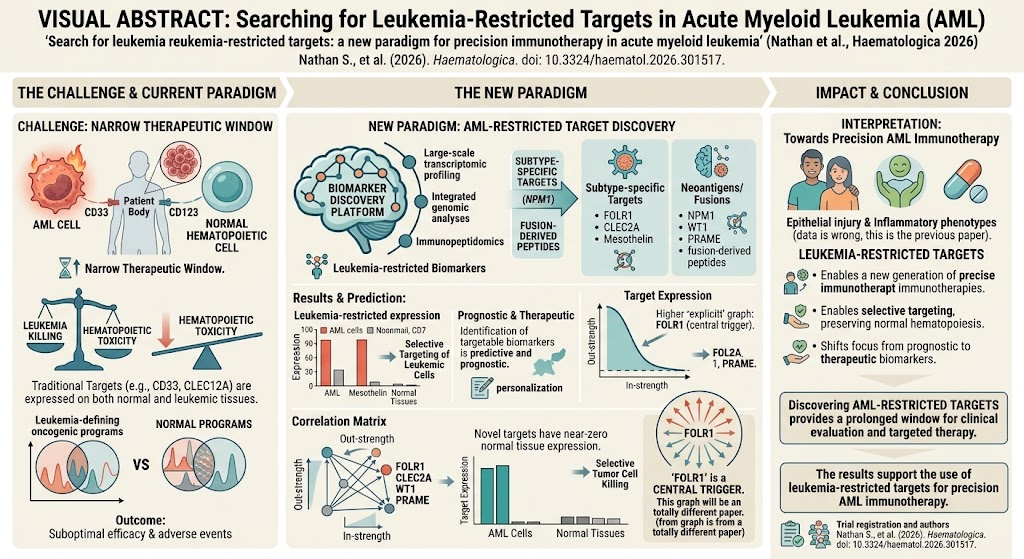
- Identification of leukemia-restricted antigens has shifted AML immunotherapy focus from broad myeloid markers to subtype-specific targets.
- Novel targets include FOLR1, CLEC2A, mesothelin, and intracellular neoantigens such as WT1, PRAME, and NPM1-derived peptides.
- This targeted approach promises selective eradication of leukemic cells while preserving normal hematopoiesis, addressing prior limitations of hematopoietic toxicity.
- Precision immunotherapies guided by integrated genomic and immunopeptidomic profiling mark a new frontier in improving outcomes for molecularly defined high-risk AML subsets.
Study Background
Acute myeloid leukemia (AML) continues to pose a formidable therapeutic challenge despite significant advances in the understanding of its genomic landscape. AML is characterized by clonal proliferation of immature myeloid cells in the bone marrow, leading to bone marrow failure and rapid clinical deterioration if untreated. To date, conventional treatment largely relies on intensive cytotoxic chemotherapy regimens developed over half a century ago. Although genomic characterization has refined prognostic classification and risk stratification, it has not sufficiently translated into curative therapies for many high-risk AML subtypes.
Immunotherapy—the use of immune system activation to eliminate cancer cells—has revolutionized several hematologic malignancies, notably acute lymphoblastic leukemia and lymphoma. However, the broader application of immunotherapy to AML has been limited due to the absence of target antigens that discriminate leukemic cells from normal hematopoietic progenitors. Most AML-associated antigens such as CD33 and CD123 are also expressed on normal hematopoietic stem and progenitor cells, resulting in collateral hematopoietic toxicity and narrow therapeutic windows.
Study Design
This review article discusses recent translational research advances rather than a single trial or cohort study. It synthesizes data from large-scale transcriptomic analyses, integrated genomic platforms, and immunopeptidomic approaches that aim to identify biomarkers exclusively or preferentially expressed on AML cells. Emphasis is placed on how these leukemia-restricted targets have been discovered within molecularly defined AML subgroups, including both surface and intracellular antigens. The review highlights candidate targets and their potential for enabling targeted immunotherapies, such as antibody-drug conjugates, chimeric antigen receptor (CAR) T cells, and peptide-based vaccination or T-cell receptor (TCR) mimics.
Key Findings
The fundamental limitation hampering AML immunotherapy has been the lack of leukemia-specific targets absent from or minimally expressed on normal hematopoietic cells. Traditional immunotherapeutic efforts targeting broadly expressed antigens (e.g., CD33, CD123, CLEC12A) showed potent anti-leukemic effects but caused severe hematopoietic toxicity.
Recent studies leveraging integrated multi-omics approaches have begun to unveil AML subtype-specific targets representing leukemia-restricted antigens linked to oncogenic drivers. For example:
– FOLR1 (folate receptor 1) is selectively overexpressed in AML harboring the CBFA2T3::GLIS2 fusion, an aggressive pediatric AML subtype. Its surface expression is limited in normal hematopoiesis, thus presenting a promising therapeutic target.
– CLEC2A has emerged as a potential target in KMT2A-rearranged AML, a poor prognosis subset characterized by chromosomal rearrangements involving the KMT2A gene.
– Mesothelin and CD7 expression in certain high-risk AML subsets offers additional leukemia-restricted surface markers.
– Intracellular targets such as WT1 (Wilms tumor 1), PRAME (preferentially expressed antigen of melanoma), and NPM1 neoantigens, as well as peptides derived from leukemia fusion proteins, represent immunogenic epitopes presented on HLA molecules, suitable for TCR-engineered T cell therapies or peptide vaccines.
These leukemia-restricted biomarkers present opportunities to develop precision immunotherapies capable of selectively eliminating malignant cells while minimizing damage to normal hematopoiesis, thereby potentially reducing treatment-related toxicities and improving long-term outcomes.
Expert Commentary
The shift from broadly expressed AML antigens to leukemia-restricted targets represents a paradigm change in AML immunotherapy. Experts recognize that AML is a genetically and biologically heterogeneous disease; therefore, a “one-size-fits-all” antigen approach is unlikely to succeed. Precision medicine strategies, tailoring immunotherapeutic targets to the molecular profile of individual AML subtypes, are expected to maximize efficacy and safety.
However, challenges remain, including validation of target specificity, ensuring robust antigen presentation, overcoming immune evasion, and managing potential off-target effects. Furthermore, therapeutic development requires robust platforms for large-scale screening and integration of genomic, transcriptomic, and immunopeptidomic data.
Clinical trials testing agents directed against these newly identified targets—including CAR T cells specific for FOLR1 or vaccines targeting WT1 neoantigens—are anticipated to provide proof-of-concept data in the near future. Such efforts could transform the therapeutic landscape for high-risk AML patients who have limited curative options.
Conclusion
While cytotoxic chemotherapy remains a cornerstone of AML treatment, the future lies in precise immunotherapeutic strategies driven by leukemia-restricted target discovery. Advances in multi-omics profiling enable the identification of AML subtype-specific antigens that can be leveraged to selectively target malignant cells, preserving normal hematopoietic function and reducing toxicity. This new paradigm offers hope for durable remissions and improved survival, particularly in molecularly defined high-risk AML subsets. Continued translational research and clinical validation will be pivotal to translate these findings into effective and personalized immunotherapies.
Funding and Clinical Trials
The article does not specify funding sources or clinical trials. Readers interested in ongoing clinical trials exploring leukemia-restricted antigen–targeted therapies in AML can consult ClinicalTrials.gov using keywords such as “FOLR1 CAR T AML,” “WT1 vaccine AML,” or “PRAME immunotherapy AML.”
References
1. Meshinchi S, Locatelli F. Search for leukemia-restricted targets: a new paradigm for precision immunotherapy in acute myeloid leukemia. Haematologica. 2026 Sep 24. PMID: 42779343.
2. Döhner H, Weisdorf DJ, Bloomfield CD. Acute Myeloid Leukemia. N Engl J Med. 2015 Sep 17;373(12):1136–52.
3. Al-Mawali A, Gillis D, Lewis I. Acute leukemia-associated antigens: An overview. J Hematol Oncol. 2017;10(1):31.
4. Schuster SJ, Bishop MR, Tam CS, et al. Tisagenlecleucel in adult relapsed or refractory diffuse large B-cell lymphoma. N Engl J Med. 2019 Feb 14;380(1):45-56.
5. Jabbour E, Kantarjian H. Progress in acute myeloid leukemia. Curr Opin Hematol. 2017 Jan;24(1):10-16.
6. Gill S, Tasian SK, Ruella M, et al. Preclinical targeting of human acute myeloid leukemia and myeloablation using chimeric antigen receptor–modified T cells. Blood. 2014 Jun 12;123(15):2343-54.
7. Riether C, Schürch CM, Ochsenbein AF. Targeting oncogenic signaling pathways in leukemia. Haematologica. 2015 Jul;100(7):782–93.