Highlight
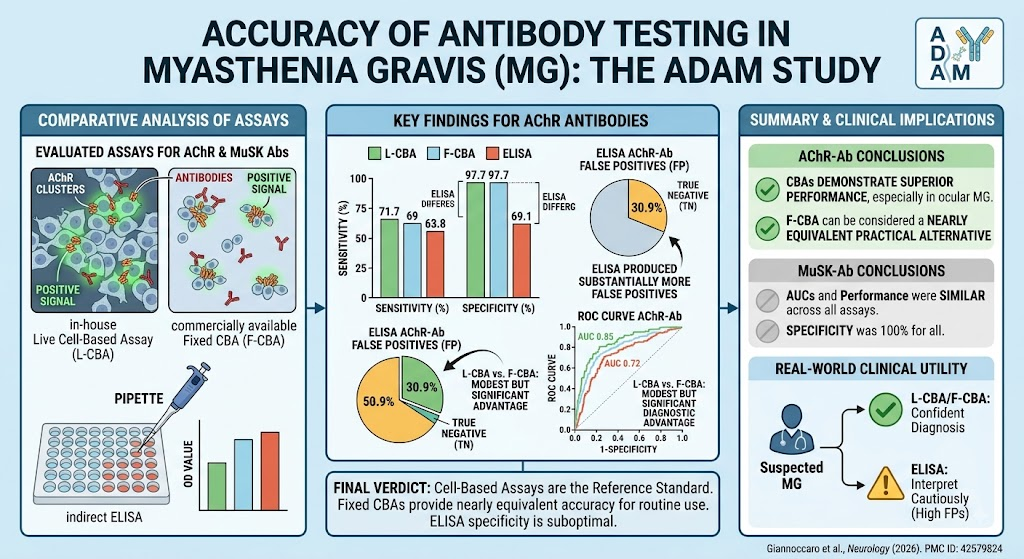
- Live cell-based assay (L-CBA) and fixed cell-based assay (F-CBA) demonstrate superior sensitivity and specificity for acetylcholine receptor (AChR) antibody detection in myasthenia gravis (MG) compared with ELISA.
- L-CBA showed a statistically significant but modest diagnostic advantage over F-CBA, confirming its role as the gold standard.
- ELISA testing exhibited substantially lower specificity, resulting in a high false-positive rate, which warrants cautious interpretation in clinical practice.
- For muscle-specific kinase (MuSK) antibody detection, all tests showed similar sensitivity and perfect specificity, indicating consistent performance across assay types.

Study Background
Myasthenia gravis (MG) is an autoimmune neuromuscular disorder characterized by antibodies that disrupt communication between nerves and muscles, most commonly targeting the acetylcholine receptor (AChR) or muscle-specific kinase (MuSK). Detecting these antibodies is critical for confirming diagnosis and guiding therapy. While several laboratory methods exist, including enzyme-linked immunosorbent assay (ELISA) and cell-based assays (CBAs), real-world comparative data on their diagnostic accuracy have been sparse. The ADAM study addresses this gap by evaluating the performance of in-house live CBAs, commercially available fixed CBAs, and ELISA in a large, prospective cohort of patients with suspected MG.
Study Design
This prospective multicenter study enrolled 327 consecutive adult and pediatric patients with suspected MG from four Italian centers between July 2023 and December 2025. Patients already receiving immunotherapy or those with incomplete diagnosis or insufficient serum samples were excluded. The diagnostic reference standard was a comprehensive assessment including neurological examination, electrophysiological studies, clinical response to pyridostigmine or corticosteroids, and exclusion of other conditions. All serum samples were tested blindly using three methods for AChR and MuSK antibodies: an in-house live cell-based assay (L-CBA), a commercially available fixed cell-based assay (F-CBA), and an indirect ELISA. Statistical analyses evaluated sensitivity, specificity, false positive rates, concordance between tests, and receiver operating characteristic (ROC) curves.
Key Findings
Among 327 included patients, 152 were diagnosed with MG and 175 with alternate diagnoses. The cohort had a median age of 63 years and was approximately evenly split by sex. Key results for each antibody and assay type include:
AChR Antibody Detection
- Sensitivity: L-CBA had the highest sensitivity at 71.7% (95% CI 63.8-78.7), followed closely by F-CBA at 69.0% (61.0-76.3), and ELISA at 63.8% (55.6-71.4).
- Specificity: Both L-CBA and F-CBA had markedly superior specificity at 97.7% (94.2-99.3) compared with ELISA’s 69.1% (61.7-75.9).
- False Positives: ELISA produced a high false positive rate of 30.9%, indicating lower reliability in ruling out MG.
- Concordance and ROC Analysis: ELISA showed lower concordance with CBAs. ROC curve analysis confirmed L-CBA’s superior diagnostic accuracy (AUC 0.85) over F-CBA (0.83; p=0.043) and ELISA (0.72; p<0.0001).
- Ocular MG: The superior performance of CBAs was particularly notable in detecting antibodies in patients with ocular MG, where diagnosis can be more challenging.
MuSK Antibody Detection
- Sensitivity for MuSK antibodies was low but similar across L-CBA (6.6%) and F-CBA (7.2%).
- Specificity was 100% for all tested methods.
- There were no significant differences in ROC AUCs between tests for MuSK antibody detection.
Implications for Practice
The findings underscore that cell-based assays, particularly live cell-based, are more accurate for confirming MG diagnosis than ELISA, primarily due to higher specificity and fewer false positives. Although L-CBA showed a modest but significant advantage over fixed CBA, the latter remains a practical and nearly equivalent option suitable for routine laboratory settings without the complexity of live cell handling. ELISA’s lower specificity highlights the risk of misdiagnosis if used in isolation and emphasizes the need for cautious interpretation alongside clinical findings.
Expert Commentary
These results align with prior studies highlighting the enhanced detection capabilities of CBAs, which better preserve native antigen conformation and thus antibody binding than antigen captured by ELISA. The study’s prospective design and comprehensive clinical verification strengthen its evidence quality. Limitations include the relatively low sensitivity for MuSK antibody detection, reflecting its lower prevalence and possible assay limitations. Future research could explore refining assay sensitivity and expanding testing to other relevant autoantibodies. Given the clinical burden of MG and potential for misdiagnosis, adopting CBAs systematically could improve diagnostic confidence and optimize treatment initiation.
Conclusion
The ADAM study provides robust Class I evidence affirming that live and fixed cell-based assays outperform ELISA in detecting AChR and MuSK antibodies for MG diagnosis. Live CBA is the most accurate method, though fixed CBA represents a practical alternative for widespread clinical deployment. ELISA’s lower specificity necessitates cautious use. Integrating these findings into clinical workflows can enhance diagnostic precision, reduce false positives, and ultimately improve patient outcomes in myasthenia gravis.
Funding and ClinicalTrials.gov
The study was conducted across multiple Italian centers with funding details not explicitly noted in the abstract. No ClinicalTrials.gov identifier was provided.
References
Giannoccaro MP, Serra L, Grondona AG, et al. Accuracy of Antibody Testing in Myasthenia Gravis: The ADAM Study. Neurology. 2026 Aug 11;107(5):e218301. PMID: 42579824.