Introduction
Hospital at Home (HaH) models offer an innovative alternative to traditional inpatient hospitalization by delivering acute hospital-level care directly in patients’ homes. This approach has been shown to provide safe, effective, and patient-centered care while reducing hospital stay-associated risks such as infections or functional decline. As HaH programs expand across the United States, an increasing focus is placed on ensuring equitable access to these services, particularly across diverse populations defined by geography, socio-economic status, and health system engagement. Equity, in this context, means enabling fair opportunities for all eligible patients to benefit from HaH regardless of demographic or social determinants of health.
Background and Rationale
Despite the clinical benefits of HaH programs, variability in access and enrollment may perpetuate existing health disparities—especially among traditionally underserved groups such as rural residents, racial and ethnic minorities, and uninsured or underinsured individuals. Leadership perspectives are critical to identifying operational and systemic barriers to equity and developing targeted strategies to overcome them as HaH adoption grows. Understanding how leaders conceptualize equity within their programs informs policy and practice towards more inclusive HaH delivery.
Study Design and Methods
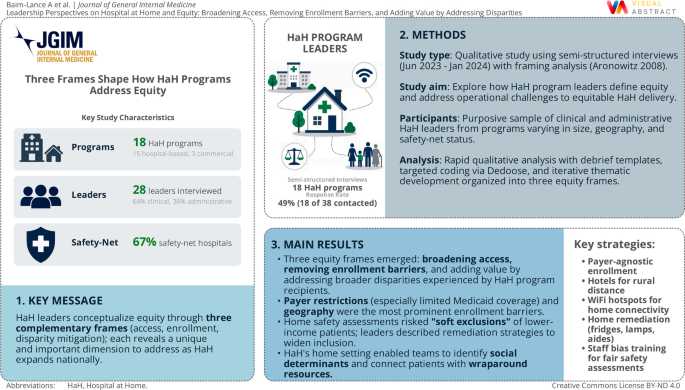
This qualitative study purposively sampled leadership from 18 HaH programs across the United States, reflecting diversity in program size, geographic location, and safety-net hospital affiliation. Researchers conducted semi-structured interviews with 28 leaders representing both hospital-based and commercial HaH programs. Data collection involved rapid analysis supported by debrief templates and thematic summaries. Targeted coding identified emergent themes, which were organized into distinct conceptual frames related to equity in HaH.
Key Findings
Three complementary frames emerged from leadership narratives, each elucidating distinct but interconnected facets of HaH equity:
Frame 1: Broaden HaH Access
Leaders emphasized the importance of expanding program establishment and availability to reach broader populations, including those in rural and underserved areas. Challenges identified included infrastructure limitations, workforce shortages, and regulatory constraints that especially impact program initiation in resource-limited settings. Strategies to broaden access involve partnerships with community providers, leveraging telehealth technologies, and advocating for supportive policy frameworks to enable HaH program scaling beyond urban tertiary centers.
Frame 2: Remove Barriers to HaH Enrollment
This frame focuses on socio-demographic factors limiting patient eligibility and participation in HaH. Enrollment barriers include payer restrictions, geographic limitations affecting service delivery feasibility, concerns about home safety, and patient or caregiver preferences. Leaders described targeted strategies such as expanding payer mix acceptance, implementing home safety assessments and interventions, culturally sensitive patient engagement, and caregiver support initiatives. Addressing these factors directly counters exclusionary enrollment practices and enhances equitable patient inclusion.
Frame 3: Add Value by Addressing Disparities
Beyond improving access, leaders recognized HaH’s potential to mitigate preexisting health and social disparities. Programs actively identify and address social determinants affecting patient outcomes, such as food insecurity, transportation challenges, and medication access. This frame reflects a holistic approach where HaH integrates acute medical care with broader social support, thereby enhancing long-term health equity and value to health systems aiming to reduce disparities.
Discussion
These delineated equity frames reveal that HaH program leaders possess nuanced understanding of equity challenges and solutions at multiple operational levels—from system entry to clinical and social outcome enhancement. Importantly, the frames are not mutually exclusive but rather synergistic, suggesting that holistic equity advancement requires coordinated efforts to expand access, dismantle enrollment barriers, and embed disparity reduction into routine care. Aligning program goals and interventions along these frames can strengthen HaH’s role in fulfilling health system equity mandates.
While this study offers rich leadership insight, limitations include its qualitative design and limited sample which may not capture all possible perspectives. Future research could quantify the impact of specific equity interventions on clinical outcomes and access metrics across varied HaH programs.
Conclusions
Hospital at Home programs represent a transformative opportunity to deliver acute care equitably by redefining hospitalization through a patient-centered lens. Leadership perspectives provide critical guidance for broadening access to underserved populations, removing enrollment barriers rooted in social and structural factors, and actively addressing health disparities through integrated care approaches. Strategic alignment and targeted operational improvements informed by these equity frames can optimize HaH’s potential to deliver comprehensive, equitable acute care as this care delivery model continues to expand nationwide.
Funding and Conflicts of Interest
The original study funding sources were not specified in the provided content. No conflicts of interest are declared by the authors in the cited publication.
References
1. Baim-Lance A, Perez S, Gorbenko K, et al. Leadership Perspectives on Hospital at Home and Equity: Broadening Access, Removing Enrollment Barriers, and Adding Value by Addressing Disparities. J Gen Intern Med. 2026 Oct 1. PMID: 42823586.
2. Levine DM, et al. Hospital-level care at home for acutely ill adults: a randomized controlled trial. Ann Intern Med. 2020;172(2):77–85.
3. Shepperd S, et al. Alternatives to inpatient hospital care: systematic review and meta-analysis. Br J Gen Pract. 2016;66(648):e315-e328.
4. National Academies of Sciences, Engineering, and Medicine. Integrating Social Care into the Delivery of Health Care: Moving Upstream to Improve the Nation’s Health. Washington, DC: The National Academies Press; 2019.
5. Kruse RL, et al. Addressing barriers to equitable care delivery in Hospital at Home programs. Health Aff (Millwood). 2022;41(7):987-995.