Highlight
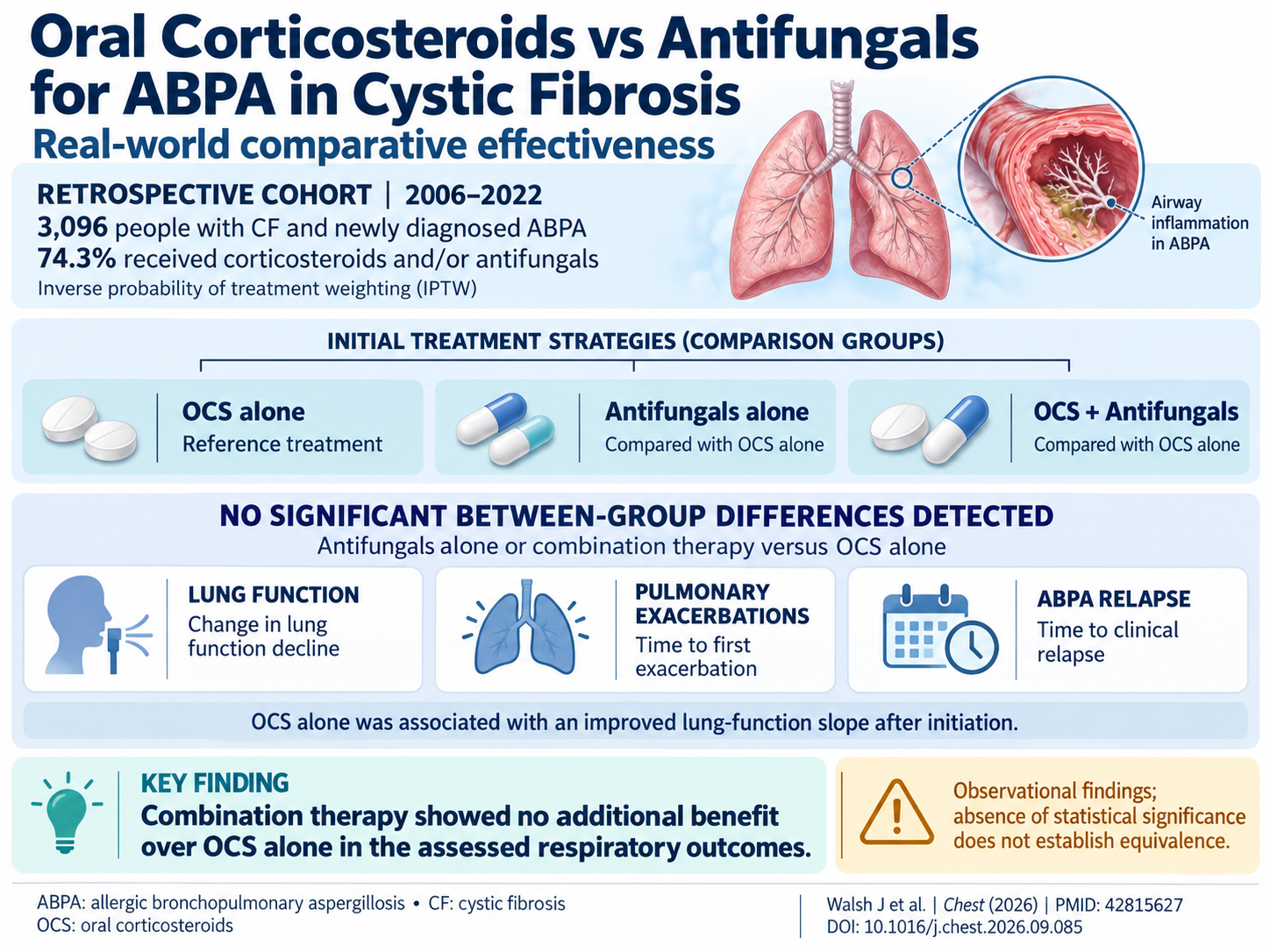
Allergic bronchopulmonary aspergillosis (ABPA) represents a challenging complication in cystic fibrosis (CF), often managed first-line with oral corticosteroids (OCS). This large real-world study analyzed factors influencing the initiation of antifungal therapy and compared the effectiveness of OCS alone versus antifungal monotherapy or combination treatment with respect to lung function and exacerbation risk. The findings indicate that OCS monotherapy improves forced expiratory volume without significant added benefit from antifungals, questioning their routine use.
Study Background
Cystic fibrosis is a multisystem genetic disorder characterized by chronic respiratory infections and progressive lung damage. Among its pulmonary complications, allergic bronchopulmonary aspergillosis is an immunologically mediated hypersensitivity reaction to Aspergillus fumigatus colonization that contributes to airway inflammation and structural lung decline. ABPA manifests clinically with worsening lung function, recurrent pulmonary exacerbations, and clinical relapse if inadequately treated. Oral corticosteroids remain the first-line standard therapy due to their potent anti-inflammatory effects, but their use is limited by adverse effects, prompting investigation into antifungal agents either alone or in combination as steroid-sparing or adjunctive treatments. However, data supporting antifungal efficacy in CF-related ABPA are sparse and inconclusive.
Study Design and Methods
This observational retrospective cohort study included 3,096 individuals with CF who received a first diagnosis of ABPA between 2006 and 2022. The cohort was derived from comprehensive clinical registries, encompassing detailed baseline characteristics and longitudinal treatment data. Investigators assessed factors associated with the initiation of antifungal therapy through Cox proportional hazards modeling, identifying patient and center variables influencing treatment choices. To evaluate clinical effectiveness, they compared lung function changes, specifically forced expiratory volume in one second percent predicted (FEV1 % predicted), and time to pulmonary exacerbation or ABPA relapse across three treatment strategies: OCS monotherapy, antifungal monotherapy, and combination OCS/antifungal therapy. Inverse probability of treatment weighting combined with generalized estimating equations accounted for confounding, with hazard ratios estimated using weighted Cox models.
Key Findings
Among the cohort, 74.3% received either OCS and/or antifungals as first-line ABPA treatment. Patients older in age, those using CFTR modulators, and those diagnosed with CF-related liver disease tended to experience delayed initiation of antifungal therapy. In contrast, prior pulmonary exacerbations, larger care centers, and baseline OCS use predicted earlier antifungal treatment. Regarding clinical effectiveness, OCS monotherapy was associated with a significant improvement in the slope of FEV1 % predicted after treatment initiation (increase of 0.24; 95% CI, 0.09–0.38; p<0.01), demonstrating its benefit in lung function recovery or stabilization. However, neither antifungal monotherapy nor combined OCS/antifungal therapy showed significant differences from OCS alone in terms of lung function trajectory, time to first pulmonary exacerbation, or time to ABPA clinical relapse. Notably, the results suggest no additive or synergistic effect of antifungals with corticosteroids on respiratory outcomes in the real-world setting.
Expert Commentary
These findings provide valuable real-world evidence reinforcing OCS as the cornerstone of ABPA treatment in CF, with clear lung function benefits measurable at the population level. The lack of superiority of antifungals challenges the growing clinical practice of empiric antifungal use, which may be driven by concerns over steroid side effects or attempts to address fungal colonization. It remains possible that antifungals could have a role in steroid-intolerant patients or in specific phenotypic subsets, but this study underscores the need for prospective randomized trials to define the precise role of antifungals. Limitations include the retrospective design, potential residual confounding, and heterogeneity in dosing regimens and diagnostic criteria. Importantly, lung function metrics and exacerbation rates may not fully capture all clinically relevant endpoints such as quality of life or corticosteroid-related toxicity.
Conclusion
This large retrospective study demonstrates that oral corticosteroids are effective in improving lung function in CF patients with ABPA, while adjunctive or alternative antifungal therapies do not confer additional measurable benefit in respiratory outcomes or relapse prevention. Clinicians should continue to prioritize corticosteroids in ABPA management while exercising judicious use of antifungals until higher-level evidence clarifies their role. Furthermore, future research should focus on optimizing steroid regimens, minimizing adverse effects, and identifying patient subgroups that may benefit from antifungal therapy.
Funding and Trial Registration
The study received institutional funding and was conducted utilizing national CF registry data. Specific funding sources and trial registration information were not reported in the publication.
References
1. Walsh J, Hsu JY, Tully E, Hong G. Comparing the real-world effectiveness of oral corticosteroids and antifungals for the treatment of allergic bronchopulmonary aspergillosis in cystic fibrosis. Chest. 2026 Sep 30. PMID: 42815627.
2. Stevens DA, Moss RB, Kurup VP, et al. Allergic bronchopulmonary aspergillosis in cystic fibrosis—state of the art: Cystic Fibrosis Foundation Consensus Conference. Clin Infect Dis. 2003;37(Suppl 3):S225-64.
3. Agarwal R, Chakrabarti A, Shah A, et al. Allergic bronchopulmonary aspergillosis: review of literature and proposal of new diagnostic and classification criteria. Clin Exp Allergy. 2013;43(8):850–73.
4. Patterson TF, Thompson GR 3rd, Denning DW, et al. Practice Guidelines for the Diagnosis and Management of Aspergillosis: 2016 Update by the Infectious Diseases Society of America. Clin Infect Dis. 2016;63(4):e1–60.
5. Sputum antifungal susceptibility and therapeutic monitoring in patients with CF undergoing aspergillosis treatment. J Cyst Fibros. 2021;20(3):425-31.