Highlight
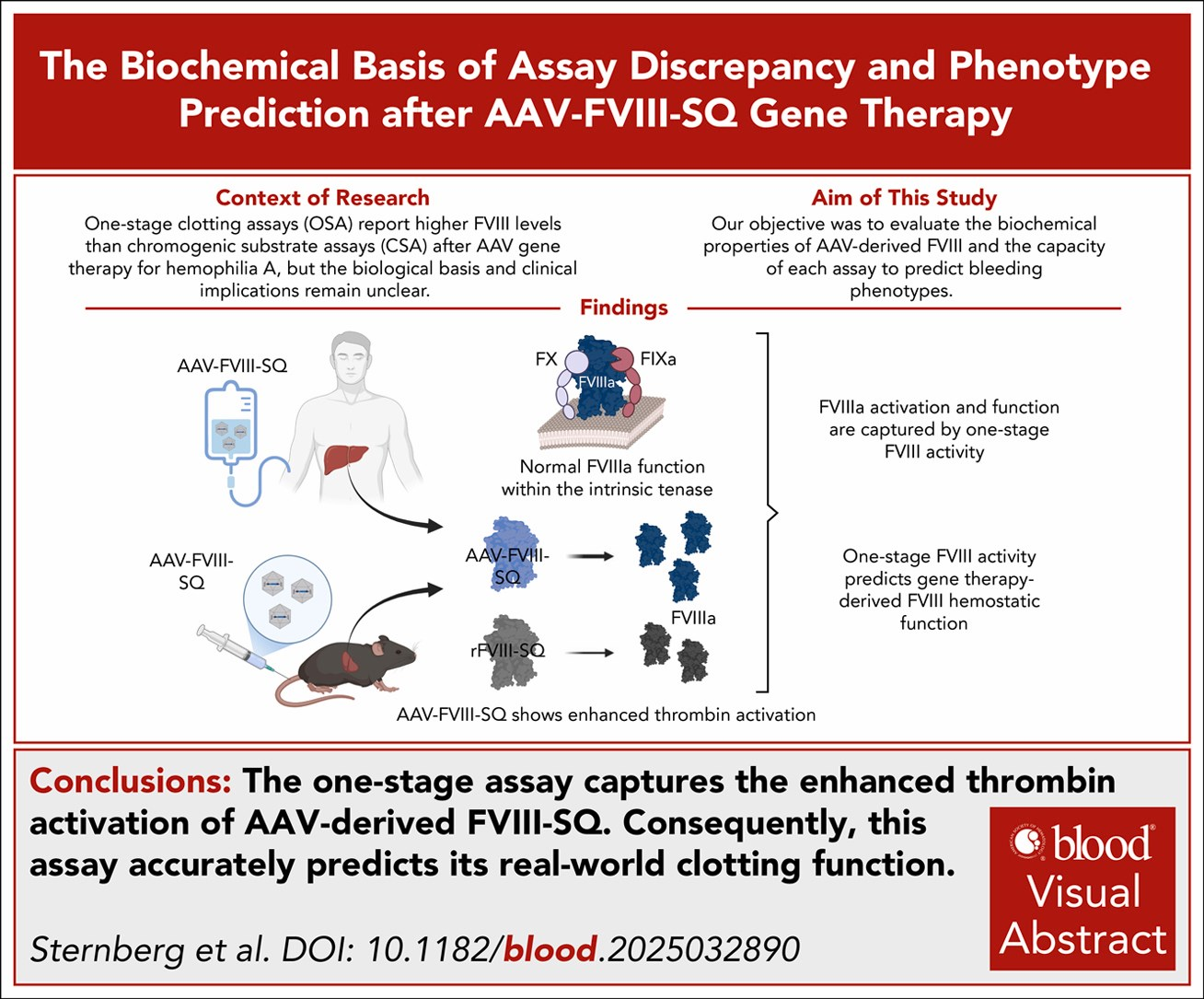
- One-stage assay (OSA) detects enhanced thrombin-mediated activation of AAV-derived factor VIII (FVIII-SQ), not captured by chromogenic substrate assay (CSA).
- In both mice and human trial participants, OSA FVIII activity correlates better with hemostatic function and clinical bleeding rates.
- The enhanced activation and normal cofactor stability of AAV-FVIII-SQ suggest distinct biochemical properties from recombinant FVIII-SQ, explaining assay discrepancies.
- These findings support prioritizing OSA for monitoring FVIII activity in hemophilia A gene therapy patients to predict phenotypic outcomes.
Study Background
Hemophilia A (HA) is an inherited bleeding disorder caused by deficiency or dysfunction of clotting factor VIII (FVIII). Accurate measurement of FVIII activity is crucial to evaluate disease severity, guide therapy, and monitor response, especially in the context of emerging gene therapies. Most HA gene therapy trials utilize adeno-associated virus (AAV)-mediated delivery of a B-domain-deleted FVIII-SQ variant to restore FVIII activity. However, discrepancies between FVIII activity assays complicate interpretation: one-stage clotting assays (OSA) often report activity levels 1.5 to 2 times higher than chromogenic substrate assays (CSA) in patients receiving AAV-FVIII-SQ, unlike recombinant FVIII-SQ where assays align more closely.
This discrepancy raises vital questions about which assay better reflects the functional FVIII contributing to hemostasis post-gene therapy. Given the critical role of thrombin in activating FVIII and enabling intrinsic tenase complex formation, understanding how AAV-derived FVIII behaves biochemically and functionally is needed to optimize clinical monitoring and predict bleeding phenotypes.
Study Design
The study analyzed AAV-FVIII-SQ function in both preclinical and clinical settings. In hemophilia A mouse models, researchers evaluated FVIII activity using OSA and CSA in presence or absence of von Willebrand factor (VWF) to assess the source of assay discrepancies. Stability of the FVIII A2 domain and cofactor function within the intrinsic tenase complex were examined to characterize biochemical properties.
In parallel, participants in the SPK-8011 clinical trial (N=23), representing 99 cumulative patient-years, underwent FVIII activity testing by both assays along with annualized bleeding rates (ABR) monitoring. Negative binomial regression was performed to assess which assay better predicted clinical phenotype. Comparative analyses between recombinant FVIII-SQ and AAV-FVIII-SQ were also conducted.
Key Findings
The findings provide clear evidence that AAV-derived FVIII-SQ has altered biochemical behavior compared with recombinant forms. In both mice and human samples, OSA consistently reported higher FVIII activity than CSA, reflecting enhanced thrombin-mediated activation of AAV-FVIII-SQ that CSA failed to detect. This enhanced activation did not depend on VWF interactions, as demonstrated by persistent assay differences in VWF knockout mice.
The stability of the A2 domain, crucial for FVIII activity duration, remained normal in AAV-derived FVIII-SQ, supporting preserved cofactor function within the intrinsic tenase complex. Functional assays in mice demonstrated that OSA-correlated activity corresponded closely with actual hemostatic function, validating OSA as a more sensitive measure of the gene therapy-derived FVIII activity.
Clinically, negative binomial regression modeling of the SPK-8011 cohort indicated a trend for better prediction of bleeding outcomes (annualized bleeding rate) using OSA rather than CSA measurements. This suggests that OSA’s enhanced detection of thrombin-activated FVIII activity translates into more accurate reflection of patient bleeding risk and therapeutic efficacy.
Expert Commentary
These insights challenge the traditional reliance on CSA for FVIII activity monitoring, especially in the context of gene therapy. The enhanced thrombin activation of AAV-FVIII-SQ—potentially due to subtle conformational or post-translational modifications induced by AAV expression systems—may confer distinct functional properties necessitating assay-specific interpretation.
Clinicians and laboratory specialists should consider the limitations of CSA measurements in gene therapy patients and prioritize OSA for FVIII activity quantification. While OSA may overestimate recombinant FVIII activity less so, it captures clinically relevant activation states of therapeutic FVIII variants better, impacts clinical decision-making, and bleeding risk assessment.
Limitations of the study include relatively small human cohort size and need for further validation across diverse AAV-based gene therapies. Future research should explore molecular mechanisms underlying differential thrombin activation and assay interactions with different FVIII constructs.
Conclusion
The study demonstrates that OSA FVIII activity more accurately reflects the enhanced thrombin-mediated activation and intrinsic tenase function of AAV-derived FVIII-SQ compared to CSA. This makes OSA a superior predictor of clinical bleeding phenotype in hemophilia A gene therapy patients. Incorporating OSA into routine clinical monitoring protocols could improve assessment of gene therapy efficacy and aid personalized management.
These findings underscore the importance of assay selection aligned with the biochemical characteristics of novel therapeutics and support further standardization and validation efforts in hemophilia gene therapy clinical care.
Funding and ClinicalTrials.gov
The SPK-8011 clinical trial was funded by Spark Therapeutics. Detailed study information is registered on ClinicalTrials.gov. Specific grant numbers were not provided in the original publication.
References
- Sternberg AR, et al. One-stage assay factor VIII activity reflects AAV-derived factor VIII-enhanced thrombin activation and predicts phenotype. Blood. 2026;148(14):1848-1853. PMID: 42371804.
- Oldenburg J, et al. Standardization of Factor VIII and Factor IX Assays for Hemophilia Gene Therapy: Current Challenges. J Thromb Haemost. 2021;19(9):2183-2192.
- Pipe SW. Progress and Challenges in Hemophilia Gene Therapy. Blood. 2023;141(6): 589-599.