Highlight
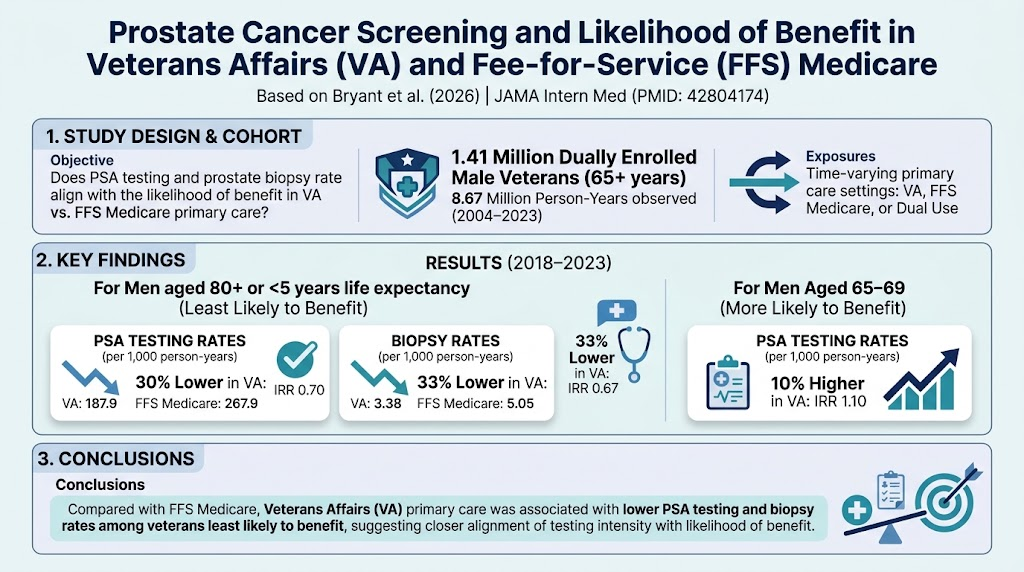
This large retrospective cohort study examined PSA screening and prostate biopsy rates among 1.41 million male veterans aged 65 years or older dually enrolled in Veterans Affairs (VA) and Fee-for-Service (FFS) Medicare from 2004 to 2023.
Key findings include significantly lower rates of PSA testing and biopsies within VA primary care for men least likely to benefit—from an older age group (≥80 years) and those with less than 5 years predicted life expectancy—compared to FFS Medicare. Conversely, PSA testing was slightly higher among younger men (65-69 years) in the VA setting.
These results suggest that the VA has better alignment of prostate cancer screening intensity with the likelihood of clinical benefit, reducing low-value care in veterans with limited life expectancy.
Study Background
Prostate cancer remains a leading malignancy among men, and prostate-specific antigen (PSA) screening is widely used for early detection. However, routine PSA screening in men with limited life expectancy can lead to overdiagnosis, overtreatment, and consequential harm without prolonging survival.
The US Department of Veterans Affairs (VA) system and Fee-for-Service (FFS) Medicare represent two prominent healthcare delivery models providing primary care to older men. While VA has implemented initiatives aimed at aligning cancer screening with patient prognosis and guidelines, direct benchmarking against non-VA (FFS Medicare) care had not been comprehensively performed prior to this study.
Study Design
This was a retrospective cohort study utilizing national linked VA-Medicare data from fiscal years 2004 through 2023. The cohort comprised a 30% random sample (approximately 1.41 million men) of male veterans aged 65 years or older, dually enrolled in VA and FFS Medicare Parts A and B.
Exclusion criteria included men with a prior history of prostate cancer or those enrolled exclusively in Medicare Advantage plans. Exposure status was defined according to predominant primary care setting—VA, FFS Medicare, or dual use—determined across a rolling 36-month window based on visit distributions.
Main outcomes were PSA testing and prostate biopsy rates, expressed per 1000 person-years. Rates were analyzed with covariate-adjusted Poisson regression models, stratified by age groups and predicted life expectancy categories to assess intensity of screening relative to likelihood of benefit.
Key Findings
Over 8.67 million person-years of follow-up were collected. Temporal trends showed PSA testing declined in both care settings from 2008 to 2017, though the decline was steeper within the VA system, reflecting potentially successful efforts to reduce low-value screening.
From 2018 to 2023, adjusted PSA testing rates among men aged 80 years or older were markedly lower in VA primary care compared to FFS Medicare (187.9 vs 267.9 per 1000 person-years; incidence rate ratio [IRR] 0.70, 95% CI 0.69-0.71). Similarly, prostate biopsy rates in this age group were reduced in VA care (3.38 vs 5.05 per 1000 person-years; IRR 0.67, 95% CI 0.60-0.75).
In men with predicted life expectancy less than 5 years, PSA testing was also lower in VA settings (IRR 0.84, 95% CI 0.82-0.86), indicating decreased screening in those least likely to derive clinical benefit. In contrast, younger veterans aged 65–69 had slightly higher PSA testing rates in the VA setting (IRR 1.10, 95% CI 1.09-1.11), consistent with expected benefit from screening in this group.
These age- and life expectancy-based patterns persisted across multiple sensitivity analyses, underscoring the robustness of the associations observed.
Expert Commentary
This study provides compelling evidence that the VA healthcare system more finely calibrates prostate cancer screening intensity according to individual patient risk profiles and life expectancy, reducing unnecessary testing and potentially avoiding harms of overdiagnosis and overtreatment in older or medically frail patients.
The steeper decline in PSA testing observed over time in VA care aligns with evolving US Preventive Services Task Force (USPSTF) recommendations discouraging routine screening in men with limited life expectancy. Differences between VA and FFS Medicare may be attributable to VA’s integrated care model, guideline adherence initiatives, and use of coordinated primary care teams.
However, findings should be interpreted considering some limitations: the observational design restricts causal inference, residual confounding could remain, and results may not generalize to non-veteran populations or those enrolled in Medicare Advantage.
Importantly, this study highlights the challenge of balancing early cancer detection with avoiding low-value interventions in aging populations. Future research should explore strategies to further individualize screening decisions, incorporating patient preferences and comorbidities.
Conclusion
In summary, among older male veterans dually enrolled in VA and FFS Medicare, the Veterans Affairs primary care system exhibited lower rates of PSA testing and prostate biopsy in men least likely to benefit based on age and life expectancy. This suggests more prudent and evidence-aligned screening practices compared to FFS Medicare.
These findings support the continued emphasis on risk- and benefit-based prostate cancer screening strategies to optimize clinical outcomes, minimize harms, and reduce healthcare costs associated with overtesting.
References
1. Bryant AK, VanDeusen A, Klamerus ML, et al. Prostate Cancer Screening and Likelihood of Benefit in Veterans Affairs and Fee-for-Service Medicare. JAMA Intern Med. 2026;Published online September 28, 2026. doi:10.1001/jamainternmed.2026.42804174
2. US Preventive Services Task Force. Screening for Prostate Cancer: US Preventive Services Task Force Recommendation Statement. JAMA. 2018;319(18):1901-1913. doi:10.1001/jama.2018.3710
3. Mohler JL, Antonarakis ES. NCCN Guidelines Prostate Cancer Early Detection Version 2.2024.