Highlight
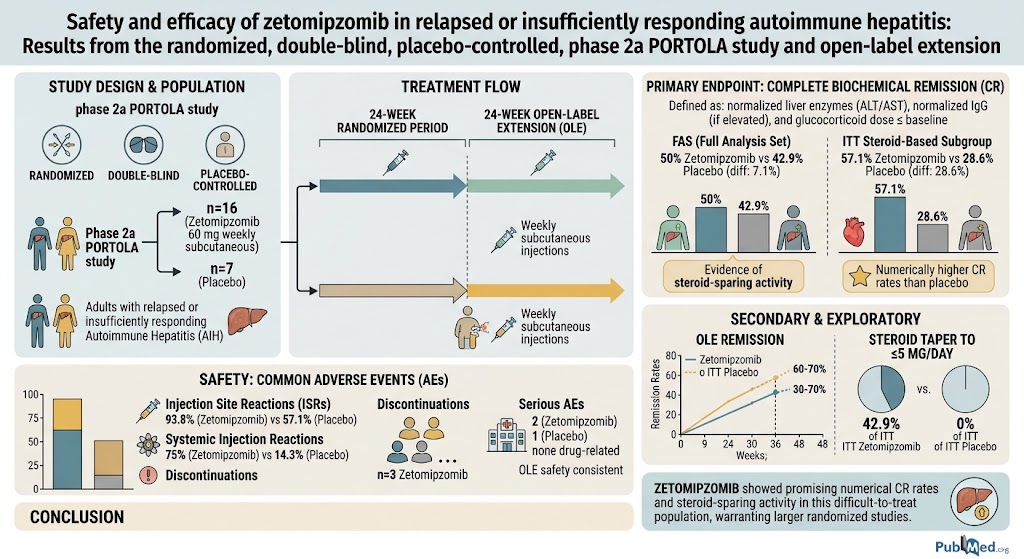
- Zetomipzomib, a selective immunoproteasome inhibitor, was evaluated in a randomized, double-blind, placebo-controlled phase 2a trial (PORTOLA) for autoimmune hepatitis (AIH) patients with active disease despite standard therapy.
- By 24 weeks, zetomipzomib showed numerically higher complete biochemical remission (CR) rates compared to placebo, with meaningful steroid-sparing effects.
- Safety data indicated common injection site and systemic reactions, with few discontinuations; no drug-related serious adverse events (AEs) were reported.
- These data support further evaluation of zetomipzomib in larger, controlled studies addressing the treatment gap in difficult-to-treat AIH.
Study Background
Autoimmune hepatitis (AIH) is a chronic inflammatory liver disease characterized by immune-mediated hepatocyte destruction. The condition often requires long-term immunosuppressive treatment, primarily glucocorticoids, which can be associated with significant adverse effects. Despite available therapies such as corticosteroids and azathioprine, a subset of patients exhibit refractory disease or frequent relapses, underscoring an unmet clinical need for effective, steroid-sparing agents.
Zetomipzomib, a novel selective immunoproteasome inhibitor, targets immune cell pathways critical to AIH pathogenesis by modulating proteasomal degradation processes involved in antigen presentation and inflammatory cytokine production. This mechanism positions zetomipzomib as a promising therapeutic candidate to improve disease control while potentially reducing steroid dependence.
Study Design
The PORTOLA study was a randomized, double-blind, placebo-controlled, phase 2a clinical trial conducted across 24 U.S. centers. The study enrolled adults diagnosed with AIH who had active disease despite at least three months of standard-of-care therapy or experienced a disease flare after remission.
Participants were randomized to receive weekly subcutaneous zetomipzomib at 60 mg or placebo for 24 weeks. Upon completion, eligible participants could enter a 24-week open-label extension (OLE) to receive zetomipzomib. The primary efficacy endpoint was achieving complete biochemical remission (CR) by week 24, defined as normalized liver enzymes (alanine transaminase and aspartate transaminase), normalization of IgG levels if elevated, and glucocorticoid dose at or below baseline.
Efficacy analyses were conducted on the full analysis set (FAS) and a steroid-based subgroup analyzed according to the intention-to-treat (ITT) principle. Safety assessments included incidence, severity, and causality of adverse events (AEs).
Key Findings
Between April 2023 and July 2024, 24 participants were randomized; 23 (16 receiving zetomipzomib, 7 receiving placebo) were included in the FAS.
By week 24, 50.0% of zetomipzomib-treated participants achieved CR compared with 42.9% in the placebo group, a difference of 7.1% (95% confidence interval [CI]: -38.5 to 48.3), which did not reach statistical significance given the sample size.
Notably, 37.5% of participants in the zetomipzomib arm achieved CR with successful tapering of glucocorticoids to ≤5 mg/day, compared to 14.3% in the placebo group. Within the ITT steroid-based subgroup (n=21), CR was observed in 57.1% with zetomipzomib versus 28.6% with placebo, corresponding to a 28.6% difference (95% CI: -20.2 to 65.4). Only zetomipzomib recipients achieved CR while tapering steroids to ≤5 mg/day (42.9%), indicating steroid-sparing potential.
Regarding safety, the most frequent adverse events included injection site reactions (93.8% with zetomipzomib vs. 57.1% placebo) and systemic injection reactions (75% vs. 14.3%). Three participants in the zetomipzomib group (18.8%) discontinued treatment due to AEs. Serious AEs occurred in two participants receiving zetomipzomib and one receiving placebo, but none were considered related to the study drug. The open-label extension safety profile was consistent, with no new safety signals or serious AEs.
Expert Commentary
The PORTOLA trial offers an important proof-of-concept regarding the safety, tolerability, and preliminary efficacy of zetomipzomib in a challenging AIH patient population refractory to standard therapies. Although the modest sample size limited definitive statistical conclusions, the signals of clinical benefit, especially in steroid reduction, are encouraging.
From a mechanistic perspective, inhibiting the immunoproteasome modulates antigen presentation and inflammatory cytokines pivotal in AIH pathogenesis. This biological plausibility adds weight to the observed clinical outcomes and rationale for continued investigation.
Limitations include the small sample size and short duration, which constrain assessment of long-term efficacy and safety, particularly regarding potential immunosuppression-related adverse effects. Larger, longer-term, phase 3 trials are needed to confirm these findings and establish the role of zetomipzomib in AIH treatment algorithms.
Integration of zetomipzomib into clinical practice, if proven effective, could reduce cumulative glucocorticoid exposure and associated morbidity, significantly improving management of refractory AIH.
Conclusion
Zetomipzomib demonstrated numerically higher rates of complete biochemical remission compared to placebo in an AIH population with active disease resistant to standard therapy. Its ability to facilitate meaningful glucocorticoid tapering without loss of disease control is notable. Safety data to date are consistent with manageable tolerability.
These findings justify larger randomized clinical trials to robustly define zetomipzomib’s efficacy and safety profile, aiming to expand therapeutic options in this difficult-to-treat autoimmune liver disease.
Funding and Clinical Trials Registration
This study was registered with ClinicalTrials.gov under identifier NCT05569759. Details on funding were not explicitly provided in the abstract but are expected to comply with industry and academic collaboration standards typical for phase 2 trials.
References
1. Lammert CS, Weinberg EM, Sclair SN, et al. Safety and efficacy of zetomipzomib in relapsed or insufficiently responding autoimmune hepatitis: Results from the randomized, double-blind, placebo-controlled, phase 2a PORTOLA study and open-label extension. Hepatology (Baltimore, Md.). 2026 Aug 26. PMID: 42770396.
2. Manns MP, Czaja AJ, Gorham JD, et al. Diagnosis and Management of Autoimmune Hepatitis. Hepatology. 2010;51(6):2193-2213.
3. Krol MP, Ten Kate FJW, Jansen PLM. Emerging Regulatory Approaches and Therapies in Autoimmune Hepatitis. Expert Rev Clin Pharmacol. 2020;13(6):625-634.