Highlight
This phase II basket trial evaluated vosoritide, a C-type natriuretic peptide analog, in children with genetic disorders affecting the Ras-MAPK pathway, including RASopathies, as well as ACAN and NPR2 deficiencies. Treatment resulted in a significant increase in annualized growth velocity (AGV) and height standard deviation scores (SDS). Short-term safety was generally favorable, though longer-term adverse events such as slipped capital femoral epiphysis (SCFE) and genu valgum led to treatment discontinuation in some patients. These findings suggest vosoritide may serve as an effective precision medicine for various growth disorders related to MAPK pathway dysregulation.
Study Background
Short stature due to genetic causes poses diagnostic and therapeutic challenges, especially when linked to dysregulation of the Ras-MAPK signaling cascade—a critical intracellular pathway controlling cell growth and differentiation. RASopathies, encompassing a range of syndromes caused by mutations in genes encoding components of this pathway, commonly present with growth impairment. Similarly, mutations in ACAN (aggrecan) and NPR2 (natriuretic peptide receptor 2) genes also disrupt skeletal growth. Currently, treatment options for these disorders are limited. Vosoritide, approved for achondroplasia—which involves FGFR3 pathway activation that cross-talks with Ras-MAPK signaling—offers a promising targeted approach by opposing MAPK pathway overactivation. This trial thus aimed to assess vosoritide’s efficacy and safety across these genetically diverse but mechanistically linked conditions.
Study Design
This was a prospective Phase II basket trial conducted at an academic medical center involving 30 prepubertal children aged 3 to 11 years, all exhibiting short stature defined by height ≤ -2.25 standard deviations. Patients were genetically confirmed to have RASopathies, or ACAN or NPR2 deficiencies. The trial consisted of an initial 6-month observation period without intervention, followed by 12 months of vosoritide administered subcutaneously at 15 µg/kg daily.
Co-primary endpoints included monitoring incidence of adverse events and evaluating changes in annualized growth velocity (AGV) and height standard deviation scores. Secondary analyses examined growth response within each genetic subgroup and safety outcomes during treatment.
Key Findings
Treatment with vosoritide produced substantial improvements in growth metrics. The mean AGV increased from 4.53 ± 1.61 cm/year during the observation period to 8.09 ± 1.58 cm/year on treatment (P < .0001), representing nearly a doubling of growth velocity. This clinical benefit translated to a highly significant increase of 4.0 standard deviations in age- and sex-adjusted AGV Z-scores (95% CI 3.08–4.91, P < .0001). Importantly, this growth acceleration was observed consistently across all genetic subgroups studied—RASopathies, ACAN, and NPR2 deficiencies—demonstrating the drug’s broad applicability within MAPK pathway-related growth disorders.
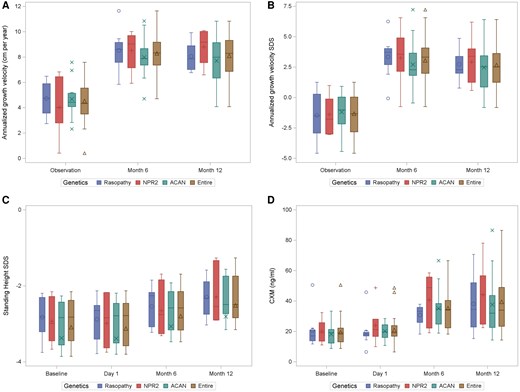
A. Absolute annualized growth velocity. B. Annualized growth velocity Z-score standardized for age and sex. C. Height standard deviation score. D. Collagen X biomarker levels.
Height SDS improved by 0.65 standard deviations during the treatment phase compared with observation (95% CI 0.53–0.77, P < .0001), indicating meaningful gains in stature beyond natural growth expectations.
Safety analysis revealed that short-term administration was well-tolerated, with the most commonly reported adverse events being mild injection site reactions. However, longer treatment exposed some clinically relevant adverse events: five children discontinued therapy due to side effects, including three cases of slipped capital femoral epiphysis (SCFE) and four cases of genu valgum (knock-knee deformity). These orthopedic complications require cautious surveillance and suggest that growth acceleration may precipitate mechanical stresses on developing skeletal structures.
Expert Commentary
The trial elegantly illustrates the therapeutic potential of targeting growth disorders via modulation of the MAPK pathway with vosoritide. Given the diverse genetic etiologies but convergent pathway involvement, the basket trial design efficiently tests a precision medicine hypothesis across distinct genetic conditions. The robust increase in growth velocity and height SDS establishes clinical proof of principle.
Nevertheless, longer-term follow-up is critical to fully characterize safety, especially skeletal complications that might arise from rapid growth changes. Orthopedic monitoring and management strategies will be essential adjuncts in clinical care. Moreover, future studies might explore optimal dosing regimens tailored to genetic subtypes or severity, and investigate combined therapeutic approaches addressing additional pathway dysregulations.
Overall, these findings align with growing evidence supporting vosoritide’s expanding clinical indications beyond achondroplasia, highlighting a shift towards personalized treatments for inherited growth failure syndromes with defined molecular mechanisms.
Conclusion
This phase II basket study confirms that vosoritide significantly enhances growth velocity and stature in children with RASopathies, ACAN, and NPR2 deficiency, genetic disorders unified by MAPK pathway disruption. While short-term safety is favorable, clinicians must monitor closely for orthopedic adverse events during prolonged treatment. These promising results pave the way for broader use of vosoritide as a precision therapeutic option in complex growth disorders and underscore the importance of molecularly guided interventions in pediatric endocrinology.
Funding and Clinical Trials
The study was conducted at an academic medical center with research support not specified in the abstract. Further information on funding and trial registration numbers would be available in the full publication or clinical trial registries.
References
Dauber A, Zhang A, Shafaei N, Seaforth R, Pitner K, Dham N, Kanakatti Shankar R, Merchant N. A phase II basket trial of vosoritide in children with RASopathies, ACAN, and NPR2 deficiency. The Journal of Clinical Endocrinology and Metabolism. 2026 Aug 13;111(9):2416-2425. PMID: 41967490. https://pubmed.ncbi.nlm.nih.gov/41967490/