Introduction
Glycated hemoglobin (HbA1c) is widely used to assess long-term glycemic control in diabetic patients, serving as a critical marker for managing diabetes and preventing complications. However, discrepancies often arise between HbA1c values and average glucose (AG) measurements from continuous glucose monitoring (CGM) devices, complicating clinical interpretation. These inconsistencies are influenced by individual variations in red blood cell (RBC) physiology, including differences in RBC lifespan and glycation rates, which vary across racial groups, ultimately impacting diabetes management and outcomes.
The Glucose-Derived Personalized HbA1c Correction (GDAC) study was designed to quantitatively assess the extent of HbA1c-AG discordance among individuals with type 1 and type 2 diabetes from diverse racial backgrounds. By developing a personalized glycation ratio (PGR) that adjusts HbA1c measurements to an individual’s unique RBC characteristics, the study proposes a refined personalized HbA1c (pA1C) metric aimed at improving alignment with CGM-derived glucose readings.
Study Design and Methods
This prospective multicenter study extended over 26 weeks and enrolled 257 subjects diagnosed with either type 1 diabetes (T1D) or type 2 diabetes (T2D) from four racial groups: Asian, White, Black, and other/mixed races. Participants were closely monitored using CGM devices continuously throughout the study period, and HbA1c levels were systematically collected biweekly.
The study period was divided into two phases: the initial 12 weeks focused on derivation of each participant’s PGR by correlating HbA1c with their CGM-measured average glucose levels, while weeks 20 to 26 involved application and testing of the personalized HbA1c (pA1C) adjusted by PGR. Statistical analyses evaluated the prevalence and degree of discordance, defined as a difference ≥0.5% between HbA1c and CGM-based glucose estimates, before and after applying the pA1C correction.
Results
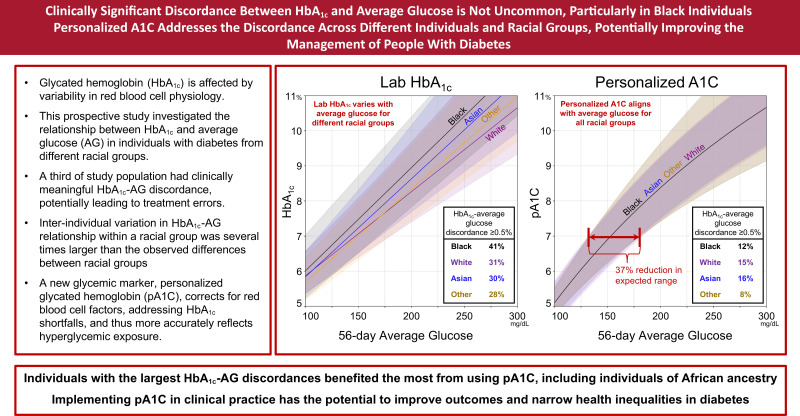
The cohort had a mean age of 53 ± 14 years, with a female representation of 45%. The racial composition included 35% Asian, 30% White, 22% Black, and 14% other/mixed. Overall, 33% of participants exhibited clinically significant HbA1c-AG discordance. Notably, the Black subgroup experienced the highest rate of discordance at 41%, underscoring potential racial differences in RBC glycation dynamics and their clinical implications.
Following adjustment with the personalized HbA1c correction (pA1C), discordance was markedly reduced across all groups. The entire cohort’s discordance dropped to 14%, representing a 58% relative reduction. Among the Black participants, discordance decreased even more substantially to 12%, reflecting a 71% reduction. These results validate the efficacy of pA1C in bringing HbA1c values into better agreement with real-time glucose profiles.
Discussion
This study highlights a prevalent and clinically meaningful discordance between HbA1c and CGM-derived average glucose, predominantly affecting Black individuals. Such discordance can lead to misinterpretation of glycemic control, inappropriate treatment adjustments, and ultimately, suboptimal patient outcomes.
The introduction of a personalized HbA1c correction based on individual glycation ratios offers a tailored approach to diabetes monitoring. By accounting for unique RBC life span and glycation variability, pA1C provides a more accurate reflection of true glycemic burden, facilitating better-informed clinical decisions.
Implementing pA1C could have significant clinical benefits, including improved risk stratification, individualized therapy optimization, and reduction of health disparities driven by racial differences in HbA1c reliability. This personalized adjustment aligns with the growing emphasis on precision medicine in diabetes care.
Clinical Implications and Future Directions
For clinicians, recognizing HbA1c-AG discordance—especially in racial minorities—is critical. Routine CGM use combined with pA1C calculation may help overcome current limitations of HbA1c-based assessments. Integrating these approaches within electronic health systems could standardize personalized glycemic evaluation.
Further large-scale real-world studies are warranted to validate pA1C utility and to explore its impact on long-term diabetes complications and quality of life metrics. Additionally, research into the biological mechanisms underpinning RBC glycation variability may uncover novel therapeutic targets.
Conclusion
The GDAC study demonstrates that HbA1c and CGM-based average glucose may not align well in many individuals, particularly among Black patients. The personalized HbA1c correction (pA1C) method significantly reduces this discordance, providing a more precise tool for clinical diabetes management. Adoption of pA1C holds promise to optimize glycemic control strategies, personalize treatment, and reduce racial disparities in diabetes outcomes.
References
Ajjan RA, Choudhary P, Xu Y, Dunn TC. Glucose-Derived Personalized HbA1c Correction (GDAC) Study to Improve Alignment Between CGM-Derived Metrics and HbA1c in Different Individuals and Racial Groups With Diabetes: Implications for Clinical Practice. Diabetes Care. 2026 Aug 1;49(8):1420-1427. PMID: 42257619.