Highlights
- Bilateral implantation of the DEN00V refractive EDF IOL provides excellent uncorrected and corrected distance and intermediate vision in both mini-monovision and emmetropic targeting strategies.
- Low contrast visual acuity is superior in the emmetropia group compared to mini-monovision, implying a trade-off between binocular intermediate/near vision gain and contrast sensitivity.
- Stereopsis is preserved in both strategies, supporting functional binocular vision despite induced anisometropia in mini-monovision.
- Patient-reported outcomes show high satisfaction and spectacle independence for distance and intermediate tasks, with mini-monovision patients experiencing slightly increased glare but reduced dependence on near spectacles.
Background
Cataract surgery with intraocular lens (IOL) implantation aims to restore visual function while addressing presbyopia-related challenges. Extended Depth of Focus (EDOF) IOLs have emerged to provide an extended range of functional vision, improving intermediate and near visual acuities without compromising distance vision or contrast sensitivity markedly. Refractive EDOF lenses, such as the TECNIS PureSee (DEN00V), use wavefront-shaping optics to achieve an elongated focal range.
The clinical challenge remains to optimize binocular vision strategies post-implantation. Mini-monovision (MMV), typically targeting mild myopia (~-0.75 D) in the non-dominant eye, extends the range of clear vision more than strict emmetropia (EMM) bilaterally but may compromise contrast sensitivity and induce visual phenomena such as glare or halos. This necessitates a critical comparison of the visual performance and patient satisfaction between these approaches to guide clinical decision-making.
Key Content
1. Clinical Evidence on Visual Outcomes of Refractive EDF IOLs in Monovision and Emmetropia
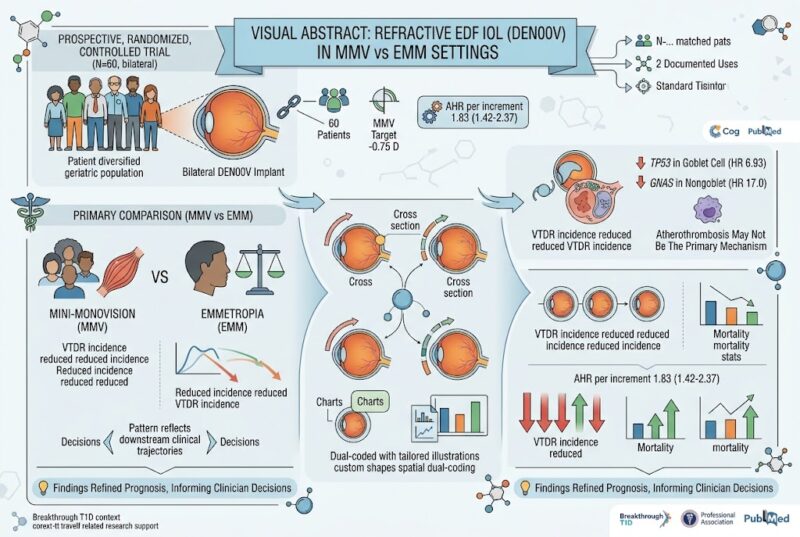
The seminal prospective, randomized controlled trial by Zeilinger et al. (2026) assessed 60 patients bilaterally implanted with the DEN00V IOL, randomized to binocular MMV (-0.75 D in the non-dominant eye) or bilateral emmetropia targeting. The study demonstrated excellent binocular uncorrected distance visual acuity (UDVA) and corrected distance visual acuity (CDVA) in both groups (mean UDVA: -0.02±0.07 logMAR MMV vs. -0.05±0.07 logMAR EMM, p=0.14). Intermediate and near visual acuities favored MMV in a non-significant trend (UIVA 0.06±0.08 MMV vs. 0.10±0.09 logMAR EMM, p=0.09; UNVA 0.20±0.07 MMV vs. 0.23±0.09 logMAR EMM, p=0.18), reflecting the mini-monovision effect on extending near focus.
However, low contrast visual acuity was statistically significantly better in the EMM group at 5% and 1.25% contrast levels (p<0.001 and p=0.01, respectively, after Holm-Bonferroni correction), indicating a trade-off where MMV induces modest contrast sensitivity reduction likely due to anisometropia-related binocular integration.
Binocular defocus curves were comparable, suggesting a broadly similar functional range of vision. Importantly, stereopsis was preserved across groups, indicating effective binocular cooperation even in MMV settings.
2. Mechanistic Insights and Translational Implications
Refractive EDF IOLs like DEN00V utilize wavefront modulation to extend the focal range smoothly, reducing dysphotopsia relative to diffractive multifocal lenses. The MMV approach adds anisometropia by moderately myoping the non-dominant eye to enhance near focus without compromising binocular summation fundamentally. This leads to improved near and intermediate functional vision but may slightly reduce contrast sensitivity, possibly due to retinal image functional disparity.
Other studies, including Ruiss et al. (2026), evaluating partial-depth of field IOLs with monovision strategies, corroborate enhanced binocular intermediate and near visual acuities with minimal photic phenomena, further supporting this approach’s clinical viability.
3. Comparative Performance of EDF IOL Designs and Broader Context
Intraindividual comparisons between different refractive EDF designs (e.g., DEN00V wavefront-shaped vs. sector-segmented AN6V) reveal comparable visual acuities but differences in intermediate focus favoring certain designs, underscoring the importance of specific IOL optical characteristics in targeted visual function restoration.
Additional reports on hybrid or partial-EDF lenses (e.g., AM2UH, 877PEY) confirm the growing spectrum of EDOF IOL technologies, each with variable compromise between range of vision, contrast sensitivity, and visual disturbances. The DEN00V’s promising tolerance to residual refractive error and monofocal-like dysphotopsia profile also highlight its robustness in real-world scenarios, where perfect refractive outcomes are challenging.
4. Patient-Reported Outcomes and Visual Quality
Patient satisfaction metrics across referenced studies demonstrate high overall satisfaction, with low dependence on spectacles for distance and intermediate vision post-implantation of refractive EDF IOLs in MMV or EMM regimens. Subjective symptoms such as glare and halos occur at low to moderate levels, with slight increases noted in mini-monovision patients potentially due to induced anisometropia.
These findings underscore the importance of individualized patient selection and preoperative counseling when choosing monovision versus strict emmetropic correction with EDF IOLs, balancing extended near vision benefits with potential reductions in contrast and increased glare sensitivity.
Expert Commentary
The randomized trial of Zeilinger et al. provides high-quality evidence supporting the safe and effective use of the DEN00V refractive EDF IOL with either emmetropic or mini-monovision target refractions. While distance and intermediate visual acuities are robust in both settings, refractive mini-monovision adds near vision gains at the expense of low-contrast visual acuity and slightly increased subjective glare.
Clinicians must weigh these trade-offs, considering individual patient lifestyle demands and tolerance for visual phenomena. The preservation of stereopsis with MMV is reassuring, negating concerns about binocular function deterioration.
The study’s methodological strengths include masking, randomization, and comprehensive visual function assessment (including defocus curves and standardized patient questionnaires). Limitations include relatively short follow-up (3 months) and single-center design, warranting longer-term multi-center studies.
Mechanistically, the smooth, refractive wavefront pattern facilitates extended depth of focus with minimal splitting of light energy, contributing to better contrast and lower photic disturbances compared to diffractive multifocal lenses. Mini-monovision capitalizes on neural adaptation mechanisms to integrate anisometropic inputs effectively.
In the context of evolving presbyopia-correcting IOLs, this study adds important clinical data supporting refractive EDF IOLs as a versatile option, adaptable to different refractive strategies targeting patient-specific visual needs.
Conclusion
Implantation of the DEN00V refractive EDF IOL bilaterally provides excellent distance and intermediate vision, preserved stereopsis, and good patient satisfaction in both mini-monovision and emmetropic settings. Mini-monovision confers improved functional near vision but with modest compromise in low-contrast acuity and increased glare. These insights inform tailored presbyopia correction strategies, highlighting refractive EDF IOLs as an effective modality for extending the range of vision post-cataract surgery.
Further studies with longer-term follow-up, diverse patient populations, and head-to-head comparisons with other EDF and multifocal designs are needed to optimize patient outcomes and confirm durability of benefits.
References
- Zeilinger J, Ruiss M, Pilwachs C, Georgiev S, Spartalis C, Findl O. Visual performance of a refractive extended depth of field intraocular lens in monovision and emmetropic settings. Am J Ophthalmol. 2026 Sep 12; S0002-9394(26)00523-4. doi: 10.1016/j.ajo.2026.09.009. PMID: 42731773.
- Ruiss M, Zeilinger J, Weidinger T, Findl O. Prospective evaluation of visual performance of a novel partial depth of field intraocular lens using a monovision strategy. J Cataract Refract Surg. 2026 Sep; doi:10.1097/j.jcrs.0000000000002056. PMID: 42715232.
- Zeilinger J, Ruiss M, Pilwachs C et al. Intraindividual comparison of two refractive extended-depth-of-focus intraocular lens designs. Am J Ophthalmol. 2026 Aug;288:52-61. doi:10.1016/j.ajo.2026.04.014. PMID: 42044763.
- Zhou Y et al. Clinical outcomes of effectiveness and safety in cataract patients implanted with the novel hybrid extended depth-of-focus intraocular lens AM2UH: a prospective study. Front Med (Lausanne). 2026 Apr 9;13:1804708. doi:10.3389/fmed.2026.1804708. PMID: 42040536.
- Molnár M et al. Assessing the clinical outcomes of a novel EDOF intraocular lens: a functional classification approach. BMC Ophthalmol. 2025 May 16;25(1):293. doi:10.1186/s12886-025-04114-8. PMID: 40380189.
- Costa Neto CM et al. Visual, refractive, functional, and patient satisfaction outcomes after implantation of a new extended depth-of-focus intraocular lens. Clin Ophthalmol. 2024 Dec 17;18:3801-3813. doi:10.2147/OPTH.S499911. PMID: 39712370.
- Findl O et al. Tolerance to refractive error with a new extended depth of focus intraocular lens. Eye (Lond). 2024 May;38(Suppl 1):15-20. doi:10.1038/s41433-024-03040-1. PMID: 38580742.
- Findl O et al. Quality of vision clinical outcomes for a new fully-refractive extended depth of focus intraocular lens. Eye (Lond). 2024 May;38(Suppl 1):9-14. doi:10.1038/s41433-024-03039-8. PMID: 38580741.
- Saad A et al. Visual performance of a new Extended Depth of Focus (EDOF) intraocular lens: Preliminary results. J Fr Ophtalmol. 2022 May;45(5):529-536. doi:10.1016/j.jfo.2021.10.007. PMID: 35090757.