Guided periodontal infection control (GPIC) reduces treatment and productivity costs compared to conventional non-surgical therapy (CNST) for periodontitis.
Both GPIC and CNST achieve comparable clinical periodontal outcomes at six months, including pocket depth reduction and bleeding on probing.
Incorporating patient education as a key step in GPIC may enhance treatment efficiency and cost savings.
Policy and practice guidelines should consider both economic and clinical evidence when recommending non-surgical periodontal therapies performed by dental hygienists.
Study Background
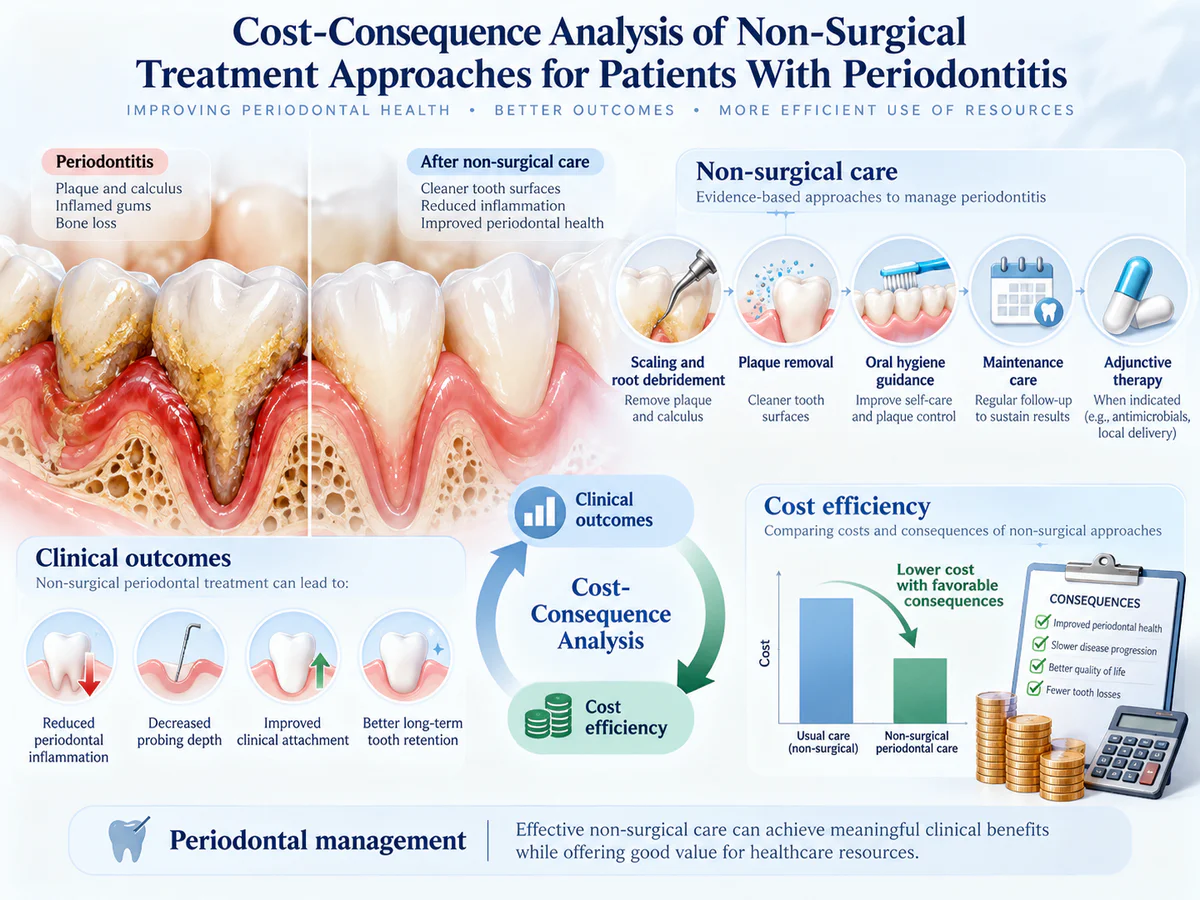
Periodontitis is a highly prevalent chronic inflammatory disease affecting the supporting structures of the teeth and is a major cause of tooth loss worldwide. Non-surgical periodontal therapy is the first-line treatment for managing periodontitis, aiming to control the subgingival biofilm and reduce periodontal inflammation. Conventional non-surgical therapy (CNST) often involves multiple treatment sessions focused on scaling and root planing at different sites over time. Alternatively, a ‘‘full-mouth’’ approach known as guided periodontal infection control (GPIC) emphasizes patient education initially, followed by intensive ultrasonic instrumentation in a single session to disrupt bacterial biofilm comprehensively.
Despite established evidence supporting these approaches, there remains a need to evaluate their relative cost implications in real-world general dental practice settings. Such economic assessments enable better resource allocation, especially when dental hygienists deliver care, contributing to health system sustainability and optimizing patient outcomes.
Study Design
This cost consequence analysis was embedded in a study involving 615 patients diagnosed with periodontitis in general dental practice. Two evidence-based non-surgical treatment protocols were compared, both performed by dental hygienists:
1. Conventional non-surgical therapy (CNST): Typically delivered over multiple sessions, focusing on sequential quadrant-wise scaling and root planing.
2. Guided periodontal infection control (GPIC): A ‘‘full-mouth’’ approach prioritizing patient education followed by a single session of ultrasonic instrumentation addressing all periodontal pockets.
Cost components analyzed included:
– Direct treatment costs,
– Patients’ travel costs,
– Productivity losses related to treatment sessions.
Clinical outcomes assessed as non-monetary consequences were reduction in periodontal pocket depth (closed pockets) and bleeding on probing at six months post-treatment. Data analysis utilized bootstrap methods (5000 replications) to obtain reliable 95% confidence intervals.
Key Findings
The analysis revealed that the GPIC approach incurred significantly lower treatment costs compared to CNST, with a mean cost difference of approximately €60 (€299.4 [95% CI: 289.3-309.1] for GPIC vs. €359.5 [95% CI: 345.5-374.2] for CNST). Productivity costs, reflecting patients’ time off work or other commitments due to treatment, were higher by about €15 in the CNST group owing to multiple appointments. Travel costs contributed minimally to the total differences, with only a marginal €1 increase for CNST.
Crucially, neither clinical outcome—measured by the number of closed periodontal pockets nor bleeding on probing—showed statistically significant differences between the two groups at six months. This suggests that GPIC delivers equivalent periodontal health benefits as CNST, despite requiring fewer sessions and incurring lower overall costs.
These findings highlight the economic advantage of incorporating patient education alongside a streamlined treatment session structure, reflecting efficient use of shared healthcare resources without compromising clinical effectiveness.
Expert Commentary
Non-surgical periodontal therapy efficacy largely depends on meticulous biofilm disruption and patient adherence to oral hygiene measures. The GPIC protocol’s emphasis on patient education aligns with best practices, empowering patients to maintain periodontal stability alongside professional intervention. From a health economics perspective, minimizing treatment sessions concomitantly reduces indirect costs such as productivity losses, potentially improving patient compliance and satisfaction.
Limitations of the study include a relatively short follow-up period of six months, which may not capture long-term cost-effectiveness or disease recurrence. Additionally, this study was performed in a general practice setting with dental hygienists as the primary operators; hence, findings may not extrapolate directly to specialist periodontal care or different healthcare systems with varying cost structures.
Future research should evaluate longer-term outcomes beyond six months and incorporate patient-reported quality-of-life measures to comprehensively assess value-based periodontal care.
Conclusion
This cost consequence analysis demonstrates that guided periodontal infection control (GPIC), emphasizing patient education and a single session of ultrasonic instrumentation, is a more cost-efficient non-surgical treatment approach for periodontitis compared to conventional non-surgical therapy (CNST) performed over multiple sessions. Both methods yield comparable short-term clinical outcomes, supporting the integration of GPIC in general dental practice to optimize resource utilization without sacrificing efficacy.
Healthcare policymakers and practitioners should consider these findings when developing periodontal therapy guidelines, highlighting the importance of evidence-based practice balanced against economic stewardship in managing a prevalent chronic oral disease.
Funding and ClinicalTrials.gov
The original publication does not specify funding sources or clinical trial registration numbers related to this analysis.
References
1. Liss A, Petzold M, Tomasi C, Abrahamsson KH, Welander M. Cost Consequence Analysis of Non-Surgical Treatment Approaches for Patients With Periodontitis. J Clin Periodontol. 2026 Jun 19;53(10):1557-1564. PMID: 42321138.
2. Tonetti MS, Jepsen S, Jin L, Otomo-Corgel J. Impact of the global burden of periodontal diseases on health, nutrition, and wellbeing of mankind: A call for global action. J Clin Periodontol. 2017 May;44(5):456-462.
3. Sanz M, Herrera D, Kebschull M, et al. Treatment of stage I-III periodontitis – The EFP S3 level clinical practice guideline. J Clin Periodontol. 2020 Apr;47 Suppl 22:4-60.
4. Needleman I, McGrath C, Floyd P, Bessant R. Impact of oral health on the life quality of periodontal patients. J Clin Periodontol. 2004 Sep;31(9):454-457.