Highlight
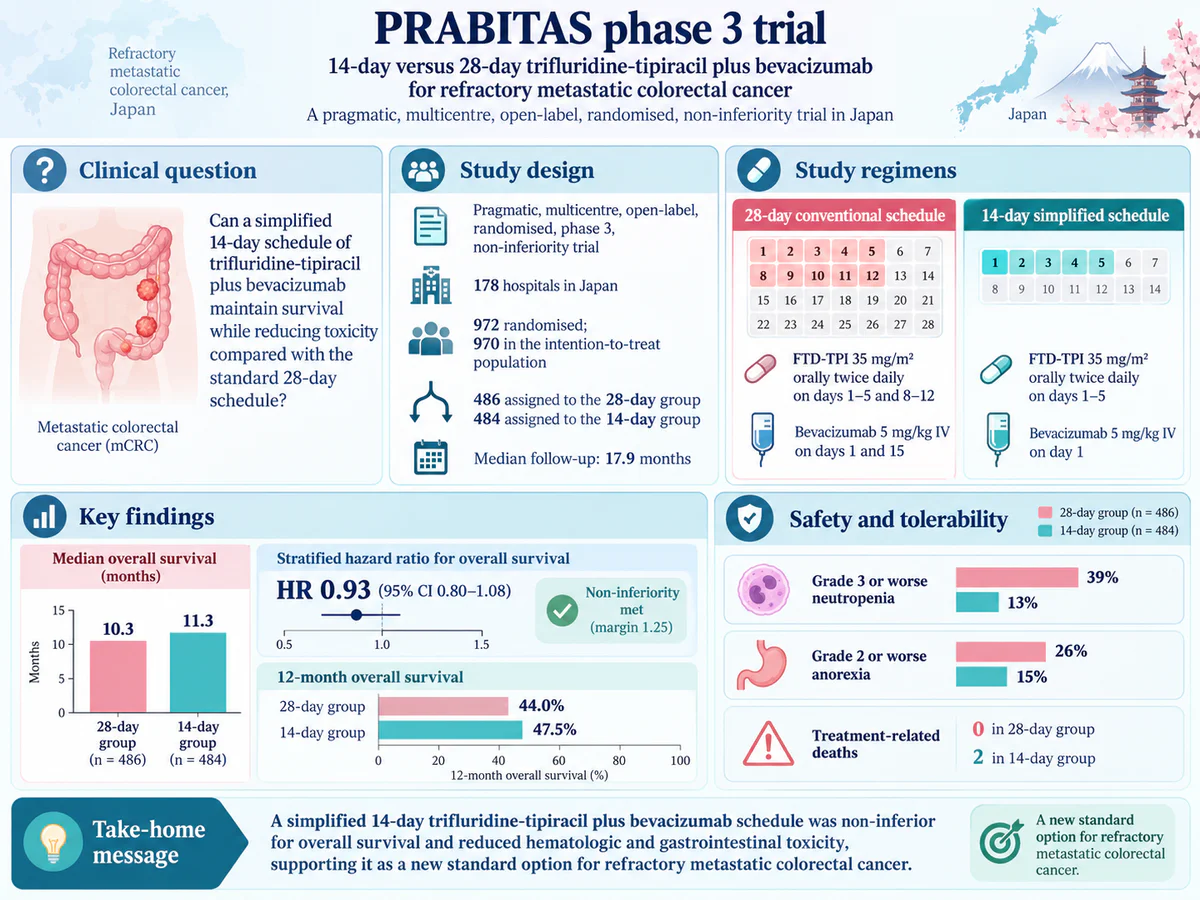
- The PRABITAS trial established non-inferiority of a 14-day trifluridine-tipiracil (FTD-TPI) plus bevacizumab regimen compared to the conventional 28-day schedule in refractory metastatic colorectal cancer (mCRC).
- The simplified 14-day schedule significantly reduced grade 3 or higher neutropenia and anorexia, addressing tolerability concerns associated with the conventional regimen.
- Overall survival outcomes were comparable between the two schedules, with median survival of 11.3 months (14-day) versus 10.3 months (28-day), and overlapping confidence intervals.
- These results support the 14-day dosing schema as a new standard of care, improving patient quality of life without compromising efficacy.
Study Background
Metastatic colorectal cancer remains a leading cause of cancer morbidity and mortality worldwide. Despite advances in systemic therapies, prognosis for patients with refractory disease—resistant to standard treatments—is poor, with limited options that balance efficacy and tolerability. Trifluridine-tipiracil (FTD-TPI) has emerged as a valuable oral fluoropyrimidine-derived agent for refractory mCRC, often administered in combination with bevacizumab, an anti-angiogenic monoclonal antibody targeting the vascular endothelial growth factor (VEGF) pathway. This combination has demonstrated clinically meaningful survival gains compared to monotherapy.
However, the conventional 28-day dosing schedule of FTD-TPI (administered days 1-5 and 8-12) in combination with biweekly bevacizumab is associated with a considerable incidence of hematological toxicities, notably neutropenia, as well as gastrointestinal adverse events. These toxicities can impair quality of life, necessitate dose reductions or interruptions, and limit treatment adherence. A more patient-friendly, simplified 14-day schedule — delivering FTD-TPI on days 1-5 plus bevacizumab on day 1 only — was hypothesized to reduce toxicity burden without compromising the anti-tumor efficacy.
Prior to PRABITAS, no randomized controlled trial prospectively evaluated the non-inferiority of the 14-day schedule versus the 28-day standard in refractory mCRC. The PRABITAS trial was designed to fill this critical knowledge gap under pragmatic clinical conditions reflective of real-world patient populations.
Study Design
PRABITAS was a pragmatic, multicenter, open-label phase 3 randomized controlled trial conducted across 178 hospitals in Japan. Key inclusion criteria involved adult patients with refractory metastatic colorectal cancer previously treated with standard therapies. The design employed a minimization algorithm to randomly assign 972 patients in a 1:1 ratio stratified by Eastern Cooperative Oncology Group (ECOG) performance status, RAS mutation status, and treating institution.
Participants received oral FTD-TPI at a dose of 35 mg/m2 twice daily plus intravenous bevacizumab 5 mg/kg. Two regimens were compared:
- Conventional 28-day schedule: FTD-TPI on days 1-5 and 8-12; bevacizumab on days 1 and 15.
- Simplified 14-day schedule: FTD-TPI on days 1-5; bevacizumab on day 1 only.
The primary endpoint was overall survival (OS) analyzed on an intention-to-treat basis with a pre-specified non-inferiority hazard ratio margin of 1.25. Safety assessments included all patients receiving at least one dose, focusing on hematological and gastrointestinal adverse events. Trial procedures aligned closely with routine clinical practice, and eligibility was intentionally broader than in conventional explanatory trials to enhance generalizability.
Key Findings
Between December 26, 2023 and May 20, 2025, 972 patients were randomized; 970 were included in the primary analysis (486 in the 28-day schedule, 484 in the 14-day schedule). Median follow-up was 17.9 months.
Primary outcome analysis demonstrated that the 14-day schedule was non-inferior to the 28-day schedule with respect to OS:
- Median OS was 11.3 months (95% CI 10.2-12.5) for the 14-day group vs. 10.3 months (95% CI 9.5-11.6) for the 28-day group.
- The stratified hazard ratio for death was 0.93 (95% CI 0.80-1.08), falling well within the non-inferiority margin of 1.25.
- 12-month OS rates were 47.5% (14-day) and 44.0% (28-day).
Regarding safety, the 14-day schedule significantly reduced relevant toxicities:
- Grade 3 or worse neutropenia occurred in 13% of patients on the 14-day schedule versus 39% on the 28-day schedule, an absolute reduction of 25 percentage points (95% CI 20-31).
- Grade 2 or worse anorexia was less frequent with the 14-day regimen (15% vs. 26%; absolute difference 11 percentage points, 95% CI 6-16).
- Notably, two treatment-related deaths occurred in the 14-day group and none in the 28-day group, a safety signal warranting further vigilance despite the overall toxicity reduction.
The findings indicate that reducing the exposure intensity by omitting the second dosing week of FTD-TPI and halving bevacizumab frequency maintains efficacy while substantially improving tolerability.
Expert Commentary
The PRABITAS trial addresses a clinically meaningful question by utilizing a pragmatic design with broad inclusion criteria that enhance its applicability to routine practice. The comparable OS outcomes with the 14-day schedule challenge the previous assumption that maximal dosing intensity necessarily confers superior survival benefit in refractory mCRC.
Hematological toxicities, especially neutropenia, are a common limitation of FTD-TPI therapy, often necessitating dose modifications or treatment interruption, potentially impacting disease control. The significant reduction in grade ≥3 neutropenia with the simplified schedule can improve patients’ quality of life and reduce healthcare resource utilization related to managing cytopenias.
Despite the trial’s strengths, certain limitations should be considered. The open-label design introduces potential bias in adverse event reporting. Additionally, although the safety profile generally improved, the occurrence of two treatment-related deaths in the 14-day group highlights the need for careful patient monitoring.
Mechanistically, the reduced cumulative dose intensity in the simplified regimen appears sufficient to maintain anti-tumor activity when combined with bevacizumab-mediated angiogenesis inhibition. This synergy may mitigate the need for continuous dose-dense chemotherapy exposure.
These data align with recent trends toward personalized, toxicity-minimizing chemotherapy schedules in metastatic colorectal cancer treatment, reflecting an evolving balance between maximizing efficacy and optimizing quality of life.
Conclusion
The PRABITAS phase 3 trial conclusively demonstrates that a simplified 14-day schedule of FTD-TPI plus bevacizumab is non-inferior to the conventional 28-day schedule for overall survival in patients with refractory metastatic colorectal cancer. Importantly, this more convenient regimen significantly reduces hematologic and gastrointestinal toxicity, with implications for enhanced patient tolerability and adherence.
These findings support adoption of the 14-day schedule as the new standard of care, facilitating an improved therapeutic index without compromising clinical outcomes. Future studies might explore further refinements in dosing strategies, predictive biomarkers for toxicity or response, and quality-of-life impacts to optimize individualized treatment approaches in this difficult-to-treat population.
Funding and Trial Registration
The PRABITAS trial was funded by the Japan Society for the Promotion of Science KAKENHI Grant-in-Aid for Challenging Research (Pioneering). It is registered with the Japan Registry of Clinical Trials under the identifier jRCTs041230120.
References
- Sakakida T, Taniguchi H, et al. 14-day versus 28-day trifluridine-tipiracil plus bevacizumab for refractory metastatic colorectal cancer (PRABITAS): a pragmatic, multicentre, open-label, randomised, phase 3, non-inferiority trial in Japan. Lancet. 2026 Oct 24; PMID: 42925880.
- Van Cutsem E, et al. Advances in Treatment of Metastatic Colorectal Cancer. Lancet Oncol. 2016;17(10):e383-96.
- Yoshino T, et al. Japanese Clinical Practice Guidelines for the Management of Colorectal Cancer. Int J Clin Oncol. 2020;25(1):1-42.