Highlight
- Postoperative sialocele occurs in over 10% of parotidectomy patients, often requiring additional interventions.
- Intraoperative botulinum toxin A injection was associated with approximately half the odds of developing sialocele in this retrospective study.
- Although the primary analysis narrowly missed statistical significance, sensitivity and propensity-score analyses support a protective effect.
- Prospective studies are necessary to establish definitive efficacy, optimal patient selection, and cost-effectiveness.
Study Background
Parotidectomy, the surgical removal of part or all of the parotid gland, is a common treatment for benign and malignant parotid tumors. A frequent postoperative complication is sialocele formation—an accumulation of saliva in the soft tissues due to salivary duct leakage or glandular disruption. Sialoceles can cause discomfort, facial swelling, delayed wound healing, and may necessitate repeated clinic visits, aspiration, or additional interventions.
The standard management of sialocele ranges from conservative observation and aspiration to surgical repair. Preventative strategies are limited, and reducing sialocele incidence remains an unmet clinical need to improve postoperative recovery.
Botulinum toxin A, a neurotoxin that inhibits acetylcholine release and thereby suppresses glandular secretion, has emerged as a potential prophylactic agent during parotidectomy. By inhibiting residual salivary flow intraoperatively, botulinum toxin may reduce salivary leakage and consequent sialocele formation. However, evidence supporting this approach is limited.
Study Design
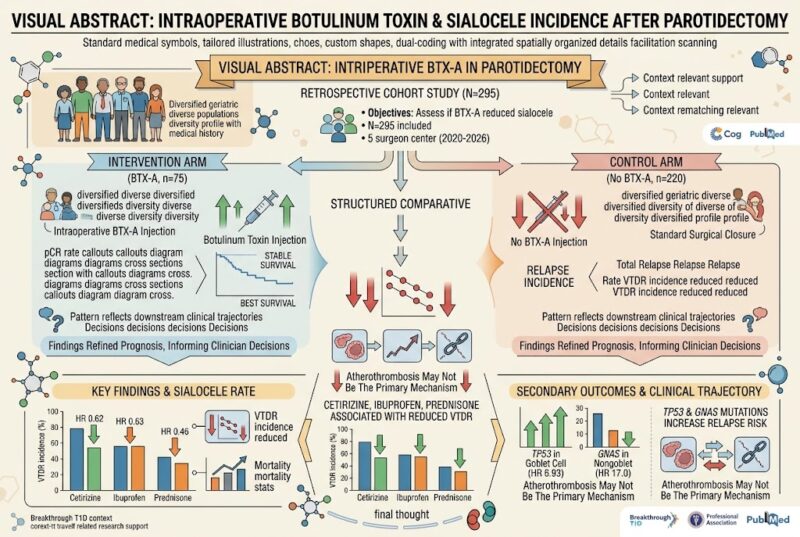
This study is a retrospective cohort analysis including 295 patients who underwent parotidectomy between January 2020 and February 2026 at multiple centers by five surgeons. Patients were divided based on whether they received intraoperative botulinum toxin A injection into the parotid gland at the time of surgery.
The primary outcome was postoperative sialocele incidence, identified during a follow-up period with ascertainment sensitivity analyses restricting to patients with available 30-day postoperative data. Multivariable logistic regression with cluster-robust variance estimation was used to assess the association between intraoperative botulinum toxin and sialocele formation, accounting for clustering by surgeon and patient covariates. Propensity-score weighting further adjusted for nonrandomized treatment allocation.
Key Findings
Of 295 patients, 32 (10.8%) developed postoperative sialocele. The sialocele incidence was higher in patients without botulinum toxin injection (12.3%, 27/220) versus those who received it (6.7%, 5/75).
The primary multivariable logistic analysis showed an adjusted odds ratio (OR) of 0.43 (95% confidence interval [CI]: 0.188–1.005; p = 0.050), indicating a 57% lower odds of sialocele with botulinum toxin, though the CI narrowly included the null.
Propensity-score overlap weighting analysis yielded a similar but nonsignificant association (OR 0.43, 95% CI 0.14–1.38; p = 0.155), attenuated by wider confidence intervals.
In a sensitivity analysis restricted to patients with confirmed 30-day postoperative outcome data, the protective association was stronger and statistically significant (adjusted OR 0.27, 95% CI 0.07–1.00; p = 0.049), suggesting robustness of the finding in patients with complete follow-up.
These findings collectively suggest that intraoperative botulinum toxin injection may reduce sialocele risk approximately by half, though the borderline statistical significance and retrospective design limit definitive conclusions.
Expert Commentary
Postoperative sialocele remains a challenging complication after parotidectomy, with significant morbidity and healthcare utilization. The biological plausibility for botulinum toxin’s efficacy is well-supported given its ability to temporarily inhibit acetylcholine-mediated salivary secretion.
However, the evidence base primarily includes small retrospective series with heterogeneous protocols, and this study, while larger, is similarly limited by its observational design and potential confounding, despite statistical adjustments.
Expert opinion currently supports considering botulinum toxin injection in selected patients at higher risk for sialocele, such as those undergoing extensive gland dissection or with prior radiation. Yet, prospective randomized controlled trials are needed to clarify optimal dosing, timing, cost-effectiveness, and long-term safety.
Potential barriers include additional operative time, drug cost, and need for surgeon training in safe botulinum toxin administration. Future investigations might also evaluate patient-reported outcomes and quality-of-life metrics related to sialocele prevention.
Conclusion
This retrospective cohort study provides encouraging but preliminary evidence that intraoperative botulinum toxin injection may decrease the incidence of postoperative sialocele following parotidectomy. The magnitude of risk reduction could translate into meaningful clinical benefits by reducing postoperative complications and healthcare visits.
Nevertheless, given the borderline statistical significance and inherent limitations of retrospective analyses, a prospective, ideally randomized, study is warranted to definitively establish efficacy, refine patient selection criteria, determine dosing protocols, and evaluate cost-effectiveness before routine clinical adoption.
Surgeons managing parotidectomies should weigh current evidence while individualizing preventive strategies, and remain informed about emerging clinical trial data to optimize patient outcomes.
Funding and Clinical Trials
The publication does not detail funding sources or clinical trial registration related to this study. Prospective confirmatory trials should be registered to ensure transparency and methodological rigor.
References
- Kons ZA, Jagarlamudi R, Noyes EA, et al. Intraoperative Botulinum Toxin and Sialocele Incidence After Parotidectomy. The Laryngoscope. 2026 Sep 12. PMID: 42730480.
- Scully C, Smith JH. Sialocele as a complication of parotidectomy: Alternative treatment with botulinum toxin A. Br J Oral Maxillofac Surg. 2003;41(5):376-378.
- Kassir S, Robin G, Garrel R. Botulinum toxin A for the prevention of salivary fistula and sialocele after parotidectomy: a systematic review and meta-analysis. Eur Arch Otorhinolaryngol. 2020;277(11):2897-2903.
- Laccourreye O, Moukouche Y, Gensollen B, et al. Botulinum toxin in head and neck surgery: An overview of current uses. Eur Ann Otorhinolaryngol Head Neck Dis. 2021;138(5):399-406.