Highlight
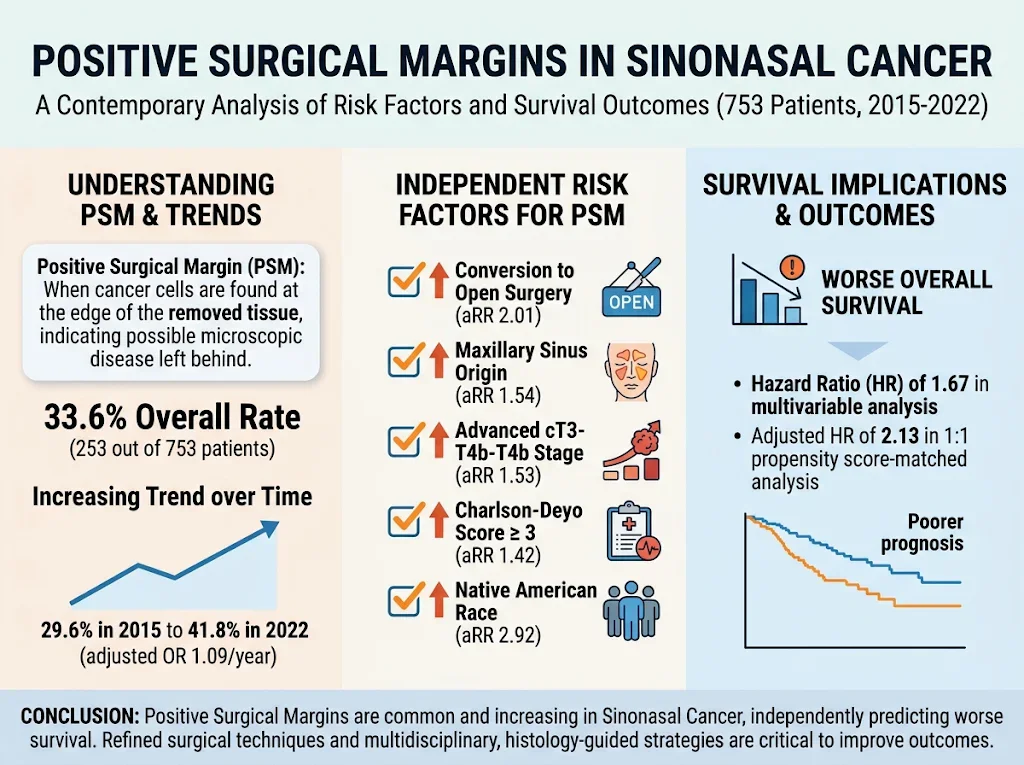
- Positive surgical margins (PSM) in sinonasal cancer (SNC) have significantly increased from 29.6% in 2015 to 41.8% in 2022.
- Advanced tumor stage (cT3-T4b), maxillary sinus origin, higher comorbidity burden, conversion to open surgery, and Native American race are independent risk factors for PSM.
- PSMs independently predict worse overall survival, with a hazard ratio exceeding 1.6 in multivariable analyses and 2.1 in propensity score matching.
- These findings underscore a need for improved surgical techniques and tailored multidisciplinary treatment strategies to enhance oncologic outcomes in SNC.
Study Background
Sinonasal cancers (SNCs) are rare but clinically aggressive malignancies arising in the complex anatomy of the nasal cavity and paranasal sinuses. Surgical resection remains a cornerstone of curative treatment, often embedded within multimodal strategies including radiation and chemotherapy. Achieving negative surgical margins is critical for local control and survival; however, the intricate sinonasal anatomical structures and proximity to critical neurovascular elements pose challenges to complete tumor excision.
Despite their rarity, SNCs carry high morbidity and mortality rates, especially when surgical margins are positive, indicating residual microscopic or gross tumor presence post-resection. Contemporary national-level data on the incidence of positive surgical margins, their risk factors, and prognostic impact within modern clinical practice are scarce. This knowledge gap hinders optimization of treatment strategies and patient counseling.
Study Design
This retrospective cohort study analyzed data from the National Cancer Database between 2015 and 2022, comprising adults diagnosed with clinically staged T1 to T4b N0 M0 sinonasal cancers who underwent definitive surgical resection. Exclusion criteria included unknown tumor size, prior malignancies, or missing surgical margin status to ensure data completeness and validity.
Surgical margin status was the primary exposure variable, classified as positive or negative. Temporal trends were evaluated using the nonparametric Cuzick test and logistic regression models. Predictors of PSM were identified via generalized linear regression models reporting adjusted relative risks (aRR) and 95% confidence intervals (CIs).
Overall survival (OS) served as the primary endpoint, analyzed using Kaplan-Meier curves, multivariable Cox proportional hazards models adjusted for relevant confounders, and propensity score-matched analyses to balance baseline characteristics and mitigate selection bias.
Key Findings
The final cohort included 753 patients with a mean age of 63.4 years and a predominance of males (66.8%). Positive surgical margins occurred in 33.6% (n=253) of cases and demonstrated a statistically significant increase over time, rising from 29.6% in 2015 to 41.8% in 2022 (adjusted odds ratio [OR] of 1.09 per year; 95% CI: 1.02-1.17; P < 0.05).
Multivariable analyses identified multiple independent predictors of PSM: higher tumor stage (cT3-T4b) increased risk by 53% (aRR 1.53; 95% CI: 1.09-2.13), maxillary sinus tumor origin by 54% (aRR 1.54; 95% CI: 1.22-1.96), Charlson-Deyo comorbidity score ≥3 by 42% (aRR 1.42; 95% CI: 1.01-1.99), conversion from endoscopic to open surgical approach doubled the risk (aRR 2.01; 95% CI: 1.14-3.55), and Native American race showed a nearly threefold increased risk (aRR 2.92; 95% CI: 1.65-5.18).
Crucially, PSM was independently associated with worsened overall survival. Adjusted multivariable Cox proportional hazards models showed a hazard ratio (HR) of 1.67 (95% CI: 1.27-2.19), indicating a 67% increase in mortality risk. Propensity score-matched analyses, which mitigated confounding, revealed an even higher adjusted HR of 2.13 (95% CI: 1.39-3.26), confirming the prognostic significance of PSM in sinonasal cancer.
Expert Commentary
The observed rising trend in positive surgical margins despite advances in surgical techniques is concerning and likely multifactorial. The complex anatomy of the sinonasal region, coupled with delayed diagnosis of advanced-stage tumors, may contribute to technical challenges in achieving clear margins. Conversion to open surgery, often a marker for more extensive or aggressive disease, further reflects the difficulty in achieving adequate resection via minimally invasive approaches.
The identification of Native American race as a significant risk factor raises concerns about possible disparities in healthcare access, tumor biology, or treatment delivery that warrant further investigation to ensure equity in care.
From a clinical perspective, the findings reinforce stringent preoperative planning incorporating advanced imaging and intraoperative navigation to optimize resection margins. Multidisciplinary approaches involving head and neck surgeons, radiation oncologists, and medical oncologists are essential to tailor adjuvant therapies based on histopathological risk features including margin status.
Limitations inherent to retrospective database analyses include potential coding errors, missing data, and inability to evaluate margin width or molecular tumor characteristics. Nevertheless, the large national cohort provides robust real-world insights into current practice patterns and outcomes.
Conclusion
Positive surgical margins are a prevalent and increasing challenge in the surgical management of sinonasal cancer, significantly impacting patient survival. High tumor stage, maxillary sinus origin, comorbidities, surgical approach changes, and racial disparities influence margin status. These findings highlight a critical need to refine surgical techniques, enhance intraoperative assessment, and implement histology-guided, multidisciplinary treatment strategies to improve oncologic outcomes. Future prospective studies should explore precision surgical and adjunctive therapies to reduce positive margins and enhance survival in this aggressive malignancy.
Funding and ClinicalTrials.gov
The original study’s funding source was not reported in the referenced abstract. There was no mention of clinical trial registration numbers associated with this analysis.
References
1. Fu BJ, Moon P, Lee JJ, Ayoub NF. Positive Surgical Margins in Sinonasal Cancer: A Contemporary Analysis of Risk Factors and Survival. The Laryngoscope. 2026 Nov 16. PMID: 43040619.
2. Takes RP, Strojan P, Silver CE, et al. Current trends in the management of sinonasal malignancies. Adv Ther. 2018;35(9):1250-1261. doi:10.1007/s12325-018-0750-0
3. Dulguerov P, Jacobsen MS, Allal AS, Lehmann W, Calcaterra TC. Nasal mucosal melanoma: a population-based study. Cancer. 2001;92(7):1673-1682. doi:10.1002/1097-0142(20011001)92:7<1673::aid-cncr1353>3.0.co;2-z
4. Hanna EY, DeMonte F. Skull base and sinonasal malignancies: challenges in surgery and radiation therapy. Cancer J. 2009;15(6):439-444. doi:10.1097/PPO.0b013e3181bdc1ec
5. Douglas CM, Ferris RL. Surgery and radiotherapy for sinonasal carcinomas: a review of recent advances. Curr Opin Oncol. 2017;29(3):168-174. doi:10.1097/CCO.0000000000000343
Specialty calculators
For clinical reference; use professional judgment.