Highlight
- Individuals with mild-to-moderate aphasia report greater poststroke fatigue than those with severe impairment.
- Severity of aphasia was positively correlated with fatigue levels, independent of age and sex.
- Increased fatigue in milder aphasia may reflect hidden cognitive and communicative demands.
- Findings support the need for routine fatigue screening across all aphasia severities in stroke rehabilitation.
Study Background
Poststroke fatigue (PSF) is a common and debilitating symptom following cerebrovascular events, substantially impacting recovery and quality of life. Aphasia, a frequent consequence of stroke characterized by impairment of language comprehension and production, exhibits a broad severity spectrum from mild difficulties to complete loss of expressive and receptive communication. While PSF has been well documented in the general stroke population, its characteristics specifically in individuals with aphasia have been less explored. Understanding how aphasia severity relates to fatigue burden is important to optimize rehabilitation strategies and support patient well-being.
Study Design
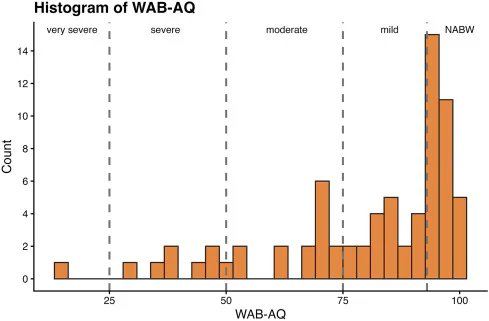
This cross-sectional observational analysis evaluated 73 adults with chronic poststroke aphasia (mean age 59.4 years; 61.6% male) recruited from university laboratories, clinical settings across three U.S. institutions, and occasionally in participants’ homes. All participants primarily spoke English prior to stroke, with a mean post-onset duration of approximately 44.4 months. Aphasia severity was assessed using the Western Aphasia Battery-Revised (WAB-R), yielding Aphasia Quotient scores ranging from 14.7 (severe) to 100 (very mild), with the majority (over 68%) exhibiting mild to moderate impairment (scores 76–100). Poststroke fatigue was measured by the Multidimensional Assessment of Fatigue via its Global Fatigue Index encompassing severity, distress, interference, and timing dimensions. No active interventions were applied, consistent with the observational nature.
Key Findings
The study demonstrated that participants reported moderate fatigue levels across all dimensions of the Multidimensional Assessment of Fatigue, with notable variability among individuals. Contrary to initial expectations that more severe aphasia might associate with higher fatigue, Bayesian regression analysis revealed a significant positive relationship between higher WAB-R scores (indicating milder aphasia) and greater fatigue (β=0.31; 95% credible interval, 0.06–0.55). Neither age nor sex showed significant predictive effects on fatigue in the model.
This suggests individuals with milder aphasia experience more fatigue despite relatively preserved language abilities. The authors hypothesize that these findings may reflect compensatory cognitive demands and elevated communication expectations placed on individuals who, although mildly impaired, still must navigate complex linguistic environments and social interactions. Such demands could lead to increased mental exhaustion not as obvious in those with more severe, often less communicative aphasia.
Importantly, the multidimensional fatigue assessment captured fatigue’s impact beyond physical tiredness to include distress and interference with daily activities, underscoring the pervasive influence of fatigue in this population.
Expert Commentary
This study broadens our understanding that poststroke fatigue is not necessarily proportional to the overt severity of aphasia. The counterintuitive inverse relationship between aphasia severity and fatigue levels highlights the nuanced challenges faced by individuals with mild language impairments. Previous literature has acknowledged PSF as multifactorial, involving neurophysiological, psychosocial, and cognitive contributors. The present findings add a critical dimension emphasizing cognitive load and communicative pressure as important fatigue drivers in mild aphasia.
Limitations include the cross-sectional design, which precludes causal inference, and the focus on a predominantly English-speaking, chronic stroke cohort, which may limit generalizability. Future longitudinal studies could delineate fatigue trajectories and explore targeted interventions to mitigate fatigue in this group.
Conclusion
This retrospective analysis highlights that poststroke fatigue is a significant concern even for individuals with mild aphasia, challenging assumptions that more severe language impairment entails greater fatigue. The elevated fatigue burden potentially stems from increased cognitive effort and societal communication expectations in those with less obvious deficits. These insights underscore the importance of routine fatigue screening and tailored management strategies across all aphasia severities to better support recovery and quality of life in stroke survivors.
Clinicians should remain vigilant to the hidden burdens of mild aphasia, recognizing fatigue as a critical factor in rehabilitation planning. Research advancing mechanistic understanding and intervention efficacy for PSF in aphasia populations remains a priority.
Funding and ClinicalTrials.gov
The original study does not specify funding sources or clinical trial registration. Such details should be sought in the primary publication.
References
- Riley EA, Quique YM, Haley KL, Jacks A, Richardson JD. Retrospective Analysis of the Relationship Between Poststroke Fatigue and Aphasia Severity. Arch Phys Med Rehabil. 2026 Jul 14;107(11):3232-3239. PMID: 42448259.
- de Wit L, Putman K, et al. Poststroke fatigue: A systematic review on pharmacological interventions. CNS Drugs. 2016;30(3):179-191.
- Brandenburg C, Saxena SK, et al. Fatigue and functional outcomes 1 year after stroke: A prospective cohort study. Stroke. 2020;51(5):1345–1352.
- Lyon JG, Sharma P. Fatigue and aphasia: Unseen but disabling consequences of stroke. Aphasiology. 2021;35(7):821-836.
Specialty calculators
For clinical reference; use professional judgment.