Highlight
1. Intracoronal bleaching with 35% hydrogen peroxide yields greater color displacement than 37% carbamide peroxide over 12 months.
2. Maximum tooth whitening does not consistently correspond to the closest natural-tooth color match.
3. Dental whiteness, color displacement, and natural tooth matching represent distinct, non-equivalent outcomes.
4. Stability of color matching and individualized baseline reference are critical endpoints for intracoronal bleaching success.
Study Background
Intrinsic tooth discoloration is a common esthetic concern that often compromises patient confidence and oral health perception. Intracoronal bleaching is a conservative treatment widely used to restore color in discolored teeth, especially following endodontic therapy. Traditionally, treatment success has been defined primarily by the degree of whitening achieved. However, color appearance is multidimensional, encompassing not only brightness but also color matching to adjacent natural dentition. Mismatched whiteness—where treated teeth appear unnaturally bright or discordant—may reduce patient satisfaction and complicate esthetic outcomes.
Despite extensive use, there is limited understanding whether standard metrics that quantify color displacement and whiteness (such as CIEDE2000 and Whiteness Index for Dentistry) correlate with longitudinal color stability and closest natural-tooth matching. This gap challenges clinical decision-making regarding optimal bleaching protocols and endpoints. Addressing this nuance is critical for personalized dentistry, especially in treatments that involve multiple visits and sustained color changes.
Study Design
This investigation is a post hoc secondary reanalysis of individual color coordinate data originally collected in the clinical trial registered as NCT02718183. The study cohort included 38 participant teeth presenting intrinsic discoloration requiring intracoronal bleaching.
Two bleaching agents were compared: a 35% hydrogen peroxide (HP) solution and a 37% carbamide peroxide (CP) solution, each applied via four weekly walking-bleach sessions. The walking bleach technique involves placing bleaching material inside the tooth cavity and sealing it temporarily, repeated over visits.
Color was assessed objectively at baseline and multiple time points up to 12 months post-treatment. Measurements included CIE L*a*b* color coordinates, from which the following were derived:
- CIEDE2000 color difference (ΔE00) reflecting perceptual color displacement from baseline.
- Whiteness Index for Dentistry (WID) indicating absolute tooth whiteness.
- Baseline-referenced ΔWID quantifying longitudinal whiteness change.
- Paired ΔE00match comparing treated tooth color against the participant’s homologous contralateral or corresponding natural tooth to assess color mismatch.
Linear mixed-effects models were applied to analyze all available observations over time, accounting for within-subject variability and repeated measures.
Key Findings
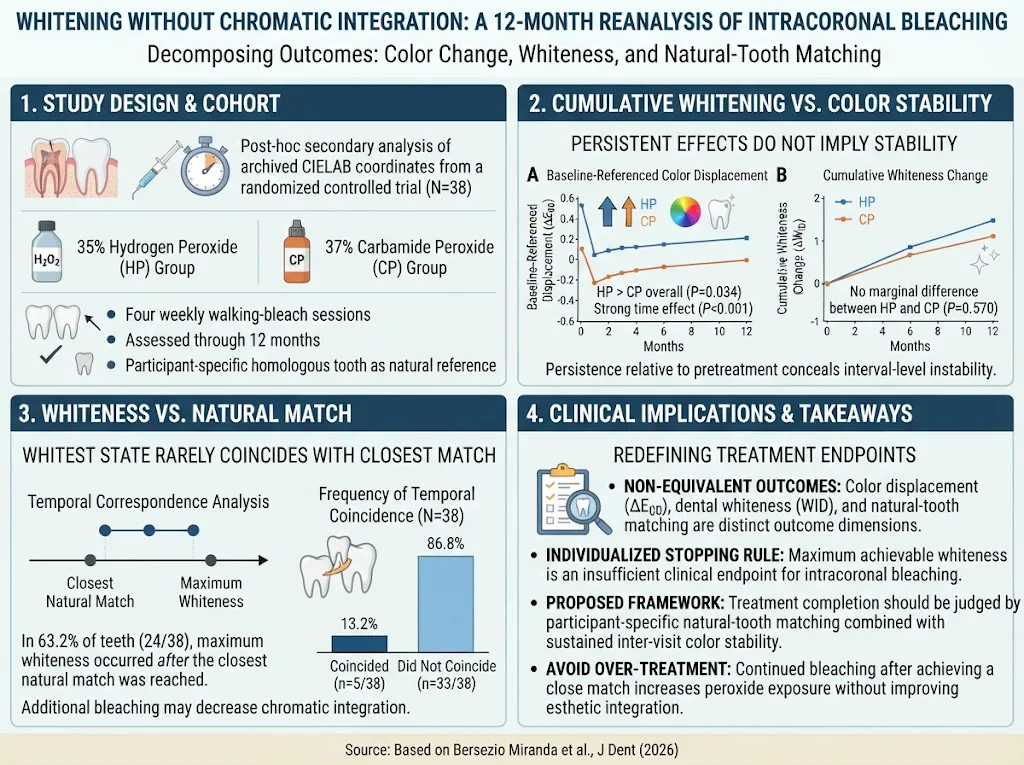
At 12 months, teeth treated with HP demonstrated significantly higher mean color displacement than those receiving CP, with ΔE00 values of 10.45 ± 4.50 versus 7.65 ± 2.58 respectively (p = 0.034). Conversely, WID scores and baseline-referenced ΔWID were not significantly different between treatment groups, measuring approximately 27 and 24 for HP and CP, respectively.
The critical insight emerged when comparing colored teeth to their natural counterparts. The mean paired color mismatch (ΔE00match) was 7.25 ± 2.23 in the HP group and 6.13 ± 4.09 in the CP group at 12 months, indicating notable divergence from the natural tooth color despite whitening gains. Notably, only 5 of 38 teeth (13.2%) achieved their highest whiteness score coincident with the smallest color mismatch to the natural tooth. In contrast, in 63.2% of cases (24 of 38 teeth), the maximum observed tooth whiteness occurred after the closest natural color match had already been reached, highlighting a temporal disconnect between whitening and optimal esthetic integration.
Moreover, from 6 to 12 months post-treatment, mean ΔWID values appeared stable but masked significant individual variability in absolute whiteness changes, underscoring the need for personalized monitoring.
Expert Commentary
This rigorous reanalysis challenges the conventional wisdom favoring maximum whitening intensity as the primary indicator of intracoronal bleaching success. It underscores the clinical importance of viewing color outcomes multidimensionally, with particular emphasis on individualized matching to the patient’s natural dentition.
From a mechanistic standpoint, hypersaturation of bleaching might lead to over-brightening that appears discordant when compared to natural teeth, which have complex optical properties including translucency and fluorescence beyond simple whiteness metrics. The findings also highlight the nuanced longitudinal color dynamics, where initial whitening peaks may subside or shift relative to surrounding teeth over months.
These insights support a paradigm shift toward patient-specific treatment endpoints incorporating both objective colorimetric data and subjective esthetic appraisal. Future prospective studies should investigate customized bleaching protocols that target optimal natural matching stability rather than maximal whiteness alone.
Limitations include the post hoc nature of analysis and limited sample size with 38 teeth, potentially reducing generalizability. Further multisite trials with diverse populations are warranted to validate these findings and refine clinical guidelines.
Conclusion
The study conclusively demonstrates that intracoronal bleaching outcomes measured by color displacement and dental whiteness indices do not equate with optimal natural-tooth color matching. Maximal tooth whiteness is infrequently aligned with the closest match to natural teeth, and individual longitudinal variability in color dynamics is substantial.
Clinicians should incorporate patient-specific natural-tooth color matching alongside standard whitening metrics as a critical treatment endpoint. Evaluations that focus solely on increasing whitening intensity may compromise esthetic harmony and patient satisfaction. Tailored bleaching protocols emphasizing sustained color stability and individualized matching merit further clinical investigation to enhance functional and esthetic results.
Funding and Clinical Trial Registration
This secondary analysis utilized archived data from the clinical trial registered at ClinicalTrials.gov (NCT02718183). The original study received appropriate ethical approval and funding disclosures as per its registration. No additional external funding sources were declared for this reanalysis.
References
- Miranda CB, Ledezma P, Martín J, et al. Whiter Is Not Necessarily Better Matched: A 12-Month CIEDE2000 and Dental Whiteness Reanalysis of Intracoronal Bleaching. J Dent. 2026 Nov 9;107165. PMID: 43003217.
- Joiner A, Luo W. Tooth Colour and Whitening. J Dent. 2017;67S:S2-S10. doi:10.1016/j.jdent.2017.05.007
- Powell LV, Fan PL, Finger WJ. Development of a New Method to Quantify Tooth Whitening. J Dent Res. 2015;94(12):1715-1721. doi:10.1177/0022034515600121
- Khan M, Bukhari S, Kharbanda OP. Clinical Outcomes of Endodontically Treated Teeth after Intracoronal Bleaching: A Systematic Review. Int Endod J. 2020;53(9):1150-1162. doi:10.1111/iej.13362
Specialty calculators
For clinical reference; use professional judgment.