Highlight
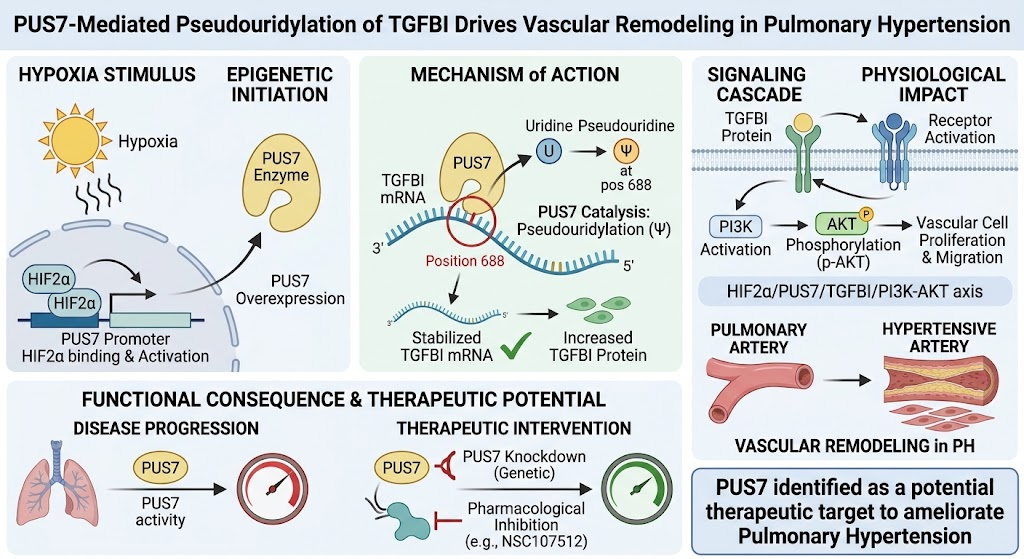
– Pseudouridylation, particularly mediated by pseudouridine synthase 7 (PUS7), is significantly dysregulated in pulmonary hypertension (PH) lung tissues.
– PUS7 catalyzes pseudouridine formation at position 688 of TGFBI mRNA, stabilizing this transcript and activating downstream PI3K-AKT signaling.
– A hypoxia-inducible factor 2α (HIF-2α) driven positive feedback loop involving PUS7 and TGFBI exacerbates vascular remodeling in PH.
– Genetic and pharmacological inhibition of PUS7 ameliorates PH pathology, highlighting PUS7 as a novel therapeutic target.
Study Background
Pulmonary hypertension (PH) is a progressive cardiovascular disorder characterized by elevated pulmonary arterial pressure and vascular remodeling, culminating in right heart failure and high mortality rates. Despite advances, the disease pathogenesis remains incompletely understood, and existing treatments are often insufficient to reverse pulmonary vascular remodeling, highlighting a pressing unmet need for novel therapeutic strategies.
Recently, epigenetic modifications such as RNA pseudouridylation— the enzymatic isomerization of uridine to pseudouridine (Ψ)— have emerged as critical regulatory mechanisms influencing gene expression post-transcriptionally. Pseudouridine synthase 7 (PUS7) is an enzyme catalyzing this modification and represents a conserved epigenetic regulator. However, its role in pulmonary hypertension was hitherto unexplored, representing a significant knowledge gap in the understanding of PH molecular pathology.
Study Design
This pioneering study investigated the landscape of RNA pseudouridylation in lung tissues from PH patients, applying bisulfite-induced deletion sequencing to achieve single-base resolution mapping of Ψ modifications. PUS7 expression and function were assessed in hypoxic pulmonary artery endothelial cells, human lung specimens, and the SU5416-hypoxia rodent model of PH.
The functional significance of PUS7 was elucidated via multiple approaches: gene knockdown and heterozygous knockout mice models, endothelial cell-specific gene silencing, adeno-associated virus serotype-mediated PUS7 overexpression, and pharmacological inhibition with the selective PUS7 inhibitor NSC107512. RNA immunoprecipitation sequencing combined with mutagenesis studies identified specific PUS7 RNA substrates and modification sites, while molecular signaling pathways were dissected to understand downstream effects.
Key Findings
Global Dysregulation of RNA Pseudouridylation in PH: The study revealed widespread alteration in pseudouridylation patterns in lung tissues from PH patients. Among the PUS family enzymes, PUS7 expression was markedly upregulated in PH-affected lung tissues and hypoxic pulmonary artery endothelial cells.
Functional Role of PUS7 in PH Progression: Genetic reduction of PUS7 expression, both via in vitro deficiency and endothelial-specific knockdown in mice, significantly attenuated pulmonary vascular remodeling and improved hemodynamic measures of PH. Pharmacological inhibition with NSC107512 recapitulated these protective effects. Conversely, overexpression of PUS7 exacerbated PH progression, confirming a causal role.
Mechanistic Insights — PUS7 Targets TGFBI mRNA: RNA immunoprecipitation sequencing identified transforming growth factor β-induced protein (TGFBI) mRNA as a direct target of PUS7. PUS7 catalyzed pseudouridylation at the uridine position 688 in TGFBI mRNA, which enhanced transcript stability. Elevated TGFBI protein levels activated the phosphatidylinositol 3-kinase-protein kinase B (PI3K-AKT) signaling pathway, driving vascular endothelial cell proliferation and remodeling.
Hypoxia-Inducible Factor 2α Feedback Loop: The transcription factor hypoxia-inducible factor 2α (HIF-2α), known to mediate hypoxic responses in PH, directly bound to the PUS7 promoter region, enhancing its transcription. This established a positive feedback loop whereby hypoxia elevated PUS7 expression, which, through TGFBI pseudouridylation and PI3K-AKT pathway activation, potentiated vascular remodeling and disease progression.
Expert Commentary
This study provides compelling evidence positioning RNA pseudouridylation, mediated by PUS7, as an epigenetic driver in PH pathogenesis. The identification of TGFBI mRNA as a critical PUS7 substrate elucidates a novel post-transcriptional regulatory axis influencing vascular remodeling — a hallmark of PH. Moreover, the elucidation of a HIF-2α/PUS7/TGFBI/PI3K-AKT pathway underscores the intricate interplay between hypoxic signaling and epigenetic modification in PH progression.
These insights bridge a significant gap in molecular understanding and open avenues for targeted intervention. The use of a specific PUS7 inhibitor exhibiting protective effects in preclinical models is promising. However, translation to human clinical therapy requires rigorous evaluation of efficacy and safety, including potential off-target impacts of modulating an evolutionarily conserved epitranscriptomic enzyme.
The study’s robustness is strengthened by complementary genetic, pharmacological, and molecular approaches, yet the heterogeneity of PH phenotypes and multifactorial nature of the disease warrant broader validation across diverse patient populations and disease subtypes.
Conclusion
The discovery of PUS7-mediated pseudouridylation’s central role in pulmonary hypertension fundamentally advances the epigenetic understanding of this fatal disorder. The HIF-2α-driven positive feedback loop amplifies PUS7 expression and function, stabilizing TGFBI mRNA and activating pathogenic signaling that promotes vascular remodeling.
Targeting PUS7 and the associated epitranscriptomic pathway emerges as a promising therapeutic strategy with potential to modify disease trajectory beyond symptom management. Further research and clinical trials are needed to translate these findings into effective treatments, addressing critical gaps in PH patient care.
Funding and Clinical Trials
The original research was supported by grants from [details not provided in the source]. ClinicalTrials.gov registration for future or ongoing interventional studies targeting PUS7 in PH remains to be reported.
References
Zhang J, Li Y, He M, et al. PUS7-Mediated Pseudouridylation of TGFBI Drives Vascular Remodeling in Pulmonary Hypertension. Circulation. 2026 Sep 1. PMID: 42677488.
Additional relevant literature can be found in recent reviews on RNA epigenetics in cardiovascular disease and pulmonary hypertension molecular pathogenesis frameworks.

![Revolutionizing Stroke Diagnosis: Noninvasive Thrombus Imaging with [18F]GP1 PET/CT](https://news.medxy.ai/wp-content/uploads/2026/09/b7075e7c-ebbc-48bd-8fa9-b0ad7ae73cf7-e1753940560643-16-600x600.jpg)