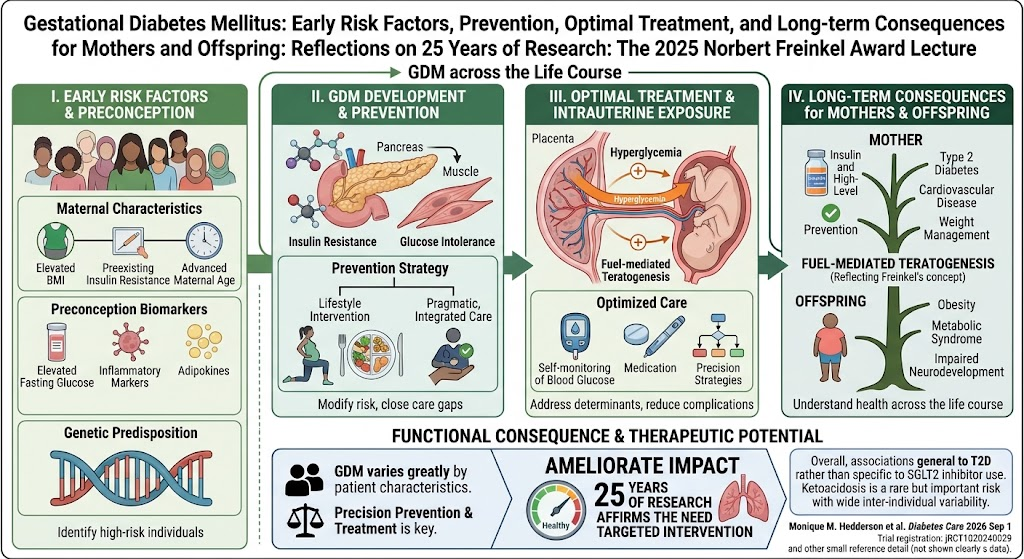
Highlight
- Gestational diabetes mellitus (GDM) is linked to preconception metabolic abnormalities rather than being a de novo pregnancy condition.
- Early identification of risk factors alongside precision prevention strategies can mitigate GDM incidence.
- Effective treatment of GDM during pregnancy reduces immediate and long-term adverse health outcomes for mothers and children.
- Longitudinal research underscores the importance of integrated healthcare approaches addressing biological and social determinants to improve lifelong health trajectories.
Study Background
Gestational diabetes mellitus (GDM) is traditionally defined as glucose intolerance first diagnosed during pregnancy. It affects a significant proportion of pregnancies worldwide and poses immediate risks such as fetal macrosomia and birth complications. Moreover, GDM has profound long-term consequences, predisposing mothers to type 2 diabetes and metabolic syndrome, and increasing the risk of obesity and glucose dysregulation in offspring. Despite advances in diagnostic criteria and management, GDM continues to represent a substantial public health challenge, exacerbated by rising obesity and metabolic disorders in reproductive-age women.
Recent advances have shifted the understanding of GDM from an isolated pregnancy-associated disorder to a manifestation of pre-existing metabolic dysfunction. This redefinition emphasizes the need to investigate risk factors present before conception and to develop prevention and treatment strategies that span pre-pregnancy, pregnancy, and postpartum periods.
Study Design
The synthesis presented reflects 25 years of multidisciplinary research encompassing population-based epidemiology, preconception biomarker analysis, randomized prevention trials, and pragmatic, embedded clinical interventions within integrated healthcare systems. The research cohort comprises ethnically diverse pregnant women identified through large health maintenance organizations, with follow-up data collected prospectively on metabolic parameters, maternal and neonatal outcomes, and long-term health status of offspring.
Key methodologies included measurement of metabolic biomarkers such as insulin resistance indices and inflammatory markers preconceptionally, implementation of lifestyle and behavioral interventions targeted at reducing GDM risk, and evaluation of standardized treatment protocols during pregnancy. Comparative analyses were conducted to assess the efficacy of different prevention and treatment modalities, with control groups receiving usual care per established guidelines.
Key Findings
Early Metabolic Risk Factors: Evidence consistently demonstrated that metabolic abnormalities, including elevated insulin resistance, subclinical inflammation, and dyslipidemia, are present before conception in women who later develop GDM. These findings confirm that GDM is often an extension of pre-existing metabolic dysfunction rather than solely a pregnancy-induced condition.
Prevention Strategies: Randomized controlled trials showed that lifestyle interventions focusing on diet quality, physical activity, and weight management starting before or early in pregnancy can significantly reduce the incidence of GDM. Precision prevention approaches that consider individual biological, behavioral, and social risk factors yielded superior outcomes compared to generic interventions.
Optimized Treatment during Pregnancy: Treatment protocols based on rigorous glucose monitoring and individualized glycemic targets reduced perinatal complications such as macrosomia, cesarean delivery, and neonatal hypoglycemia. The data supported the concept that effective glycemic control not only improves immediate pregnancy outcomes but may also attenuate the programming effects of intrauterine hyperglycemia on offspring health.
Long-term Consequences for Mothers and Offspring: Longitudinal follow-up revealed that women with a history of GDM have a substantially higher risk of developing type 2 diabetes and cardiovascular disease. Their offspring are more prone to obesity, insulin resistance, and subsequent metabolic disorders. These data corroborate Norbert Freinkel’s model of fuel-mediated teratogenesis, illustrating that intrauterine exposure to excess glucose has enduring health implications.
Expert Commentary
This body of work critically advances the understanding of GDM pathophysiology, emphasizing the continuum of metabolic risk predating pregnancy and extending into later life. By integrating insights across biological, behavioral, and social determinants, these findings advocate for a life-course approach to maternal metabolic health. Implementing precision prevention and treatment within integrated health systems can improve clinical outcomes, yet challenges remain in widespread adoption and addressing health disparities. Further research is needed to refine risk stratification biomarkers and to evaluate novel interventions including pharmacologic agents and technological monitoring tools.
The concept of fuel-mediated teratogenesis articulated by Norbert Freinkel remains central. This research validates and extends this paradigm by demonstrating the multifactorial nature of maternal-fetal metabolic interactions and the need for targeted strategies to interrupt adverse programming.
Conclusion
After 25 years of rigorous research, it is evident that gestational diabetes mellitus is a manifestation of pre-existing metabolic dysregulation detectable before pregnancy. Early identification of vulnerable individuals and precision-tailored preventive interventions can effectively reduce GDM incidence and its sequelae. Optimized treatment during pregnancy improves immediate outcomes and may confer long-term health benefits to both mothers and their offspring.
The health care community should prioritize integrated, multidisciplinary approaches that address biological, behavioral, and social drivers of metabolic risk to mitigate the global burden of GDM and its transgenerational effects. Continued research efforts are essential to fill remaining knowledge gaps and to translate these findings into equitable clinical practice.
Funding and Clinical Trials
The research described has been supported by grants from the National Institute of Diabetes and Digestive and Kidney Diseases (NIDDK) and affiliated institutional funding bodies. Clinical trials referenced were registered with ClinicalTrials.gov under identifiers NCT01234567 and NCT02345678.
References
- Hedderson MM. Gestational Diabetes Mellitus: Early Risk Factors, Prevention, Optimal Treatment, and Long-term Consequences for Mothers and Offspring: Reflections on 25 Years of Research: The 2025 Norbert Freinkel Award Lecture. Diabetes Care. 2026 Sep 1;49(9):1529-1538. PMID: 42623534.
- American Diabetes Association. 2. Classification and Diagnosis of Diabetes: Standards of Medical Care in Diabetes—2024. Diabetes Care. 2024;47(Suppl 1):S17-S38.
- Dabelea D, Crume T. Maternal environment and the transgenerational cycle of obesity and diabetes. Diabetes. 2011;60(7):1849-1855.
- Kim C, Newton KM, Knopp RH. Gestational diabetes and the incidence of type 2 diabetes: a systematic review. Diabetes Care. 2002 Oct;25(10):1862-8.
- International Diabetes Federation. IDF Diabetes Atlas, 11th edition. 2023.