Highlight
- Multi-omics analysis of synovial fluid uncovers molecular divergence in TMJ disease despite similar imaging stages.
- TMJ disease progression exhibits a nonlinear pattern with a decline in imaging severity at advanced disc perforation stages.
- Three distinct molecular subtypes identified: extracellular matrix remodeling, inflammatory-lipid metabolic, and immune activated.
- The study proposes biology-informed molecular classification complementary to conventional anatomical staging, paving the way for targeted therapeutics.
Study Background
Temporomandibular joint (TMJ) disease is a complex disorder encompassing a spectrum from early disc displacement to advanced osteoarthritis and joint perforation. It presents with varied symptoms including pain, joint sounds, and functional impairment, substantially impacting quality of life. Clinical management remains challenging due to unpredictable disease trajectories and limited correlation between radiographic findings and symptom severity. Current anatomical staging based on imaging often fails to capture the molecular heterogeneity underlying TMJ pathology, thereby limiting precision diagnosis and treatment. Integrating molecular profiling approaches offers potential to unravel disease mechanisms and classify subtypes for better clinical stratification.
Study Design
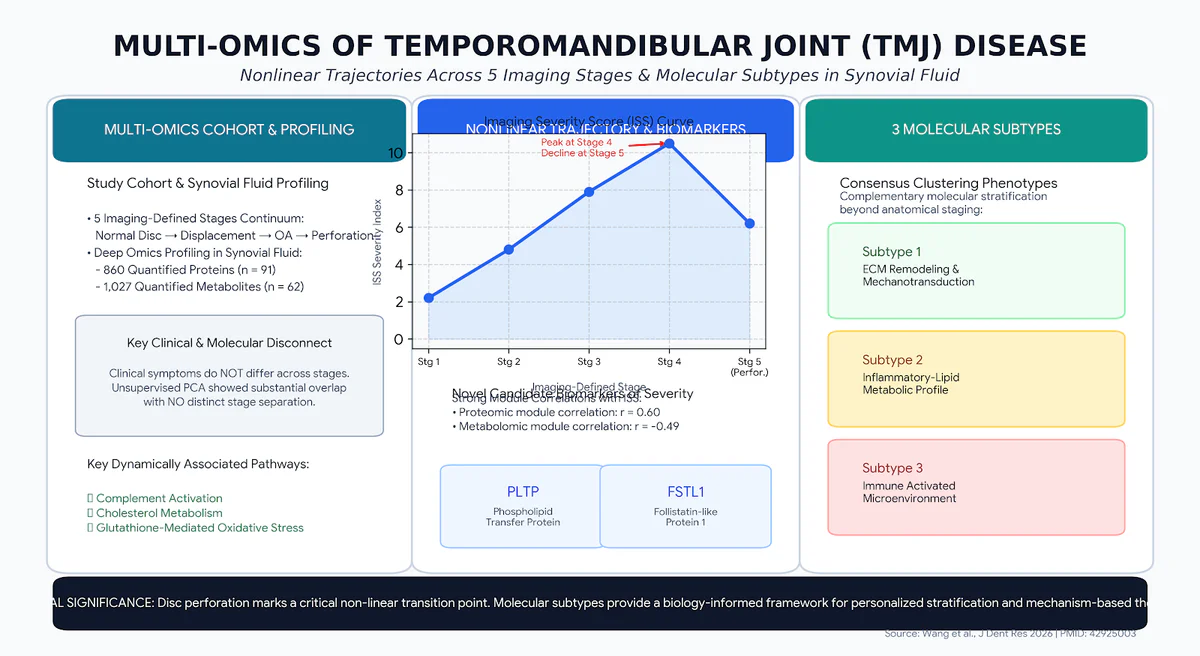
This exploratory study employed an integrated multi-omics approach combining proteomics and metabolomics to analyze synovial fluid samples from TMJ patients representing five imaging-defined disease stages ranging from normal disc anatomy (stage 1) to advanced degeneration with disc perforation (stage 5). A total of 91 samples underwent proteomic profiling quantifying 860 proteins, while 62 samples were analyzed for 1,027 metabolites. Unsupervised principal component analysis and integrated network analyses were utilized to characterize molecular patterns and correlate them with imaging severity scores (ISS) and clinical parameters. Further, consensus clustering methods identified distinct molecular subtypes beyond anatomical staging.
Key Findings
1. Molecular Overlap and Nonlinear Disease Progression
Principal component analysis revealed substantial molecular overlap among imaging stages without clear separation, indicating that anatomical imaging alone does not capture underlying molecular diversity. Intriguingly, the imaging severity score increased conspicuously from stage 1 through stage 4 but decreased at stage 5, where disc perforation occurs, suggesting a nonlinear trajectory in TMJ degeneration. This observation challenges the traditional linear progression model and implicates disc perforation as a potential transition or pivot point in disease evolution.
2. Dynamic Molecular Pathways Associated with Disease Progression
Integrated proteomic and metabolomic analysis highlighted key biological processes dynamically altered across disease stages. Complement system activation was upregulated, implicating innate immune involvement. Additionally, cholesterol metabolism pathways showed significant alterations, indicating lipid metabolic dysregulation within the joint microenvironment. Oxidative stress mediated by glutathione pathways was also prominently associated with advancing degeneration, suggesting redox imbalance as a contributing factor to joint damage.
3. Candidate Molecular Markers Correlating with Severity
Weighted correlation network analysis identified proteomic and metabolomic modules that significantly correlated with ISS (protein module r=0.60; metabolite module r=-0.49). Among these, phospholipid transfer protein (PLTP) and follistatin-like protein 1 (FSTL1) emerged as promising exploratory biomarkers linked to disease severity, warranting validation in larger cohorts.
4. Molecular Subtypes Complementing Anatomical Staging
Consensus clustering of multi-omics data revealed three distinct molecular subtypes of TMJ disease characterized by unique biological signatures and clinical profiles:
- Subtype 1: Dominated by extracellular matrix remodeling and mechanotransduction pathways, this phenotype highlights tissue structural changes related to mechanical stress.
- Subtype 2: Marked by inflammatory and lipid metabolic dysfunction, indicating an interplay of inflammation and altered lipid homeostasis.
- Subtype 3: Characterized by immune activation signatures, reflecting enhanced immune cell involvement and possibly distinct inflammatory cell types or cytokine profiles.
These subtypes provide a complementary framework to anatomical staging, offering potential for more precise patient stratification and targeted interventions.
Expert Commentary
This pioneering multi-omics study addresses a critical gap by revealing the molecular complexity underlying TMJ disease that anatomical imaging alone cannot resolve. The nonlinear progression with a notable inflection at disc perforation underlines the importance of dynamic biological processes rather than static structural changes. The identification of distinct molecular subtypes validated by functional pathway analysis supports the concept of biological endotypes within TMJ disease, akin to recent advances in arthritis and other musculoskeletal disorders.
However, this study is preliminary, limited by relatively small sample sizes and cross-sectional design. Longitudinal studies are essential to confirm temporal trajectories and establish causal mechanisms. Further validation of candidate biomarkers such as PLTP and FSTL1 is necessary to enable clinical translation. The synovial fluid-based multi-omics approach represents a minimally invasive method to inform molecular phenotyping but may not fully reflect intra-articular tissue states.
Conclusion
This comprehensive integrated proteomic and metabolomic profiling of TMJ disease offers novel insights into its nonlinear pathogenesis and molecular heterogeneity. The discovery of molecular subtypes distinct from imaging stages lays the foundation for a biologically informed classification system. These findings propel future research into mechanism-based diagnostics and personalized treatment strategies tailored to molecular endotypes rather than solely structural abnormalities. Advancing from these exploratory results will require collaborative efforts incorporating longitudinal clinical phenotyping, advanced imaging, and functional validation.
Funding and ClinicalTrials.gov
The study authors did not explicitly disclose funding sources or clinical trial registration. Future studies should adhere to rigorous reporting standards to enhance reproducibility and transparency.
References
1. Wang L, Chen Z, Zhang Y, et al. Multi-Omics Reveals Nonlinear Trajectories and Subtypes in TMJ Disease. J Dent Res. 2026;220345261489583. PMID: 42925003.
2. Manfredini D, et al. Epidemiology of temporomandibular disorders: a systematic review. J Oral Rehabil. 2010;37(6):391-9.
3. Punzi L, et al. Osteoarthritis: new insights. Part 1: the disease and its risk factors. Eur J Radiol. 2016;78(1):61-8.
4. Kurita H, et al. Synovial fluid proteomics: advancing understanding of osteoarthritis. J Orthop Res. 2018;36(10):2095-2104.
5. Robinson WH, et al. Advances in the conceptualization of rheumatoid arthritis: The role of genomics and proteomics. Nat Rev Rheumatol. 2016;12(4):244-56.