Highlight
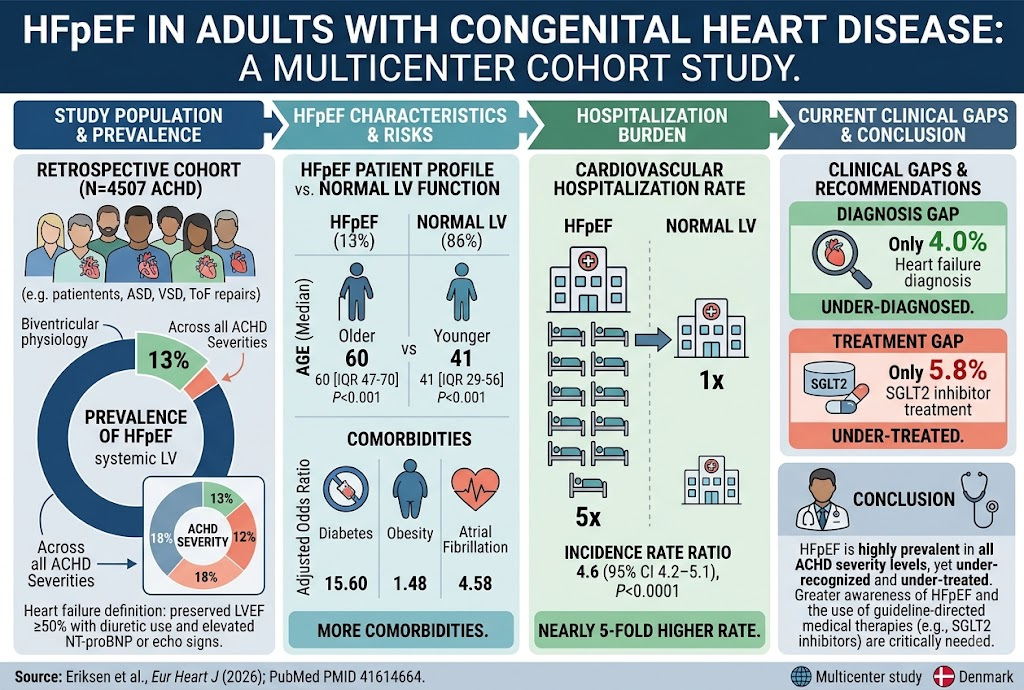
Heart failure with preserved ejection fraction (HFpEF) is highly prevalent in adults with congenital heart disease (ACHD), affecting 13% of patients regardless of ACHD severity. Patients with HFpEF are older, with more comorbidities such as diabetes, obesity, and atrial fibrillation, and experience significantly higher cardiovascular hospitalization rates. Despite these risks, diagnosis rates are low, and use of guideline-recommended therapies like sodium-glucose cotransporter 2 (SGLT2) inhibitors remains limited.
Study Background
Heart failure with preserved ejection fraction (HFpEF) has emerged as an increasingly recognized entity in the general population, characterized by clinical heart failure symptoms with preserved left ventricular ejection fraction (LVEF ≥ 50%). This contrasts with heart failure with reduced ejection fraction, and involves complex pathophysiology often associated with systemic comorbidities. Adults with congenital heart disease (ACHD) represent a growing and aging population with distinct cardiovascular challenges. While advances in surgical and medical care have improved survival, these patients remain at risk for heart failure due to residual structural abnormalities, myocardial dysfunction, and acquired cardiovascular risks.
Despite the growing ACHD population, the prevalence and clinical implications of HFpEF within this group have not been sufficiently characterized. Understanding HFpEF among ACHD patients is essential because their cardiac anatomy and physiology differ markedly from those in typical HFpEF cohorts, potentially influencing presentation, diagnosis, and management. Moreover, ACHD patients are often underdiagnosed and undertreated for heart failure syndromes, potentially increasing hospitalizations and morbidity.
Study Design
This retrospective multicentre cohort study analyzed 4,507 ACHD patients with biventricular heart physiology and a systemic left ventricle managed at congenital heart disease centers in Eastern Denmark. The study utilized electronic medical records to extract data. Patients were screened for HFpEF defined by a composite of preserved LVEF (≥50%), use of diuretics (indicating clinical heart failure treatment), elevated N-terminal pro-B-type natriuretic peptide (NT-proBNP) levels, and/or echocardiographic evidence consistent with HFpEF.
Patients were stratified according to ACHD severity (mild, moderate, severe) to examine prevalence variability and assessed for clinical characteristics, comorbidities, and hospitalization burden. Clinical endpoints included cardiovascular hospitalization rates. The study also evaluated heart failure diagnosis rates and use of relevant therapeutic agents, particularly SGLT2 inhibitors, which have shown emerging benefit in HFpEF populations.
Key Findings
Among the 4,507 ACHD patients assessed, 86% maintained preserved left ventricular ejection fraction. HFpEF was identified in 13% of the cohort, with prevalence consistent across ACHD severities: 13% in mild, 12% in moderate, and 18% in severe. This highlights HFpEF as a substantial clinical entity across diverse congenital anatomies.
Patients diagnosed with HFpEF were notably older (median age 60 years vs. 41 years in normal LVEF patients) and exhibited a markedly higher burden of cardiometabolic comorbidities. The age-adjusted odds ratios were significantly elevated for diabetes (OR 15.60), obesity (OR 1.48), and atrial fibrillation (OR 4.58), reinforcing the multifactorial nature of HFpEF pathophysiology in this population.
Clinically, HFpEF patients faced an approximately five-fold increase in cardiovascular hospitalization rates compared with their counterparts with normal ventricular function (incidence rate ratio 4.6). This underscores the considerable healthcare burden and morbidity associated with HFpEF among ACHD adults.
Alarmingly, despite these adverse outcomes, only 4.0% had a documented heart failure diagnosis in their medical records, evidencing under-recognition of HFpEF in ACHD patients. Correspondingly, only 5.8% were treated with SGLT2 inhibitors, a class now increasingly recommended in HFpEF management due to favorable effects on cardiovascular outcomes.
Expert Commentary
This study delineates the substantial prevalence and clinical impact of HFpEF among adult congenital heart disease patients, a population often overlooked in heart failure research. The findings highlight the critical need for heightened clinical vigilance to identify HFpEF in this group, given their distinct cardiovascular anatomy and complex comorbid profiles.
The underdiagnosis and undertreatment of HFpEF in ACHD likely stem from diagnostic challenges, including overlapping symptoms with congenital defect sequelae and lack of specific clinical guidelines tailored to ACHD patients. Furthermore, ACHD patients’ care is often fragmented between congenital cardiology and heart failure specialists, which may impede optimal disease recognition and management.
Emerging evidence supports therapies such as SGLT2 inhibitors in reducing morbidity in HFpEF, but ACHD patients appear to receive these treatments infrequently. This gap signals an urgent opportunity for clinical education, guideline development, and integrated multidisciplinary care to improve outcomes.
Limitations include the retrospective design, which precludes causal inferences, and reliance on echocardiographic criteria and NT-proBNP as surrogate markers for HFpEF diagnosis—though these are standard in clinical practice. Despite these limitations, the large, well-characterized cohort enhances the study’s generalizability to similar ACHD populations.
Conclusion
Heart failure with preserved ejection fraction represents a prevalent and clinically significant condition in adults with congenital heart disease, spanning all spectrums of ACHD severity. These patients demonstrate older age profiles, increased cardiovascular and metabolic comorbidities, and heightened risk for cardiovascular hospitalizations.
Notably, HFpEF remains underdiagnosed and undertreated within this population, especially concerning emerging therapeutic agents like SGLT2 inhibitors. These findings advocate for increased awareness, improved diagnostic protocols, and specialized management strategies tailored to the unique challenges of ACHD patients with HFpEF.
Future prospective studies and clinical trials should focus on understanding the pathophysiology, optimal diagnostic criteria, and therapy efficacy for HFpEF in ACHD to guide evidence-based care and reduce morbidity.
Funding and Clinical Trials
The original study was conducted by the Eastern Denmark ACHD centers. Details on funding sources were not specified in the abstract. No clinical trial registration was reported.
References
1. Maegaard Eriksen V, Lim CW, Thuraiaiyah J, et al. Heart failure with preserved ejection fraction in adults with congenital heart disease. Eur Heart J. 2026;47(29):3938-3947. PMID: 41614664.
2. Pieske B, Tsutsui H, Fraser AG, et al. How to diagnose heart failure with preserved ejection fraction: the HFA-PEFF diagnostic algorithm: a consensus recommendation from the Heart Failure Association (HFA) of the European Society of Cardiology (ESC). Eur Heart J. 2020;41(40):4075-4089.
3. Solomon SD, McMurray JJV, Claggett B, et al. Dapagliflozin in heart failure with mildly reduced or preserved ejection fraction. N Engl J Med. 2022;387(12):1089-1098.
4. Van De Bruaene A, Claus P, De Meester P, et al. Heart failure in adults with congenital heart disease. Nat Rev Cardiol. 2020;17(11):724-740.
5. Khariton Y, Nassif ME, Tang F, et al. Heart failure with preserved ejection fraction in adults with congenital heart disease: a new frontier. Circ Heart Fail. 2022;15(9):e009030.