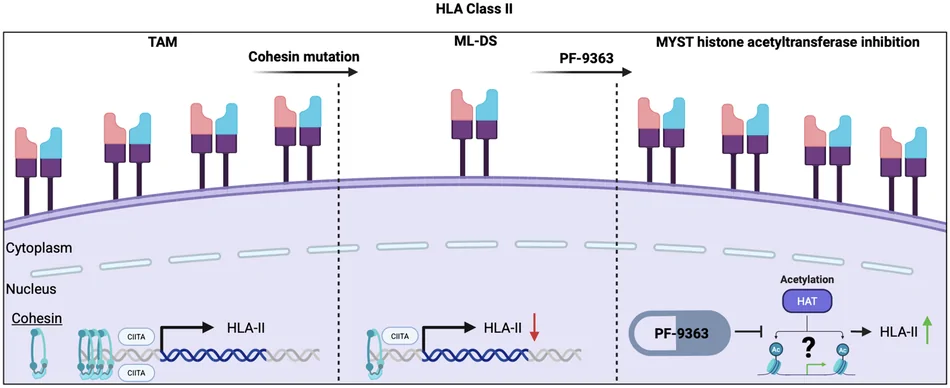
Highlight
- Cohesin mutations, particularly in RAD21, downregulate HLA-class II gene expression in ML-DS.
- Reduced HLA-DR expression correlates with higher risk of progression from TAM to ML-DS.
- RAD21 haploinsufficiency impairs chromatin accessibility and disrupts binding of transcriptional regulators GATA1s and CIITA.
- Similar HLA-class II downregulation occurs in other AML subtypes with decreased cohesin component expression, suggesting broader leukemogenic implications.
Study Background
Children with Down syndrome (DS) face a unique hematological challenge, frequently developing transient abnormal myelopoiesis (TAM), a precursor condition that mostly resolves spontaneously. However, a subset of these children progress to develop myeloid leukemia of Down syndrome (ML-DS), a malignancy with distinct biological and clinical features compared to other myeloid leukemias. The progression from TAM to ML-DS typically involves acquisition of additional somatic mutations, with recurrent alterations frequently identified in components of the cohesin complex, such as RAD21. The cohesin complex plays a critical role in chromatin structure and gene regulation. Despite clear genetic associations, the mechanistic link between cohesin mutations and leukemogenesis in ML-DS remains poorly understood, representing a critical gap in knowledge that could inform therapeutic targeting and prognostication.
Study Design
This investigation leveraged both in vitro cellular models and clinical patient data to elucidate the biological consequences of cohesin mutations on gene expression in ML-DS. Specifically, the RAD21-mutant CMY cell line and isogenic clones corrected for RAD21 mutations provided a controlled experimental system to directly assess transcriptional and chromatin alterations attributable to cohesin haploinsufficiency. Bulk RNA sequencing characterized gene expression changes, while multi-omics approaches—including chromatin accessibility assays and chromatin immunoprecipitation—investigated the effects on transcription factor occupancy. Complementary analyses in ML-DS patient samples examined HLA-class II protein expression differences between TAM and ML-DS stages and correlated these findings with clinical progression risk. Additional AML subtypes with cohesin mutations were also evaluated to explore broader relevance.
Key Findings
Downregulation of HLA-Class II Genes in Cohesin-Mutant ML-DS
RNA sequencing revealed a significant downregulation of major histocompatibility complex (MHC) class II genes, including classical HLA-DR, HLA-DQ, and HLA-DP loci, in cohesin-mutant cells relative to their RAD21-corrected counterparts. At the protein level, flow cytometry and immunophenotyping demonstrated that HLA-DR surface expression was lower in ML-DS cells compared to transient abnormal myelopoiesis cells, suggesting impaired antigen presentation capacity linked to leukemia progression.
Association Between Decreased HLA-DR and Leukemia Progression
In patient cohorts, reduced HLA-DR expression correlated strongly with an increased risk of progression from TAM to frank ML-DS. This indicates that loss of HLA-class II expression may serve as a biomarker and possibly a mechanistic contributor to leukemic transformation, potentially via immune evasion or altered cellular differentiation signaling.
Mechanistic Insights: Cohesin Haploinsufficiency Alters Chromatin Accessibility and Transcription Factor Occupancy
Chromatin accessibility maps demonstrated that RAD21 haploinsufficiency leads to a restrictive chromatin state at HLA-class II gene loci, reducing accessibility to transcriptional regulators. Particularly, occupancy of GATA1s—an isoform critical in DS-related leukemogenesis—and CIITA, the master transactivator governing HLA-class II gene expression, was markedly impaired in cohesin-mutant cells. Restoration of RAD21 rescued CIITA chromatin binding and reinstated HLA-class II gene expression, providing a direct mechanistic link between cohesin function and immune gene regulation in leukemia.
Broader Implications in AML Subtypes
Parallel analyses in other acute myeloid leukemia (AML) subsets with reduced RAD21 or STAG2 expression recapitulated the pattern of HLA-class II downregulation, indicating that cohesin complex alterations may broadly impair antigen presentation pathways across myeloid malignancies beyond ML-DS.
Expert Commentary
This study addresses a pressing need to clarify how cohesin complex mutations contribute to leukemogenesis in DS-associated myeloid leukemia. The demonstration that cohesin haploinsufficiency disrupts HLA-class II expression through impaired chromatin dynamics and transcription factor binding offers important biological insights. HLA-class II molecules are crucial for antigen presentation to CD4+ T cells, and their downregulation may represent an immune escape mechanism favoring leukemic proliferation. The findings also highlight potential translational opportunities, including using HLA-DR expression as a biomarker for disease progression risk in DS patients and exploring agents that modulate cohesin function or restore CIITA activity. However, some limitations warrant consideration: the study primarily utilized a single cell line model and retrospective patient data; prospective validation and functional immune assays are needed to confirm clinical relevance. Furthermore, the contribution of other cohesin components and their interplay with epigenetic regulators remains to be elucidated fully.
Conclusion
In summary, cohesin mutations, particularly haploinsufficiency in RAD21, contribute to the pathogenesis of ML-DS by disrupting HLA-class II gene expression through altered chromatin accessibility and transcription factor binding. This impairment correlates with increased leukemia progression risk, suggesting a novel leukemogenic mechanism involving immune evasion. These insights open avenues for biomarker development and targeted therapeutic strategies aimed at restoring antigen presentation and immune surveillance in myeloid leukemias associated with Down syndrome and potentially other AML subtypes.
Funding and ClinicalTrials.gov
The original article does not specify funding sources or clinical trial registrations. Further research into this mechanistic pathway may be supported by grants focused on leukemia biology and Down syndrome hematology.
References
1. Boucher AC, Rosikiewicz W, Cotton A, et al. The effect of cohesin mutations on HLA-class II expression in the myeloid leukemia of Down syndrome. Leukemia. 2026;40(9):2018-2026. PMID: 42481796.
2. Yoshida K, Toki T, Okuno Y, et al. The landscape of somatic mutations in Down syndrome-related myeloid disorders. Nat Genet. 2013;45(11):1293-1299.
3. Thota S, Viny AD, Makishima H, et al. Genetic alterations of the cohesin complex genes in myeloid neoplasms. Blood. 2014;124(11):1790-1798.
4. Regha K, Schroeter C, Wunderlich M, et al. GATA1 mutations in the Down syndrome transient myeloproliferative disorder: relationship to leukemogenesis. Blood. 2021;137(15):2128-2137.