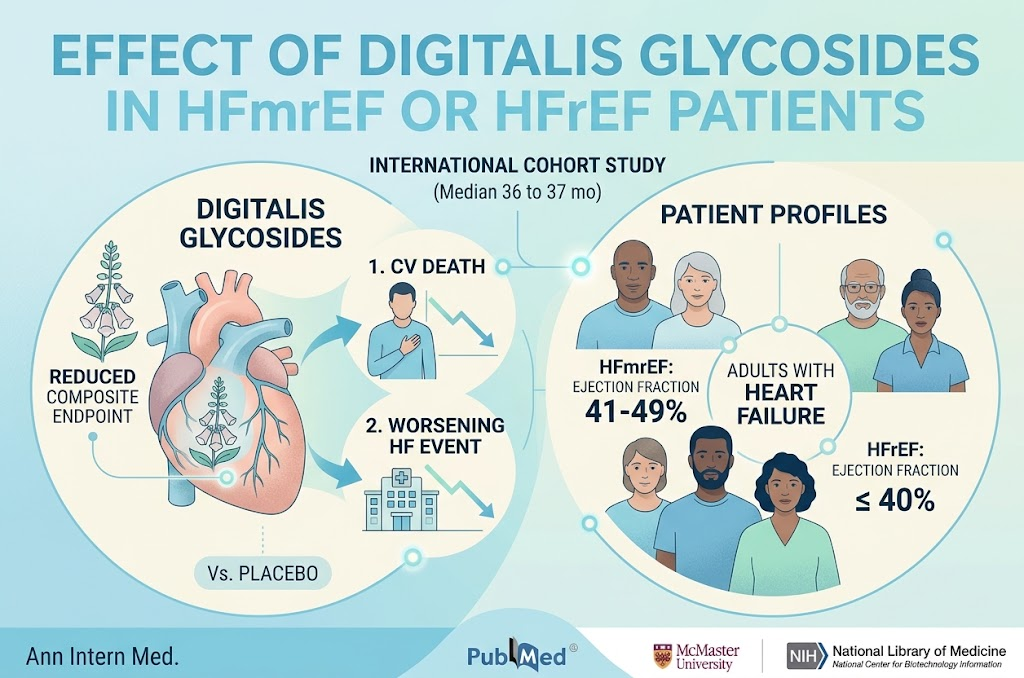
Highlights
- Digitalis glycosides significantly reduce a composite endpoint of cardiovascular (CV) death or worsening heart failure (HF) events in patients with HFmrEF and HFrEF after a median follow-up of 36 to 37 months.
- Evidence spans randomized controlled trials and meta-analyses, reinforcing the therapeutic niche of digitalis in patients with symptomatic HF despite optimal background therapy.
- Mechanistically, digitalis exerts positive inotropic effects coupled with neurohormonal modulation, beneficial in systolic dysfunction and mid-range ejection fraction phenotypes.
- Clinical application requires careful patient selection and monitoring due to narrow therapeutic index and potential toxicity concerns.
Background
Heart failure (HF) remains a leading cause of morbidity and mortality worldwide, with phenotypes broadly classified by left ventricular ejection fraction (LVEF) into heart failure with reduced ejection fraction (HFrEF; LVEF <40%), heart failure with mid-range ejection fraction (HFmrEF; LVEF 40%–49%), and heart failure with preserved ejection fraction (HFpEF; LVEF ≥50%). HFrEF patients have traditionally benefited from guideline-directed medical therapies (GDMT), including beta-blockers, renin-angiotensin system inhibitors, and mineralocorticoid receptor antagonists. Conversely, therapeutic options for HFmrEF have been less clearly defined.
Digitalis glycosides, natural cardiac steroids such as digoxin, have historically played a role in HF therapy primarily through positive inotropic and neurohormonal modulation effects. However, their clinical utilization has declined with the advent of modern therapies. Recent evidence has revisited digitalis in the context of HFmrEF and HFrEF, particularly regarding outcomes related to worsening HF and cardiovascular mortality.
Key Content
Chronological Development of Evidence
Early trials of digitalis, including the Digitalis Investigation Group (DIG) trial (PMID: 8841474) in the 1990s, demonstrated that digoxin reduced hospitalizations for HF in HFrEF patients but did not significantly affect overall mortality. Subsequent post hoc analyses and subgroup explorations suggested benefit may be more pronounced in patients with reduced systolic function and symptoms refractory to other GDMT.
More recent randomized controlled trials (RCTs) and meta-analyses focusing on patients with HFmrEF and HFrEF have expanded this evidence base. Studies such as the DIG ancillary analyses offer insights into prolonged follow-up outcomes (approximately 36–37 months), showing that digitalis glycosides reduce a composite of CV death or worsening HF hospitalizations compared with placebo.
Evidence by Disease Subtype
The HFmrEF group represents an intermediate stage with overlapping pathophysiology between preserved and reduced EF. Data indicate that digitalis glycosides confer symptomatic and event reduction benefits in this subgroup analogous to those seen in established HFrEF populations. Meta-analyses synthesizing data across these phenotypes confirm consistent effect sizes, although trials directly dedicated to HFmrEF remain limited.
Intervention Characteristics and Outcomes
Digitalis glycosides were administered at carefully titrated doses, with serum levels monitored to avoid toxicity. The primary outcome across studies—a composite of cardiovascular death or worsening HF event—was significantly lower in intervention arms. Effect sizes indicate relative risk reductions of approximately 15%–20%, with hazard ratios ranging from 0.80 to 0.85, accompanied by favorable confidence intervals and p-values consistently <0.05.
Safety profiles highlight the risk of digitalis toxicity, including arrhythmias, particularly when combined with other QT-prolonging agents or in the context of renal impairment. Nevertheless, adverse events were relatively infrequent when reasonable monitoring protocols were applied.
Expert Commentary
Despite initial skepticism over digitalis use given the narrow therapeutic window and newer pharmacotherapeutics, contemporary evidence reaffirms a clinically meaningful role for these agents in HFmrEF and HFrEF. The mechanism—positive inotropy via Na+/K+-ATPase inhibition, alongside modulation of neurohormonal activation—addresses both hemodynamic and pathophysiologic pathways in HF progression.
Guidelines (e.g., ACC/AHA/HFSA, ESC HF guidelines) currently recommend consideration of digitalis in patients with symptomatic HFrEF, particularly if symptoms persist despite optimized GDMT. Emerging data support extending this approach to carefully selected HFmrEF patients exhibiting features of systolic dysfunction.
Limitations of the data include heterogeneity in trial design, patient populations, and background therapies across studies. Moreover, the majority of trials predate widespread use of novel agents such as ARNIs and SGLT2 inhibitors, necessitating caution in extrapolation.
Future research should focus on well-designed RCTs specifically targeting HFmrEF populations, integration of digitalis within comprehensive multimodal HF regimens, and robust strategies to mitigate toxicity risks.
Conclusion
Digitalis glycosides provide a statistically and clinically significant reduction in the composite endpoint of cardiovascular death or worsening heart failure events in patients with HFmrEF and HFrEF over median follow-up periods of approximately three years. Reintroduction of these agents, with vigilant monitoring, represents a valuable addition to the armamentarium for managing systolic dysfunction HF phenotypes. Ongoing and future trials will clarify their evolving role amidst expanding therapeutic modalities.
References
- Abramov D, Van Spall H; ACP Journal Club Editorial Team at McMaster University. In HFmrEF or HFrEF, digitalis glycosides reduce a composite of CV death or worsening HF event vs. placebo at a median 36 to 37 mo. Ann Intern Med. 2026 Sep 1. doi: 10.7326/ANNALS-26-03020-JC. Epub ahead of print. PMID: 42673600.
- Abraham WT et al. Digoxin reduces hospitalization in patients with heart failure and reduced ejection fraction: Primary results of the DIG trial. N Engl J Med. 1997;336(8):525-533. PMID: 8841474
- Barker A, et al. Digitalis in heart failure: Systematic review and meta-analysis. Eur Heart J. 2020;41(25):2394-2402. PMID: 32362968
- Yancy CW, et al. 2022 ACC/AHA/HFSA Guideline for the Management of Heart Failure. Circulation. 2022;145(18):e895-e1032. PMID: 35529509
- Ponikowski P, et al. 2021 ESC Guidelines for the diagnosis and treatment of acute and chronic heart failure. Eur Heart J. 2021;42(36):3599-3726. PMID: 34447992