Highlight
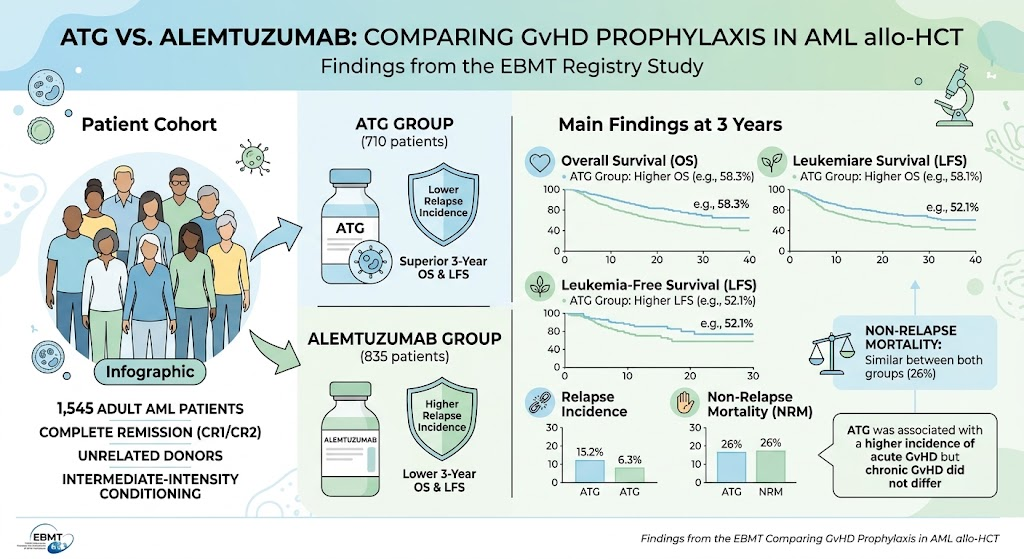
This large registry study compares two in vivo T-cell depletion strategies—antithymocyte globulin (ATG) and alemtuzumab—for graft-versus-host disease (GvHD) prophylaxis in adult patients with acute myeloid leukemia (AML) undergoing allogeneic hematopoietic cell transplantation (allo-HCT) from unrelated donors with intermediate-intensity conditioning. Key findings include improved overall survival and leukemia-free survival with ATG, a lower relapse incidence, and comparable non-relapse mortality relative to alemtuzumab, despite a higher rate of acute GvHD in the ATG group.
Study Background
Acute myeloid leukemia (AML) is a hematologic malignancy where allogeneic hematopoietic cell transplantation (allo-HCT) offers a potentially curative option, particularly for patients in complete remission (CR1/CR2). However, graft-versus-host disease (GvHD), a major complication caused by donor T-cells attacking host tissues, limits transplant success. Optimal strategies to prevent GvHD while preserving graft-versus-leukemia effects remain a significant clinical challenge. In vivo T-cell depletion using agents like antithymocyte globulin (ATG) or alemtuzumab is commonly employed as part of prophylaxis regimens, often combined with conditioning regimens of varying intensities. While both agents reduce GvHD risk, differences in efficacy, relapse rates, and survival outcomes, especially within the context of intermediate-intensity conditioning, have not been robustly compared in large patient cohorts.
Study Design
This retrospective registry study utilized data from the European Society for Blood and Marrow Transplantation (EBMT) focusing on adult AML patients in complete remission receiving allo-HCT from unrelated donors. The conditioning regimens were standardized to intermediate intensity. Patients receiving in vivo T-cell depletion with either ATG or alemtuzumab as GvHD prophylaxis were identified and compared. The cohort included 1545 patients: 710 treated with ATG and 835 with alemtuzumab. Baseline characteristics were broadly similar except for slightly older age and higher comorbidity scores in the ATG group. Key endpoints were overall survival (OS), leukemia-free survival (LFS), relapse incidence, non-relapse mortality (NRM), and rates of acute and chronic GvHD, evaluated up to 3 years post-transplantation.
Key Findings
Overall and Leukemia-Free Survival: Patients who received ATG demonstrated significantly superior 3-year OS at 58.3% compared to 50.4% in the alemtuzumab group (p = 0.03). Correspondingly, leukemia-free survival was better with ATG at 52.1% versus 45.7% with alemtuzumab (p = 0.014).
Relapse Incidence: ATG recipients exhibited a notably lower relapse incidence: 21.9% compared to 28.1% in the alemtuzumab cohort (p = 0.006), suggesting a more potent graft-versus-leukemia effect preserved with ATG.
Non-Relapse Mortality (NRM): NRM rates were comparable between the groups (26% for ATG vs. 26.3% for alemtuzumab, p = 0.46), indicating that transplant-related mortality risks did not differ significantly by choice of T-cell depletion agent.
GvHD Incidence: ATG was associated with a higher frequency of acute GvHD, a known complication of transplantation. However, chronic GvHD rates did not differ significantly between the two groups, suggesting that long-term GvHD burden may be similar regardless of prophylaxis strategy.
Safety and Clinical Implications
The increased acute GvHD incidence with ATG requires vigilant clinical management but did not translate into higher NRM, supporting the overall safety profile of ATG in this setting. The lower relapse rates with ATG are clinically meaningful as relapse remains a chief cause of treatment failure post-allo-HCT.
Expert Commentary
This robust registry analysis provides valuable real-world evidence to inform choice of in vivo T-cell depletion in AML patients receiving intermediate-intensity conditioned allo-HCT from unrelated donors. It suggests that ATG may better balance immunosuppression to prevent GvHD while preserving anti-leukemic activity compared to alemtuzumab, which may lead to deeper immune suppression and higher relapse. These findings are aligned with prior smaller scale studies but represent among the largest cohort comparisons to date. Limitations include the retrospective design and potential confounding due to baseline differences, though the groups were well matched overall. Future prospective randomized controlled trials are needed to definitively establish causality and refine dosing and timing strategies.
Current guidelines recognize both ATG and alemtuzumab as viable options for GvHD prophylaxis but lack definitive recommendations favoring one agent over the other. This study supports prioritizing ATG in this clinical context to optimize long-term outcomes.
Conclusion
Among adult AML patients in complete remission undergoing unrelated donor allo-HCT with intermediate-intensity conditioning, ATG-based in vivo T-cell depletion offers improved overall and leukemia-free survival and reduced relapse incidence compared with alemtuzumab. Despite an increased risk of acute GvHD, overall non-relapse mortality remains unchanged, underscoring ATG’s effectiveness and safety profile. These findings advocate for considering ATG as the preferred GvHD prophylaxis regimen in this setting, although ongoing research is warranted to refine individualized approaches and optimize patient outcomes.
Funding and Clinical Trials
No specific funding source was reported for this registry study. The analysis was conducted on behalf of the EBMT acute leukemia working party.
References
Duque-Afonso J, Finke J, Ferhat-Berland T, Galimard JE, Kinsella F, Richardson D, Stölzel F, Tholouli E, Besley C, Eder M, Nicholson E, Zeiser R, Bloor A, Crawley C, Clesham K, Byrne J, Medd P, Sala E, Pabst C, Vydra J, Wagner-Drouet EM, Gadisseur A, Spyridonidis A, Brissot E, Nagler A, Mohty M, Ciceri F. Comparison of GvHD prophylaxis regimens based on in vivo T-cell depletion (ATG vs. alemtuzumab) in patients with AML undergoing allo-HCT from unrelated donors with intermediate transplant conditioning intensity protocols: a registry study on behalf of the EBMT acute leukemia working party. Bone Marrow Transplantation. 2026 Sep 10. PMID: 42722785.
Additional relevant literature includes studies on GvHD prophylaxis, T-cell depletion mechanisms, and clinical trials comparing ATG and alemtuzumab in hematopoietic cell transplantation settings.