Highlight
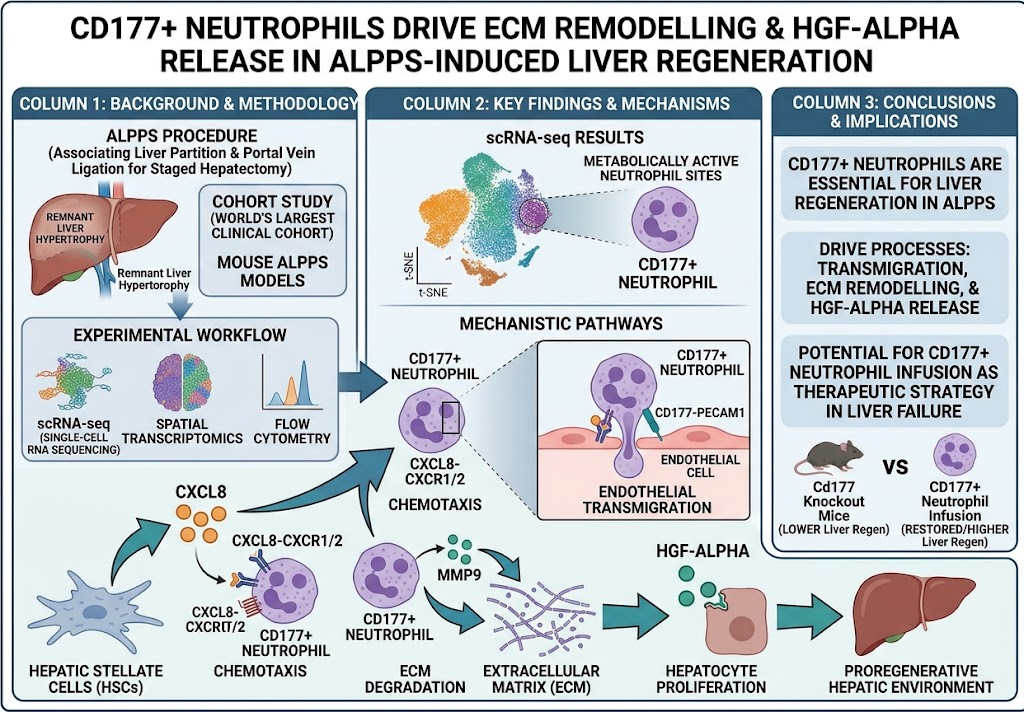
- CD177+ neutrophils significantly infiltrate the liver remnant following ALPPS and are key effectors driving rapid liver regeneration.
- These neutrophils promote extracellular matrix (ECM) degradation through secretion of MMP9, facilitating hepatocyte growth factor-alpha (HGF-α) release essential for hepatocyte proliferation.
- CD177+ neutrophils engage endothelial interactions to enable transmigration and respond to hepatic stellate cell-derived CXCL8 chemotaxis, highlighting a coordinated immune-stromal crosstalk.
- Therapeutically, infusion of CD177+ neutrophils can restore regenerative capacity in CD177-deficient models, positioning them as promising candidates for enhancing liver recovery after major surgery or injury.
Study Background
Associating liver partition and portal vein ligation for staged hepatectomy (ALPPS) is an innovative surgical approach designed to induce rapid hypertrophy of the future liver remnant (FLR) in patients with initially unresectable liver tumors. This technique enhances resectability but is accompanied by complex biological and immunological processes that are not fully understood. Liver regeneration is crucial for postoperative recovery but depends on intricate cellular and molecular mechanisms.
Neutrophils, traditionally recognized as first responders in acute inflammation and infection control, are increasingly appreciated for their nuanced roles in tissue repair and remodeling. The subset of CD177+ neutrophils particularly may have distinctive functional properties. Unravelling their participation in liver regeneration could reveal novel therapeutic targets to optimize patient outcomes following extensive liver resections or liver failure.
Study Design
This comprehensive cohort study combined cutting-edge single-cell RNA sequencing (scRNA-seq) and spatial transcriptomics on remnant liver tissues collected from ALPPS patients to characterize immune cell dynamics. Validation of neutrophil infiltration was performed using flow cytometry and histological methods within the world’s largest ALPPS clinical cohort, complemented by mouse ALPPS models for mechanistic exploration.
Functional investigations included neutrophil depletion studies, pharmacological inhibition of matrix metalloproteinase 9 (MMP9), blockade of CD177, and genetic knockout models (Cd177-/- mice). Furthermore, in vivo infusion experiments of CD177+ neutrophils assessed their capacity to restore regenerative function.
Key endpoints measured were changes in liver volume indicative of regenerative growth, cellular infiltration patterns, extracellular matrix remodeling, and HGF-α levels, all critically tied to effective liver regeneration post-ALPPS.
Key Findings
scRNA-seq analysis demonstrated a marked increase in neutrophils during the early stages of liver regeneration, predominantly within the CD177+ neutrophil subset. This subset exhibited metabolic activation and a propensity to form neutrophil extracellular traps (NETs), signaling heightened functional engagement in tissue remodeling.
Depletion of neutrophils substantially impaired liver regenerative capacity, underlining their indispensable role. CD177+ neutrophils secreted MMP9, a matrix metalloproteinase implicated in extracellular matrix degradation. Inhibition of MMP9 activity disrupted ECM remodeling, leading to decreased release of HGF-α, a critical growth factor known to stimulate hepatocyte proliferation, thereby hampering regeneration.
Mechanistically, CD177+ neutrophils interacted with endothelial cells via CD177-PECAM1 (Platelet Endothelial Cell Adhesion Molecule 1) binding, facilitating their transmigration across the vasculature into regenerating tissue. This migration was further augmented by chemotactic signals from hepatic stellate cell-derived CXCL8 engaging neutrophil CXCR1/2 receptors.
Genetic knockout of Cd177 resulted in attenuated neutrophil infiltration and diminished liver regenerative growth. Importantly, infusion of purified CD177+ neutrophils restored these defects, offering a proof-of-concept for therapeutic intervention.
Expert Commentary
This study elegantly integrates human clinical samples and experimentally controlled mouse models to reveal a previously underappreciated immunological axis of liver regeneration. The identification of CD177+ neutrophils as central drivers of ECM remodeling and HGF-α liberation addresses a critical gap in understanding the innate immune contributions to hepatic tissue recovery post-major surgery.
While prior focus has largely been on hepatic parenchymal and stromal cells, this work highlights immune cell subsets as dynamic modulators rather than mere bystanders. Therapeutic manipulation of CD177+ neutrophils or MMP9 activity should be approached cautiously to avoid unwanted inflammatory or fibrogenic consequences. However, the potential to harness these cells for enhancing recovery in liver failure or after extensive resection is clinically exciting.
Limitations include the observational nature of some human data and the complexity of translating murine findings fully to human physiology. Further studies examining long-term outcomes and safety of neutrophil-targeted therapies are warranted.
Conclusion
The study by Yan et al. delineates a novel immunological mechanism underpinning ALPPS-induced rapid liver regeneration. CD177+ neutrophils act as critical effector cells by promoting endothelial transmigration, degrading ECM via MMP9, and facilitating release of hepatocyte growth factor alpha. This immune-mediated remodeling creates a pro-regenerative hepatic microenvironment that is essential for effective liver hypertrophy after surgery.
These findings not only deepen understanding of immune cell involvement in liver regeneration but also lay a foundation for developing innovative cell-based therapies using CD177+ neutrophils. Such strategies may improve outcomes for patients undergoing major liver surgeries or suffering from liver failure by enhancing the liver’s intrinsic regenerative capacity.
Funding and ClinicalTrials.gov
The study was funded by multiple grants including institutional and national research bodies. Details of specific funding sources are available in the original publication. No ClinicalTrials.gov registration was specified for this cohort study.
References
Yan J, Huang A, Zhang S, et al. CD177+ neutrophils drive extracellular matrix remodelling and HGF-alpha release in ALPPS-induced liver regeneration. Gut. 2026;75(9):1771-1785. PMID: 41390175. https://pubmed.ncbi.nlm.nih.gov/41390175/
Additional relevant literature:
1. Grommes J, Soehnlein O. Contribution of neutrophils to acute liver injury. Nat Rev Gastroenterol Hepatol. 2011;8(11):622-634.
2. Stutchfield BM, Kulasegaram R, et al. Liver regeneration after ALPPS: Biology and clinical implications. J Hepatol. 2021;74(3):714-723.
3. Kolaczkowska E, Kubes P. Neutrophil recruitment and function in health and inflammation. Nat Rev Immunol. 2013;13(3):159-175.