Highlight
– Recent-onset adult type 1 diabetes manifests as three distinct clinical and metabolic subtypes, distinguished by glutamic acid decarboxylase antibody (GADA) presence and insulin sensitivity.
– Two GADA-positive subtypes share autoimmune features but differ in body mass index (BMI), insulin sensitivity, and β-cell function, indicating variability in disease presentation.
– The GADA-negative subtype displays lower genetic risk for type 1 diabetes and unique metabolic profiles, suggesting alternative pathophysiology.
– Longitudinal trajectories show mixed type 1 diabetes patients experience earlier clinical presentation along the β-cell decline pathway, highlighting opportunities for targeted disease-modifying interventions.
– Subtype-specific risks for hypoglycemia, retinopathy, and cardiovascular autonomic neuropathy emphasize the need for tailored complication management.
Study Background
Type 1 diabetes (T1D) traditionally is considered a uniform autoimmune condition characterized by destruction of pancreatic β-cells leading to absolute insulin deficiency. However, adult-onset T1D patients demonstrate substantial heterogeneity in clinical manifestation, metabolic status, and disease progression kinetics, challenging this canonical view. Differentiating whether such variability represents distinct disease subtypes or merely different temporal stages of a shared autoimmune process is critical. Understanding these nuances is vital for refining diagnosis, guiding personalized treatment strategies, and identifying windows for effective disease modification.
Study Design
This prospective cohort study leveraged data from the German Diabetes Study (GDS), enrolling 600 adults aged 18–69 years with clinically diagnosed type 1 diabetes within the past 12 months, including a subgroup with glutamic acid decarboxylase antibody (GADA) positivity but initially classified as type 2 diabetes. Using unsupervised machine learning integrating clinical and metabolic variables—GADA status, fasting C-peptide, glucose levels, triglycerides, and high-density lipoprotein (HDL) cholesterol—the investigators stratified patients into metabolic and clinical subtypes. These subtypes were subsequently compared for etiological markers such as polygenic risk scores specific for type 1 and type 2 diabetes, partitioned type 2 diabetes genetic risk, human leukocyte antigen (HLA) profiles, islet autoantibody patterns, insulin sensitivity, and β-cell function over time assessed by glucagon-stimulated C-peptide trajectories. Validation occurred in an independent cohort from the German Diabetes Prospective Follow-up Registry (DPV), comprising 483 adults with type 1 diabetes. The mean follow-up time was 6.1 years (SD 4.7) in GDS and 3.1 years (SD 5.0) in DPV.
Key Findings
The study identified three distinct subtypes of recent-onset adult type 1 diabetes:
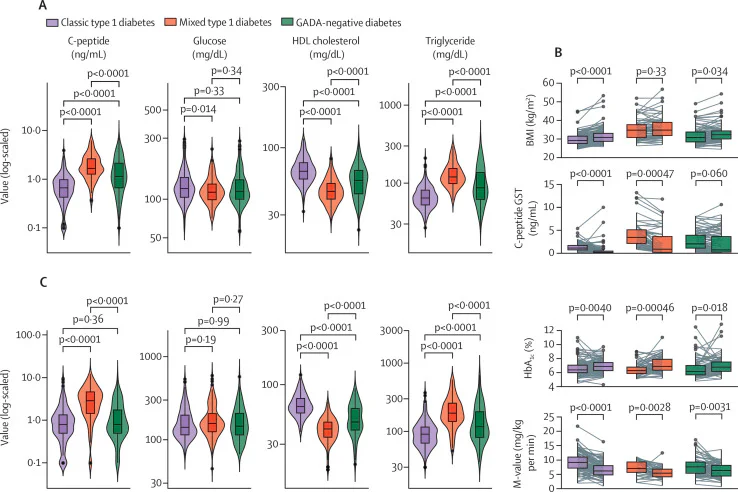
- Classic type 1 diabetes (GADA-positive subtype 1): Characterized by lower body mass index, higher insulin sensitivity, and severe β-cell dysfunction, corresponding to the traditional autoimmune phenotype with overt insulin deficiency.
- Mixed type 1 diabetes (GADA-positive subtype 2): Exhibited higher BMI, reduced insulin sensitivity, and relatively better residual β-cell function, indicating overlap with insulin resistance and metabolic features often associated with type 2 diabetes.
- GADA-negative subtype: Defined by absence of autoimmunity, lower genetic predisposition for type 1 diabetes, and distinct metabolic features, suggesting a divergent pathogenic mechanism.
Comparative analysis revealed no significant differences in islet autoantibody profiles or type 1 diabetes polygenic risk scores between the two GADA-positive subtypes, affirming shared autoimmunity despite metabolic divergence. HLA risk haplotypes did not distinctly segregate subtypes, indicating that other genetic or environmental factors contribute to clinical heterogeneity.
Longitudinal modeling of β-cell function decline estimated that patients in the mixed type 1 diabetes group presented approximately 6.1 years earlier along the β-cell function deterioration trajectory compared with those in the classic subtype (95% confidence interval 4.6–7.8 years). This suggests that individuals with combined autoimmunity and insulin resistance manifest clinical diabetes at an earlier disease stage, potentially signifying an accelerated or modified pathogenic course.
In terms of clinical outcomes, the subtypes demonstrated significant differences in complications:
- Hypoglycemia: Risk varied significantly across subgroups (log-rank p=0.0019), underscoring differences in glycemic control dynamics and insulin requirement.
- Retinopathy: The mixed type 1 diabetes subtype had a markedly increased adjusted hazard ratio of 4.93 (95% CI 1.71–14.24) relative to the classic subtype, suggesting greater microvascular vulnerability potentially attributable to insulin resistance and metabolic factors.
- Cardiovascular autonomic neuropathy: Incidence rates differed significantly (log-rank p=0.028) among subtypes, aligning with divergent metabolic and vascular risk profiles.
The DPV cohort validated the reproducibility of the identified subtypes, bolstering the generalizability of these findings.
Expert Commentary
This study represents a landmark in stratifying adult-onset type 1 diabetes beyond conventional autoimmune markers. By incorporating metabolic parameters alongside immunological profiling, it delineates clinically meaningful subtypes with distinct trajectories and complication risks. The recognition of a mixed subtype harboring insulin resistance phenotypes alongside autoimmunity challenges the simplistic dichotomy of diabetes into type 1 versus type 2. This calls for nuanced diagnostic pathways and tailored therapeutic approaches that integrate immunomodulation with metabolic management.
Limitations include the predominantly European ancestry of the cohorts, potentially limiting applicability to diverse populations. The observational design precludes causal inference, and longer follow-up is needed to fully characterize complication emergence. Additionally, mechanistic studies are warranted to elucidate the interplay between autoimmunity and insulin resistance in the mixed subtype.
Conclusion
This prospective investigation identifies three clinically and metabolically distinct subtypes of recent-onset adult type 1 diabetes, differentiating classic autoimmune, mixed insulin-resistant autoimmune, and GADA-negative phenotypes. The mixed subtype appears earlier on the β-cell decline pathway and carries higher risk for retinopathy and autonomic neuropathy, highlighting an urgent need for subtype-specific intervention paradigms. These findings pave the way for precision medicine approaches in adult type 1 diabetes, emphasizing tailored timing for disease-modifying therapies and personalized complication surveillance.
Funding
The study was funded by BreakthroughT1D, the German Research Foundation (DFG), the German Center for Diabetes Research (DZD), Schmutzler Stiftung, the German Federal Ministry of Health, the Ministry of Culture and Science of the State of North Rhine-Westphalia, and the German Federal Ministry of Education and Research.
References
Prystupa K et al. Clinical and metabolic subtypes of recent-onset adult type 1 diabetes: a prospective cohort study. Lancet Diabetes Endocrinol. 2026 Oct 30. PMID: 42962686.
Kaas A, et al. The heterogeneity of type 1 diabetes in adults: clinical relevance and impact on precision medicine. Diabetologia. 2022;65(7):1175-1188.
Oram RA, et al. Genetic and clinical heterogeneity in adult-onset autoimmune diabetes: implications for diagnosis and treatment. Nat Rev Endocrinol. 2021;17(3): 161-173.
Redondo MJ et al. Immunogenetics and metabolic phenotyping underpin new diabetes subgroups: implications for tailored therapy. Lancet Diabetes Endocrinol. 2019;7(1):76-88.
Coussens M et al. Polygenic risk scores and autoantibody profiles identify clinically distinct adult type 1 diabetes endotypes. J Clin Endocrinol Metab. 2023;108(4):803-813.
Specialty calculators
For clinical reference; use professional judgment.