Highlight
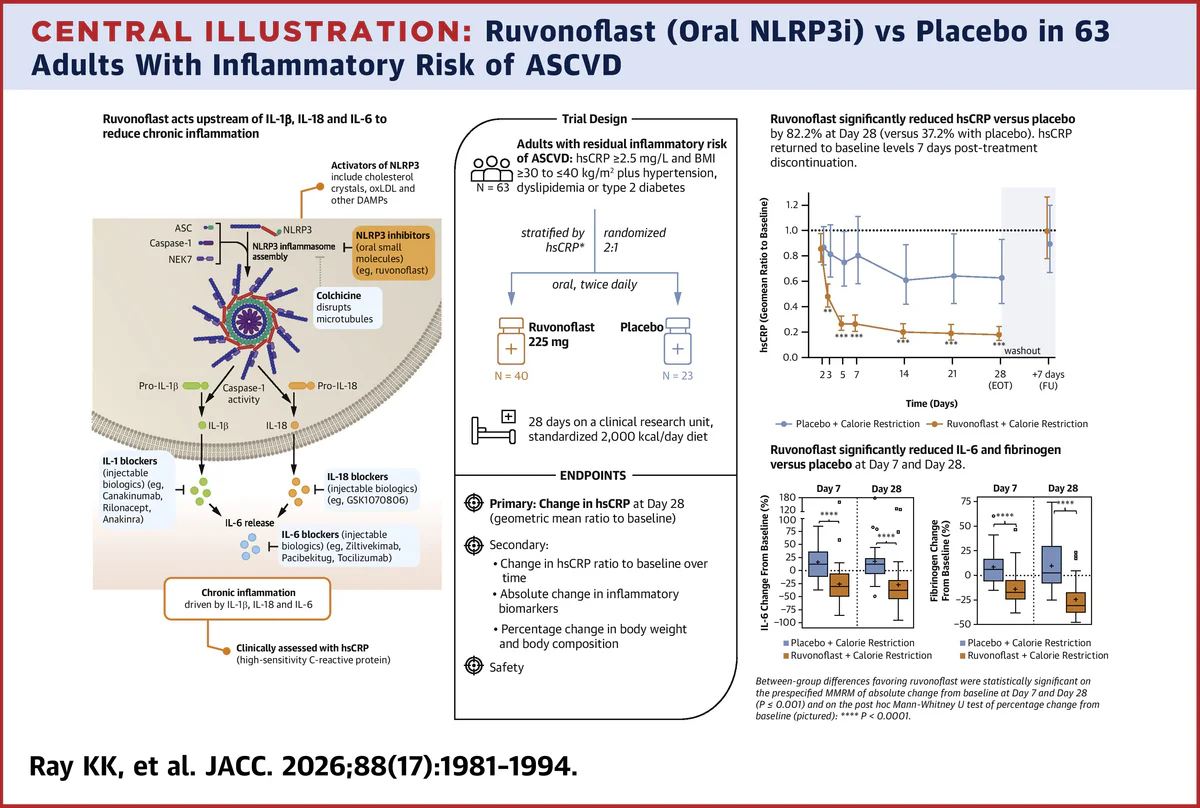
- Oral ruvonoflast, an NLRP3 inflammasome inhibitor, significantly reduced high-sensitivity C-reactive protein (hsCRP) by over 80% at 28 days in obese participants with elevated cardiovascular risk.
- Ruvonoflast also lowered secondary inflammatory biomarkers, including interleukin-6 and fibrinogen, compared to placebo, demonstrating broad anti-inflammatory effects.
- The treatment was generally well tolerated, with transient adverse events leading to discontinuation in 10% of patients, but no significant safety signals emerged.
- The rapid return of hsCRP to baseline after treatment cessation underscores the drug’s reversible and dynamic action on systemic inflammation.
Study Background and Disease Burden
Cardiovascular disease (CVD) remains the leading cause of morbidity and mortality worldwide, heavily associated with chronic low-grade inflammation, especially in individuals with obesity and metabolic dysfunction. The nucleotide oligomerization domain-, leucine-rich repeat-, and pyrin domain-containing protein 3 (NLRP3) inflammasome is an intracellular multiprotein complex pivotal in sensing cellular stress and triggering inflammatory cascades by promoting the maturation and release of pro-inflammatory cytokines like interleukin (IL)-1β and IL-18. Dysregulated NLRP3 activation has been implicated in atherosclerosis pathology and other noncommunicable diseases contributing to cardiovascular events. Current anti-inflammatory strategies targeting inflammasome pathways (e.g., IL-1β inhibition) have demonstrated clinical benefit but with limitations regarding delivery and toxicity profiles. Ruvonoflast, an oral inhibitor of the NLRP3 inflammasome, offers a potentially innovative approach to directly modulate this upstream inflammatory sensor, with early clinical data suggesting beneficial systemic and central nervous system anti-inflammatory effects. This study addresses an unmet need for safe, convenient, and effective therapies for residual inflammatory risk in high-risk cardiovascular populations.Study Design
This was a multicenter, randomized, double-blind, placebo-controlled Phase 1b study enrolling 63 adult participants at elevated cardiovascular risk defined by high-sensitivity C-reactive protein (hsCRP) levels ≥2.5 mg/L and obesity (body mass index [BMI] between 30 and 40 kg/m2), compounded by additional cardiovascular risk factors such as dyslipidemia, hypertension, or type 2 diabetes. Participants were randomized 40:23 to receive oral ruvonoflast 225 mg twice daily or matched placebo for 28 days while maintained on a controlled 2,000 kcal/day diet. The primary endpoint was the change from baseline in hsCRP ratio at Day 28, assessed by a Bayesian analysis of covariance model. Secondary endpoints included changes in other systemic inflammatory biomarkers such as IL-6 and fibrinogen, as well as body weight changes. Safety and tolerability were monitored throughout via descriptive analyses.Key Findings
The study population had a mean age of 52.6 years, predominantly female (71.4%) and White (69.8%), with median baseline hsCRP of 5.7 mg/L indicating substantial systemic inflammation.Primary Endpoint Results
Treatment with ruvonoflast led to a profound reduction in hsCRP, with an 82.2% geometric least-squares mean decrease at Day 28 (95% confidence interval [CI]: 75.9%–86.8%), compared to a 37.2% reduction (95% CI 7.0%–57.6%) in the placebo group. The posterior probability for superiority exceeded 99%, confirming statistically robust anti-inflammatory efficacy. Differences in hsCRP reduction favoring ruvonoflast were evident as early as Day 3 (P ≤ 0.001), indicating a rapid onset of action. Notably, hsCRP levels rebounded to baseline within 7 days following treatment discontinuation, reflecting a reversible effect on inflammatory status.Secondary Biomarkers
Significant reductions in IL-6 and fibrinogen levels were observed with ruvonoflast compared to placebo at Day 28 (P < 0.001), supporting a broader anti-inflammatory impact beyond hsCRP alone. These biomarkers are known mediators and predictors of cardiovascular events.Weight and Safety
Both groups displayed similar modest percentage reductions in body weight at Day 28, suggesting that weight loss did not confound inflammatory biomarker changes. Adverse events were comparable between groups; however, 4 participants on ruvonoflast (~10%) discontinued treatment due to transient and reversible adverse events, emphasizing the need for continued safety monitoring.Expert Commentary
The data from this Phase 1b trial are compelling in demonstrating that targeted NLRP3 inflammasome inhibition can significantly mitigate systemic inflammation in a high-risk obese population, potentially addressing a critical driver of atherosclerotic progression. The rapid and marked hsCRP reduction is encouraging given the established causative links between elevated hsCRP and cardiovascular events. The reduction of IL-6 and fibrinogen further confirms modulation of key inflammatory pathways. While prior anti-inflammatory therapies such as canakinumab (IL-1β antibody) have shown cardiovascular benefit, their injectable route and immunosuppressive risks pose barriers. Ruvonoflast, as an oral agent with an acceptable safety profile and reversible effects, represents a promising therapeutic advance. Limitations include the relatively small sample size, short duration, and predominance of female and White participants limiting generalizability. Furthermore, clinical cardiovascular outcomes were not assessed, necessitating larger Phase 2/3 studies to evaluate efficacy in event reduction and long-term safety.Conclusion
This pioneering study establishes that oral NLRP3 inhibition with ruvonoflast markedly reduces systemic inflammation as measured by hsCRP and other key biomarkers in obese individuals at elevated cardiovascular risk. The treatment demonstrated an acceptable safety profile and reversible effects on inflammation, supporting further investigation in larger and longer trials to define its therapeutic potential in cardiovascular risk mitigation.Funding and ClinicalTrials.gov
The trial, Effects of NT-0796 in Obese Participants at Risk of Cardiovascular Disease (NCT06129409), is supported by institutional grants and industry collaboration. Additional Phase 2 studies are ongoing to confirm these findings.References
1. Ray KK, Clarke N, Thornton P, et al. Anti-Inflammatory Effects of Oral NLRP3 Inhibition With Ruvonoflast Among Individuals at Elevated Cardiovascular Risk. J Am Coll Cardiol. 2026;88(17):1981-1994. PMID: 42187339. 2. Ridker PM, et al. Inflammation, hsCRP, and Cardiovascular Disease: Clinical Implications. Circulation. 2021;143(25):2510-2522. 3. Tschopp J, Schroder K. NLRP3 inflammasome activation: The convergence of multiple signaling pathways on ROS production? Nat Rev Immunol. 2010;10(3):210-215. 4. Ridker PM, et al. Effect of interleukin-1β inhibition with canakinumab on cardiovascular events. N Engl J Med. 2017;377(12):1119-1131.Specialty calculators
For clinical reference; use professional judgment.