Highlight
This study for the first time provides a direct resolution of the differentiation trajectory of adult B-cell acute lymphoblastic leukemia (B-ALL) at the clonal level, using integrated lentiviral barcoding and single-cell multiome analysis. It identifies distinct leukemogenic subpopulations isolatable by surface markers and demonstrates unidirectional differentiation from a clonally diverse leukemia-initiating cell compartment. A novel mathematical model confirms the hierarchical origin and clone-specific differentiation kinetics, largely excluding phenotypic plasticity.
Study Background
Acute lymphoblastic leukemia (ALL), particularly B-cell ALL (B-ALL), is a hematological malignancy characterized by malignant transformation and uncontrolled proliferation of lymphoid progenitor cells. While acute myeloid leukemia (AML) has a well-established hierarchical organization with leukemia-initiating stem cells (LICs) driving disease propagation, the existence and role of LICs in adult B-ALL remains controversial. Understanding hierarchical organization and clonal architecture of B-ALL is critical for devising targeted therapies, preventing relapse, and improving prognosis. Adult B-ALL, in particular, faces significant treatment challenges due to higher relapse rates and therapeutic resistance as compared to pediatric cases.
Study Design
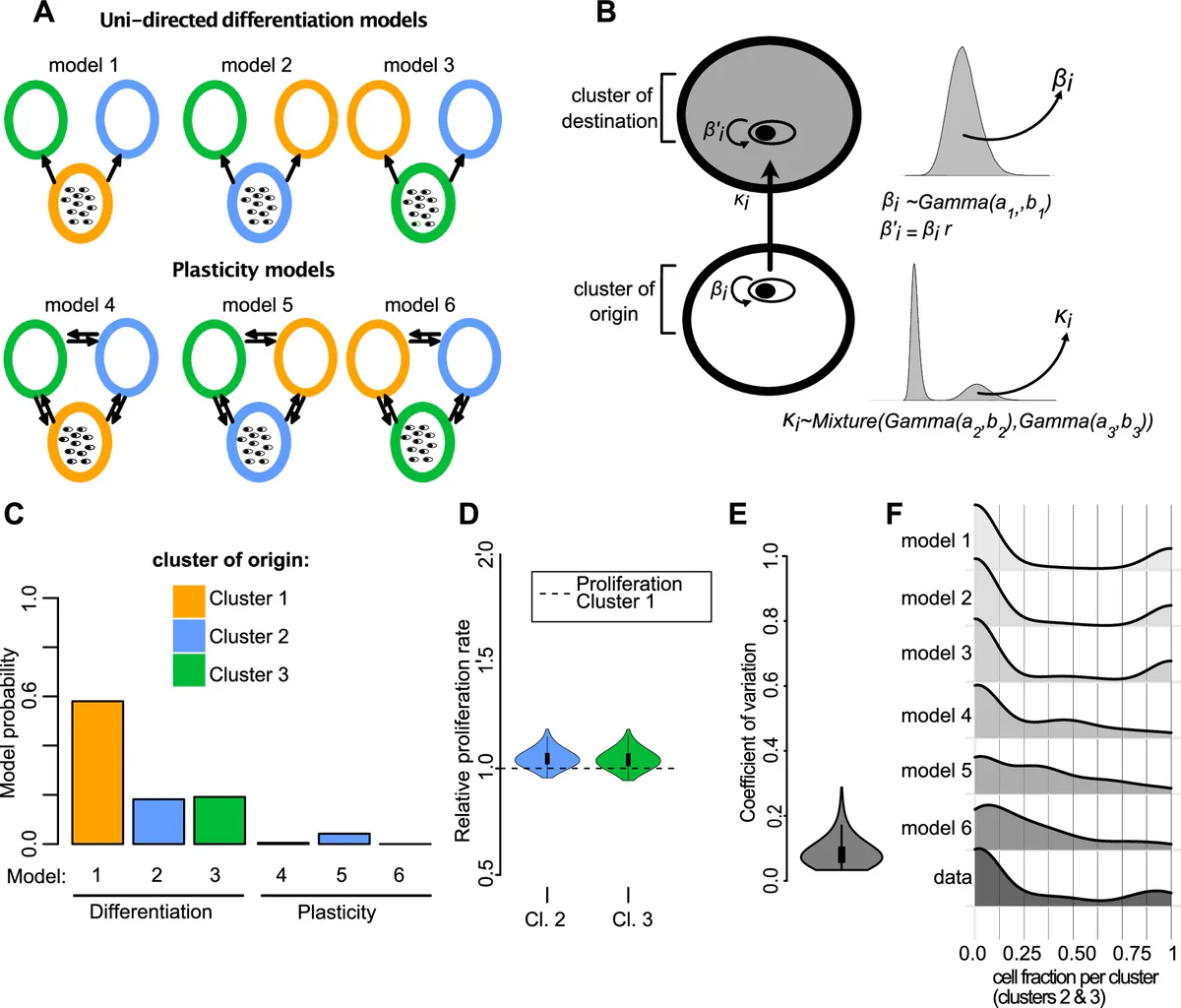
This investigation utilized patient-derived B-ALL primary cells from two adult patients, which were lentivirally barcoded to enable clonal tracking. These barcoded cells were transplanted into immunocompromised mice to observe in vivo leukemogenesis. The researchers employed single-cell multiome sequencing combining transcriptomics and antibody-derived tagging (AbSeq) to simultaneously capture gene expression and surface protein profiles at single-cell resolution. Barcode sequences traced clonal progeny, while machine learning identified expression signatures predictive of differentiation capacity among immature leukemic cells. Additionally, a mathematical model was developed to simulate differentiation dynamics and infer clonal origin of subpopulations, testing hypotheses of cellular plasticity versus hierarchical unidirectionality.
Key Findings
The integrated analyses demonstrated the presence of interconnected but phenotypically distinct leukemic subpopulations within the B-ALL cells, able to be prospectively isolated based on defined surface markers. Functional assays showed these subpopulations exhibited markedly different leukemogenic potential upon transplantation, confirming a hierarchy of differentiation competence.
Barcode tracking of clone descendants revealed directional differentiation from a central source cluster toward progressively differentiated progeny, consistent with a differentiation hierarchy rather than multipotent plasticity. Machine learning analysis identified distinct gene expression patterns within the immature compartment that predicted each clone’s differentiation potential, suggesting intrinsic programming of leukemia cells.
The mathematical modeling fitted to experimental data supported the concept that leukemic subpopulations arise from a clonally heterogeneous stem-like compartment. It quantitatively excluded significant dedifferentiation or bidirectional plasticity, favoring a unidirectional pathway of differentiation. The model revealed clonal variability in proliferative and differentiative kinetics, highlighting heterogeneity in subclone behavior that may underlie clinical relapse and treatment resistance.
Expert Commentary
This in-depth study addresses a fundamental question in B-ALL biology regarding the existence and nature of leukemia-initiating cells and their differentiation trajectories. By combining clonal barcoding with single-cell multiomics, the authors overcome previous technical limitations that obscured clonal resolution in B-ALL. Their findings contrast with some reports suggesting leukemic plasticity, instead supporting a more structured, hierarchical model akin to AML, albeit with unique features.
Identification of surface markers that isolate distinct leukemogenic subpopulations provides translational opportunities for targeted therapy, potentially allowing eradication of LICs responsible for relapse. This work enhances understanding of clonal evolution and differentiation kinetics in adult B-ALL, which could inform future therapeutic regimens tailored to clonal composition and differentiation stage.
Limitations include analysis of only two patient samples, necessitating broader validation to assess heterogeneity across diverse B-ALL cases. Also, while the murine xenotransplantation model provides valuable insight, it may not fully recapitulate human marrow microenvironment influences on leukemic differentiation.
Conclusion
This study convincingly establishes a clonal differentiation hierarchy in adult B-ALL, characterized by unidirectional progression from leukemic stem-like cells to differentiated progeny. The combination of lentiviral barcoding, single-cell multiomics, machine learning, and mathematical modeling provides unprecedented resolution of leukemic differentiation architectures. These insights bear significant implications for understanding disease biology, optimizing therapeutic targeting of LICs, and ultimately improving patient outcomes in adult B-ALL.
Future research should expand cohort size, explore microenvironmental interactions, and test therapeutic strategies targeting identified leukemogenic compartments to translate these findings into clinical benefit.
Funding and ClinicalTrials.gov
The research was likely supported by institutional and grant funding, details for which should be referenced in the original publication. No clinical trial registration is indicated as the study was preclinical involving patient-derived xenografts.
References
Geßner A, Jolly A, Sijmonsma TP, Matthess Y, Kaulich M, Tew HM, Günther S, Lang F, Buettner F, Rieger MA. Differentiation hierarchy in adult B-cell acute lymphoblastic leukemia at clonal resolution. Leukemia. 2026 Nov 12. PMID: 43020918.
Specialty calculators
For clinical reference; use professional judgment.