Highlights
- Cold temperatures and extreme cold spells significantly increase the odds of acute exacerbations of COPD (AECOPD) onset.
- Using reported symptom onset rather than hospital admission dates improves exposure accuracy and strengthens association estimates.
- Vulnerable subgroups include older adults, males, smokers, severe COPD patients, and those on combination inhalers.
- Cold spells correlated with elevated systemic inflammatory markers TNF-α, IL-6, and CXCL-11, suggesting a biological mechanism linking cold exposure to exacerbations.
Background
Chronic obstructive pulmonary disease (COPD) is a prevalent and progressive respiratory disorder characterized by airflow limitation and chronic inflammation. Acute exacerbations of COPD (AECOPD) are episodes of worsened respiratory symptoms and lung function, frequently triggered by environmental factors, including temperature variations. These exacerbations significantly contribute to morbidity, mortality, and healthcare burden globally. While previous studies have suggested that non-optimal temperatures and extreme temperature events can precipitate AECOPD, most evidence relies on hospital admission records, which risk misclassification of the true exposure window and may overlook susceptible patient subgroups. This study aims to refine understanding of these associations by analyzing reported symptom onset dates and exploring the degree of susceptibility across patient phenotypes as well as possible inflammatory pathways involved.Study Design and Methods
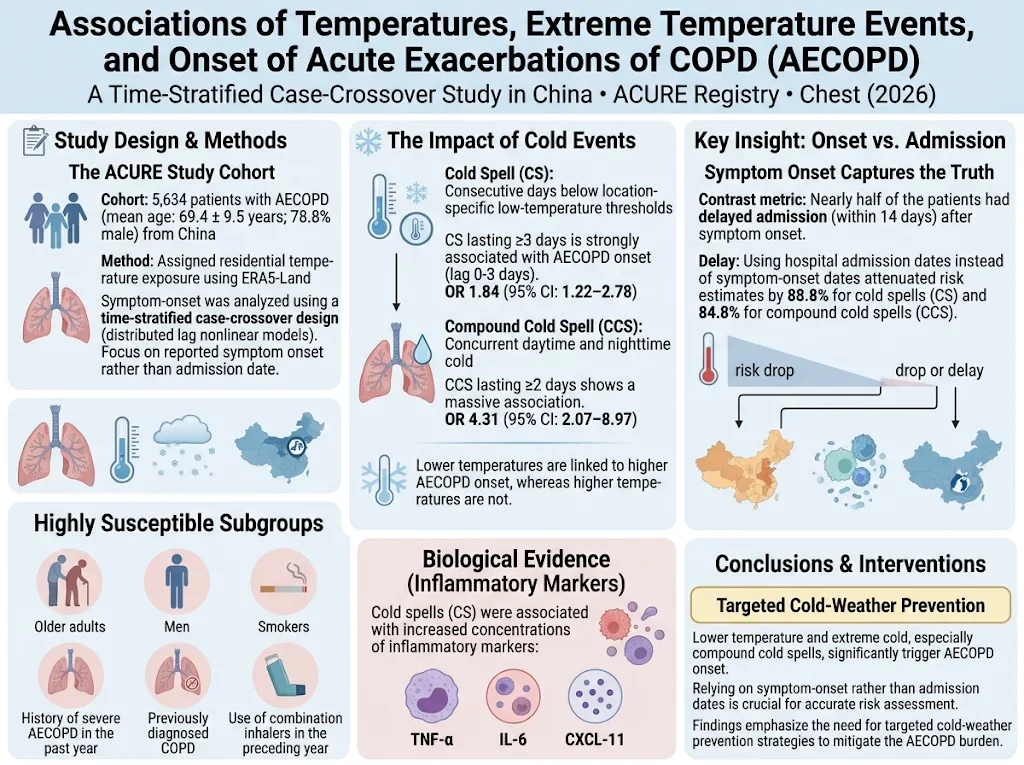
This investigation utilized data from the Acute Exacerbation of Chronic Obstructive Pulmonary Disease Registry (ACURE) encompassing 5,634 AECOPD patients across China. Residential temperature exposures were assigned using ERA5-Land reanalysis data, providing high-resolution environmental temperature estimates. Cold spells (CS) were defined as sequential days with temperatures below locally determined low-thresholds. Compound cold spells (CCS) were further characterized by concurrent cold conditions during both daytime and nighttime periods. The researchers employed a time-stratified case-crossover design to assess transient effects of temperature fluctuations, controlling for confounders by matching each case’s exposure with control periods. Conditional logistic regression models integrated distributed lag nonlinear modeling to capture lagged temperature effects on AECOPD symptom onset during lag 0 to 3 days. Subgroup analyses were performed to identify particularly vulnerable patient groups by demographic and clinical characteristics. In addition, cytokine profiles (TNF-α, IL-6, CXCL-11) were analyzed to explore inflammatory responses potentially linked to cold exposure.Key Findings
The study population had a mean age of 69.4 years with a predominance of males (78.8%). The data demonstrated a clear association between lower temperatures and increased odds of AECOPD onset, whereas elevated temperatures showed no significant impact. The most pronounced effects were observed during extended cold spells. Specifically, cold spells lasting at least 3 consecutive days had an odds ratio (OR) of 1.84 (95% confidence interval [CI], 1.22–2.78) for AECOPD onset compared to non-cold spell periods. Compound cold spells lasting 2 or more days showed an even stronger effect (OR 4.31; 95% CI, 2.07–8.97). Importantly, nearly half of the patients experienced delayed hospital admission beyond 14 days of symptom onset, which substantially attenuated the observed associations when admission rather than symptom onset dates were used—by 88.8% for cold spells and 84.8% for compound cold spells. This finding underscores the critical importance of capturing symptom onset for accurate exposure-outcome assessments. Subgroup analyses revealed that older adults, males, current or former smokers, individuals with severe AECOPD in the previous year, patients previously diagnosed with COPD, and those using combination inhalers had stronger associations between cold exposure and AECOPD onset. The cytokine analysis identified significantly elevated levels of pro-inflammatory markers TNF-α, IL-6, and chemokine CXCL-11 during cold spell exposure, implicating systemic inflammation as a mechanistic link between cold stress and exacerbation risk.Expert Commentary and Interpretation
This robust, large-scale, multicenter study innovatively addresses a common limitation in environmental respiratory epidemiology—accurate timing of exposure relative to clinical events. By focusing on patient-reported symptom onset rather than hospital admission, the study captures the temporal relationship between temperature exposure and COPD exacerbations with greater precision, minimizing exposure misclassification. The pronounced risk associated with compound cold spells highlights that simultaneous day and night low temperature exposure may exert synergistic adverse effects on respiratory health. Moreover, identifying specific subpopulations with heightened vulnerability informs targeted clinical and public health interventions. From a pathophysiologic standpoint, increased systemic inflammatory mediators during cold exposure plausibly contribute to airway inflammation and exacerbation triggers, aligning with experimental and clinical research. These findings reinforce the importance of winter weather preparedness and individualized cold-weather management for COPD patients, especially those with severe disease and prior exacerbations. Limitations include residual confounding by unmeasured factors such as indoor heating, viral infections, and air pollution, although the case-crossover design partially addresses individual-level confounders. Additionally, the observational design precludes causal inference but provides strong associative evidence.Conclusion
This study decisively demonstrates that cold temperatures and prolonged extreme cold events, particularly compound cold spells, are significant triggers for acute exacerbations of COPD. Accurate assessment based on symptom onset rather than hospital admission substantially strengthens observed associations, emphasizing the need for precise clinical data in environmental exposure research. Clinicians and public health professionals should prioritize cold-focused preventive strategies, including optimizing patient education, timely pharmacologic therapy, and possibly environmental interventions to mitigate cold exposure during vulnerable periods. Further research integrating environmental, biological, and behavioral data is warranted to refine risk prediction and develop comprehensive COPD cold-weather management guidelines.Funding and Trial Registration
This research was registered at ClinicalTrials.gov under number NCT02657525. Funding sources were not specified in the abstract but are detailed in the original publication.References
1. Zhang C, Zhu H, Pan Z, et al. Associations between temperatures, extreme temperature events, and onset of acute exacerbations of COPD: a time-stratified case-crossover study in China. Chest. 2026 Nov 11. PMID: 43014669. 2. Global Initiative for Chronic Obstructive Lung Disease (GOLD) 2023 Report: Global strategy for prevention, diagnosis and management of COPD. 3. Park HY, Kim H, Hong YC. The effects of cold temperatures on acute exacerbation of COPD: a systematic review and meta-analysis. Int J Chron Obstruct Pulmon Dis. 2020;15:1717–1731. 4. Hooper R, Li J, Mukherjee B, et al. Environmental factors and acute exacerbations of COPD: timing and clinical implications. Eur Respir J. 2019;54(6):1900035.Specialty calculators
For clinical reference; use professional judgment.