Highlight
This exploratory study identified a bidirectional relationship between body mass index (BMI) and peripheral inflammatory markers, especially neutrophil-to-lymphocyte ratio (NLR), influencing assisted reproductive technology (ART) outcomes in women with polycystic ovary syndrome (PCOS). Higher BMI and elevated NLR were associated with fewer oocytes retrieved and a reduction in high-quality embryos, with BMI showing a greater mediating effect on reproductive outcomes.
Study Background
Polycystic ovary syndrome (PCOS) is a common endocrine disorder affecting women of reproductive age and is characterized by ovulatory dysfunction, hyperandrogenism, and polycystic ovarian morphology. Women with PCOS frequently experience infertility, often requiring assisted reproductive technology (ART) to achieve pregnancy. Obesity, measured by BMI, is prevalent among women with PCOS, exacerbating metabolic, hormonal, and inflammatory perturbations that may impair ovarian response and embryo quality during ART treatment.
Chronic low-grade systemic inflammation, reflected by peripheral inflammatory indices such as the neutrophil-to-lymphocyte ratio (NLR), systemic immune-inflammation index (SII), and platelet-to-lymphocyte ratio (PLR), has emerged as a potential mechanistic link between obesity and reproductive dysfunction in PCOS. Yet, the causal pathways and interaction between BMI and inflammation in this context remain incompletely understood. Clarifying these mediation effects may inform personalized interventions to improve ART success in this population.
Study Design
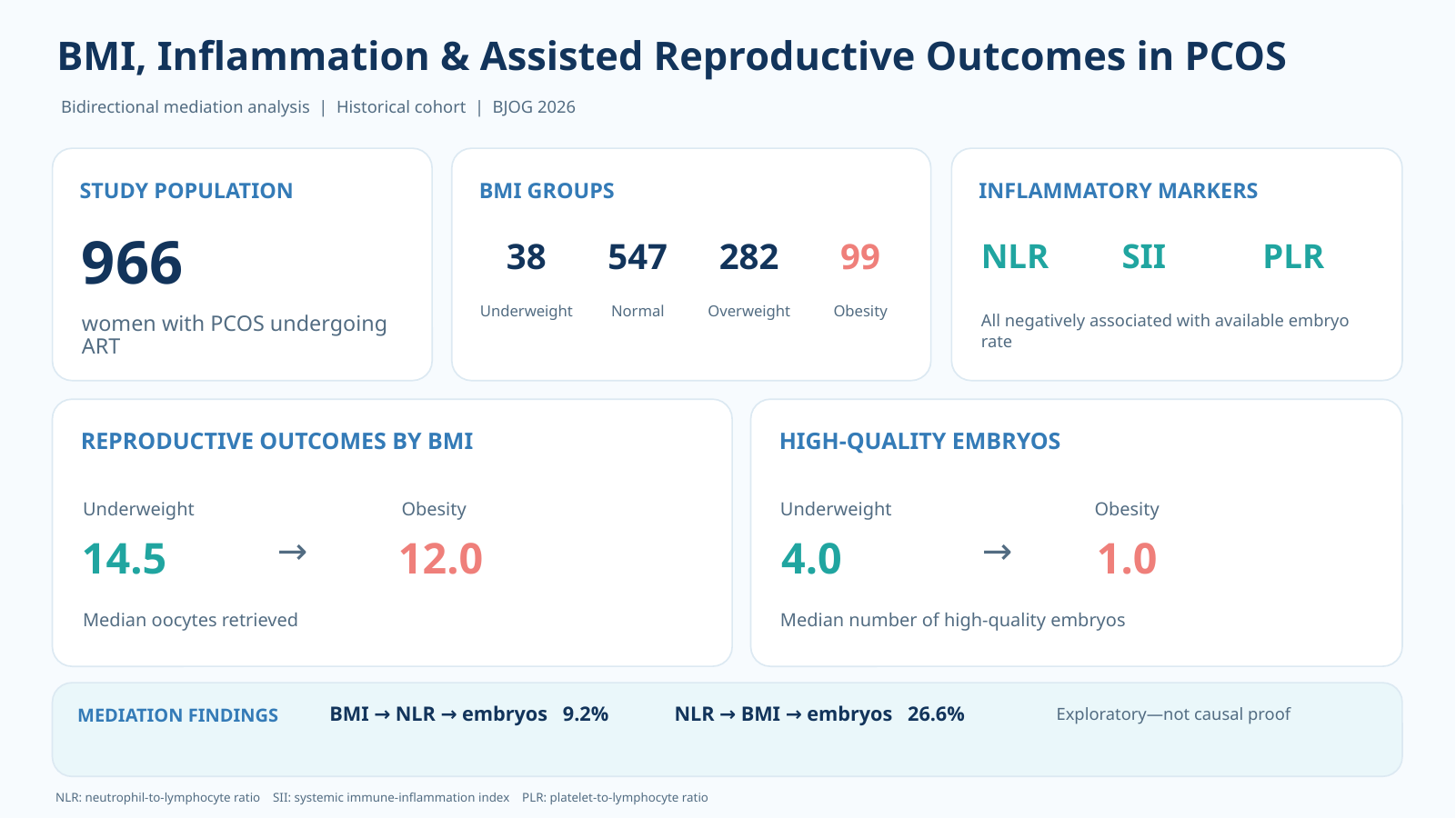
This historical cohort study conducted at the Department of Reproductive Medicine, Nanjing Women’s Hospital, included 966 women diagnosed with PCOS undergoing ART. Participants were categorized by BMI into underweight, normal weight, overweight, and obese groups. Peripheral inflammatory markers – NLR, SII, and PLR – were measured from blood samples.
The study employed robust multivariable regression analyses, restricted cubic spline modeling to assess nonlinear dose-response relationships, and a novel bidirectional causal mediation analysis using Quasi-Bayesian simulation with 1000 iterations to examine the mediation effects of BMI on inflammatory markers and vice versa with respect to ART outcomes.
Main ART outcomes assessed included the number of oocytes retrieved during stimulation, number of high-quality embryos, available embryo rate, and clinical pregnancy occurrence.
Key Findings
The results demonstrated a clear negative association between increasing BMI and ART outcomes. The median number of oocytes retrieved declined from 14.5 in underweight women to 12.0 in obese women (p<0.001). Similarly, the number of high-quality embryos reduced from a median of 4 in the underweight group to 1 in the obese group (p<0.001), indicating compromised oocyte quality and embryo developmental potential with increasing adiposity.
All inflammatory markers (NLR, SII, PLR) exhibited consistent negative dose-response relationships with the available embryo rate, notably with p-values <0.001, highlighting inflammation’s detrimental effect on embryo availability.
Bidirectional mediation analyses revealed complex interrelations:
- NLR mediated 9.2% (95% CI: 2.3%–20.0%) of the effect of BMI on the number of high-quality embryos.
- BMI mediated a significant 26.6% (95% CI: 13.3%–62.3%) of the effect of NLR on high-quality embryos and an even larger 58.6% (95% CI: 5.6%–528.4%) effect on the available embryo rate.
- SII and PLR showed minimal mediation effects (less than 5%) in both directions.
These findings suggest overlapping but predominantly BMI-driven pathways mediating the influence of systemic inflammation, particularly as indexed by NLR, on embryo quality and availability in women with PCOS undergoing ART.
Expert Commentary
The study contributes novel insights into the intricate biochemical and physiological interactions between obesity and systemic inflammation in reproductive outcomes for PCOS women. The use of bidirectional mediation analysis offers a refined methodological approach to dissect complex causal pathways, moving beyond simple associations.
Although the mediation by NLR was modest, the larger proportion mediated by BMI highlights clinical importance of weight management as a modifiable factor to potentially enhance ART outcomes. The minimal mediation effects observed for SII and PLR suggest specificity in inflammatory markers’ roles or perhaps limitations in their predictive utility in this context.
However, this study is exploratory and hypothesis-generating, limited by its single-center retrospective design, potential confounding, and lack of direct mechanistic investigation. The wide confidence intervals for some mediation estimates imply uncertainty that warrants validation in larger, prospective cohorts with mechanistic endpoints.
Biologically, obesity-induced systemic inflammation may impair folliculogenesis, oocyte competence, and endometrial receptivity via altered cytokine profiles and oxidative stress, consistent with the observed ART outcomes deterioration. Targeted anti-inflammatory strategies alongside weight optimization might merit future clinical testing.
Conclusion
This historical cohort study elucidates important bidirectional mediation effects between BMI and inflammatory markers, especially NLR, on assisted reproduction outcomes in PCOS women. The predominant role of BMI in mediating inflammatory impacts on embryo quality and availability underscores the critical influence of adiposity in compromised fertility among PCOS patients.
These findings reinforce the need for integrated clinical strategies addressing both weight and inflammation to improve ART success. Further prospective and mechanistic studies are essential to confirm these pathways and translate insights into optimized individualized therapeutic approaches.
Funding and Clinical Trials Registration
The original study does not report external funding sources or clinical trials registration information.
References
- Teede HJ, Misso ML, Costello MF, et al. Recommendations from the international evidence-based guideline for the assessment and management of polycystic ovary syndrome. Hum Reprod. 2018;33(9):1602-1618.
- Escobar-Morreale HF. Polycystic ovary syndrome: definition, aetiology, diagnosis and treatment. Nat Rev Endocrinol. 2018 Jul;14(7):270-284.
- Diamanti-Kandarakis E, Dunaif A. Insulin resistance and the polycystic ovary syndrome revisited: an update on mechanisms and implications. Endocr Rev. 2012 Dec;33(6):981-1030.
- Yilmaz M, Sati L, Altinkaya S, et al. Systemic immune-inflammation index is increased in women with polycystic ovary syndrome: association with insulin resistance. J Obstet Gynaecol Res. 2019 Aug;45(8):1631-1639.
- Xu Y, Qiao J. Significance of inflammatory markers in patients with PCOS. Reprod Sci. 2019 May;26(5):567-574.