Highlight
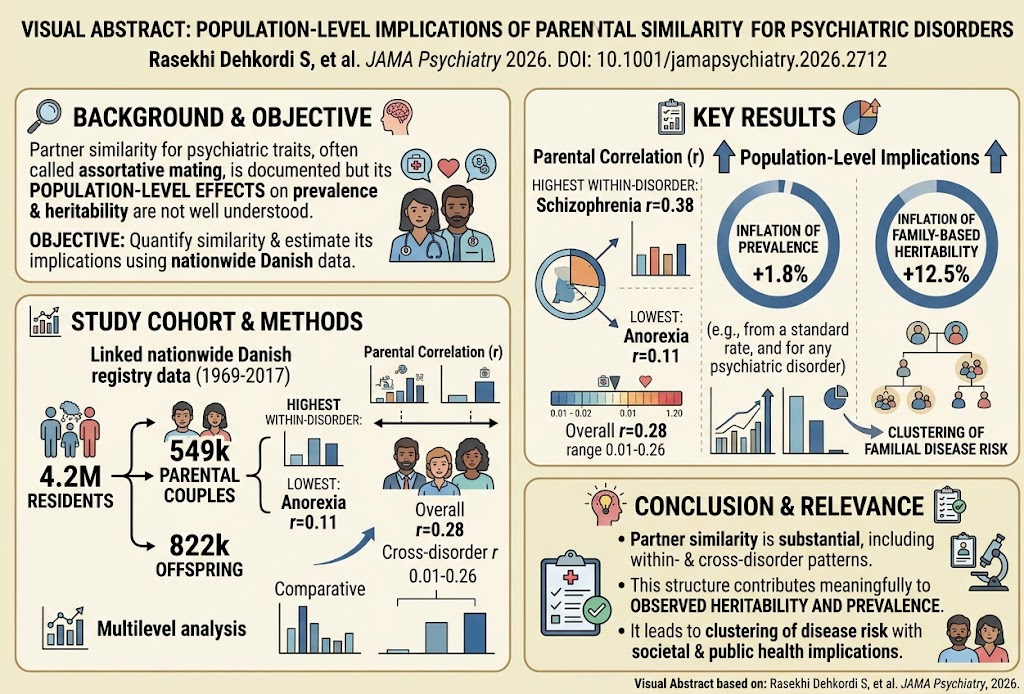
– Parental similarity for psychiatric disorders is substantial, with schizophrenia showing the highest concordance.
– Assortative mating among parents elevates psychiatric disorder prevalence by almost 2% and heritability estimates by over 12%.
– Partner similarity extends to cross-disorder patterns and is less pronounced for somatic comorbidities, mostly explained by psychiatric overlap.
– These findings imply familial clustering of psychiatric risk, informing genetic counseling and public health policy.
Study Background
Psychiatric disorders are highly burdensome worldwide, with complex genetic and environmental etiologies. Traditionally, family-based heritability estimates assume random mating; however, evidence indicates that individuals tend to select partners with similar psychiatric traits—a phenomenon known as assortative mating. This nonrandom mating could inflate estimates of disease prevalence and heritability, thus confounding genetic risk assessments. Despite repeated documentation of partner similarity, the population-level consequences have been largely theoretical and unverified empirically in large, unselected cohorts. This study addresses critical gaps by quantifying partner similarity for psychiatric and somatic disorders, and evaluating its intergenerational implications in a nationwide Danish population.
Study Design
This population-based cohort study utilized nationwide Danish registry data encompassing 4,244,585 residents born between 1969 and 2017. Parental pairs and their offspring were identified through the Danish Civil Registration System, and diagnostic data were extracted from comprehensive national health registers. The study identified 549,541 parental couples and 822,209 offspring. Parental correlations for psychiatric and somatic disorders were calculated, and empirical estimates of prevalence and heritability in offspring were compared against simulated scenarios presuming random mating. Data analysis spanned 2021 to 2026, enabling robust longitudinal evaluation.
Key Findings
Parental correlations for psychiatric disorders were substantial, with an overall correlation coefficient of 0.28 (SE, 0.003). Among individual disorders, schizophrenia exhibited the highest parental concordance (r = 0.38; SE, 0.015), while anorexia nervosa showed the lowest (r = 0.11; SE, 0.029). Cross-disorder correlations ranged from minimal (0.01) to moderate (0.26), suggesting assortative mating extends beyond single disorder categories.
In contrast, somatic illnesses exhibited weaker parental correlations (r = 0.03–0.14), and these associations were almost entirely attributable to comorbid psychiatric disorders, delineating the primacy of psychiatric factors in partner similarity.
Simulation models demonstrated that the observed patterns of nonrandom mating inflated the population prevalence of any psychiatric disorder among offspring by approximately 1.8%. Even more strikingly, family-based heritability estimates increased by 12.5% due to assortative mating effects, illustrating that conventional genetic heritability estimates may be overestimated if nonrandom mating is not considered.
Expert Commentary
This comprehensive empirical investigation represents a landmark contribution in psychiatric epidemiology, quantifying assortative mating effects on heritability and prevalence from population-based registers. The high parental concordance, notably for schizophrenia, reaffirms genetic and social selection factors contributing to partner choice.
Methodologically, using nationwide registry data minimizes selection bias and enhances generalizability. However, limitations include potential underdiagnosis or misclassification within registries and the inability to disentangle all mechanisms generating partner similarity (e.g., social homogamy versus direct assortment). Furthermore, the study design precludes definitive causal inference regarding the directionality of mating similarity.
Clinically, these findings implicate assortative mating in familial clustering of psychiatric disease risk, which may affect genetic counseling, risk prediction models, and public mental health strategies. The inflation of heritability estimates suggests revisiting genetic models and interpretation of familial aggregation data.
Conclusion
This large-scale Danish cohort study robustly establishes that partner similarity for psychiatric disorders is considerable and impacts the observed prevalence and heritability estimates at the population level. The findings underscore the importance of considering assortative mating effects when interpreting familial risk and planning public health interventions.
Further research is warranted to elucidate underlying mechanisms driving partner similarity, explore interactions with environmental factors, and assess implications for personalized medicine and psychiatric genetics. Clinicians and public health policymakers should recognize the role of assortative mating in shaping psychiatric disease burden and heritability statistics.
Reference
Dehkordi SR, Meijsen J, Waples R, Zetterberg R, Helenius D, Athanasiadis G, Vaez M, Shorter J, Montalbano S, Hellberg KL, Krebs MD, Ingason A, Werge T, Buil A. Population-Level Implications of Parental Similarity for the Prevalence and Heritability of Psychiatric Disorders. JAMA Psychiatry. 2026 Sep 9:e262712. doi: 10.1001/jamapsychiatry.2026.2712. Epub ahead of print. PMID: 42714899; PMCID: PMC13559730.