Highlight
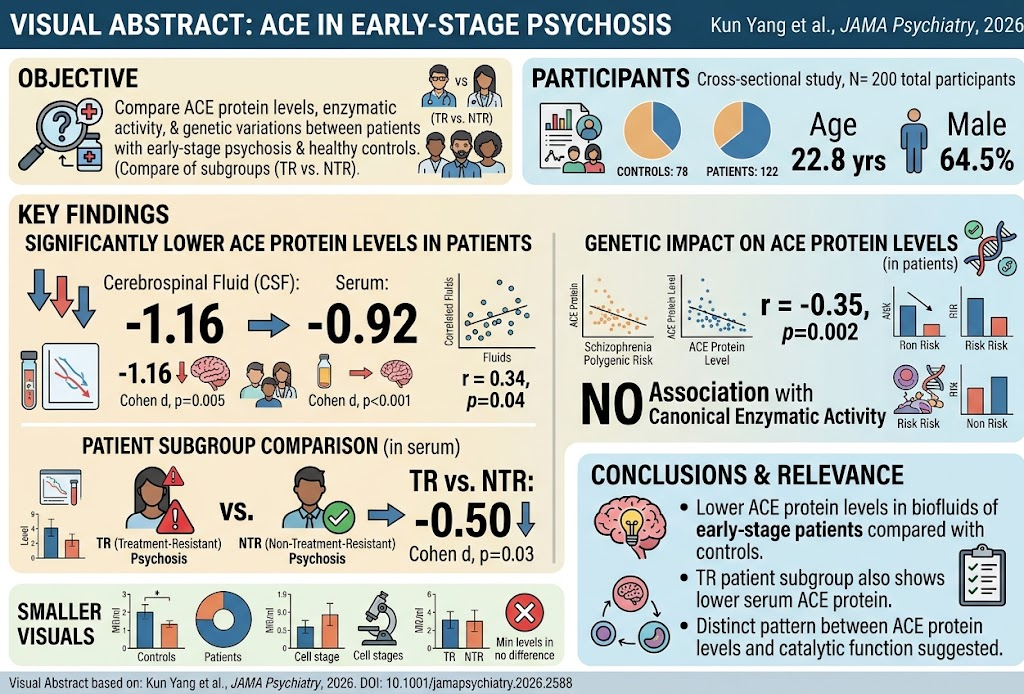
This study identifies significantly lower angiotensin-converting enzyme (ACE) protein levels in both cerebrospinal fluid and serum of patients with early-stage psychosis compared to healthy controls. Notably, patients with treatment-resistant psychosis exhibit even greater reductions in serum ACE protein. Genetic variations linked to schizophrenia correlate with ACE protein levels but not with its canonical enzymatic activity, suggesting distinct biological roles of ACE in psychosis pathophysiology.
Study Background
Psychotic disorders, including schizophrenia, present formidable clinical challenges due to their heterogeneity and lack of reliable objective biomarkers for diagnosis, prognosis, and treatment response. Despite extensive genetic and neurobiological research, translation into clinical biomarkers remains limited. The renin-angiotensin system (RAS), particularly angiotensin-converting enzyme (ACE), is known primarily for cardiovascular regulation but also implicated in neural function and neuroinflammation.
Prior genome-wide association studies (GWAS) have identified ACE genetic variants as risk factors for schizophrenia, suggesting a plausible pathogenic link. However, the downstream biological impact of these variants at the protein level and enzyme function remains unclear, particularly in early-stage psychosis where neurobiological changes may be more amenable to intervention.
Study Design
This cross-sectional study enrolled 200 participants aged 13 to 35 years, including 122 patients with early-stage psychosis (onset within the prior 2 years) and 78 matched healthy controls. Recruitment occurred at the Johns Hopkins Schizophrenia Center between October 30, 2013, and February 9, 2018, with data analysis extending until June 2026.
Primary measures included ACE protein levels in cerebrospinal fluid (CSF) and serum, serum ACE enzymatic activity (canonical renin-angiotensin pathway function), and genomic assessments using genomewide and ACE gene-specific polygenic risk scores. Subgroup comparisons assessed differences between treatment-resistant and non-treatment-resistant psychosis.
Key Findings
The study demonstrated robust reductions in ACE protein levels in patients with early-stage psychosis compared to healthy controls: a large effect size was observed in CSF (Cohen d = -1.16, P = .005) and serum (Cohen d = -0.92, P < .001). ACE protein levels in these biofluids correlated modestly (r = 0.34, P = .04), supporting concordant central and peripheral alterations.
Further genomic analysis revealed that higher ACE-related polygenic risk scores for schizophrenia inversely correlated with ACE protein levels in patients (r = -0.35, P = .002) but showed no significant association with serum ACE enzymatic activity. This dissociation suggests that genetic risk influences ACE protein expression or stability more than its canonical catalytic function.
Among patients, those classified as treatment-resistant psychosis exhibited significantly lower serum ACE protein levels than those with non-treatment-resistant disease (Cohen d = -0.50, P = .03), although enzymatic activity did not differ between these groups. This finding highlights a potential biomarker for treatment resistance and points to pathogenic processes beyond enzyme catalysis.
Expert Commentary
The study’s finding of reduced ACE protein but preserved canonical enzymatic activity challenges traditional views of ACE’s role in psychosis and schizophrenia. It suggests that ACE may have non-canonical functions, possibly in neuroinflammation, neuronal signaling, or blood-brain barrier integrity, which could impact psychosis onset and progression.
Notwithstanding the cross-sectional design, which limits direct causal inference, the correlation between genetic risk and ACE protein levels provides mechanistic plausibility linking ACE genetics to biological dysfunction. This work underscores the complexity of molecular pathways in psychosis and advocates for research into non-enzymatic roles of ACE and targeted therapies.
Limitations include the moderate sample size, potential confounders such as medication use, and lack of longitudinal follow-up to assess changes over disease course and treatment response. Generalizability to chronic stages of psychosis or other psychiatric disorders also warrants evaluation.
Conclusion
Lower ACE protein levels in the CSF and serum characterize early-stage psychosis and are further reduced in treatment-resistant cases, while enzymatic activity remains unaffected. These findings indicate that ACE protein expression, influenced by schizophrenia-associated genetic variation, may serve as a biomarker for psychosis and a candidate for novel mechanistic and therapeutic investigation.
Future studies should explore longitudinal dynamics of ACE in psychosis, its functional roles beyond enzymatic catalysis, and the potential benefit of modulating ACE pathways to improve clinical outcomes, particularly in treatment-resistant populations.
Funding and Clinical Trials
The study was supported by institutional and grant funding through Johns Hopkins Schizophrenia Center and related NIH grants. No clinical trial registration number is reported, consistent with the cross-sectional observational design.
Reference
Yang K, Longo L, Di Carlo P, Lam M, Wang R, Etyemez S, Mihaljevic M, Cascella NG, Nucifora FC Jr, Coughlin JM, Nestadt G, Sedlak TW, Hayes L, Sawa A. Angiotensin-Converting Enzyme in Patients With Early-Stage Psychosis. JAMA Psychiatry. 2026 Sep 9:e262588. doi: 10.1001/jamapsychiatry.2026.2588. Epub ahead of print. PMID: 42714889; PMCID: PMC13559731.