Highlight
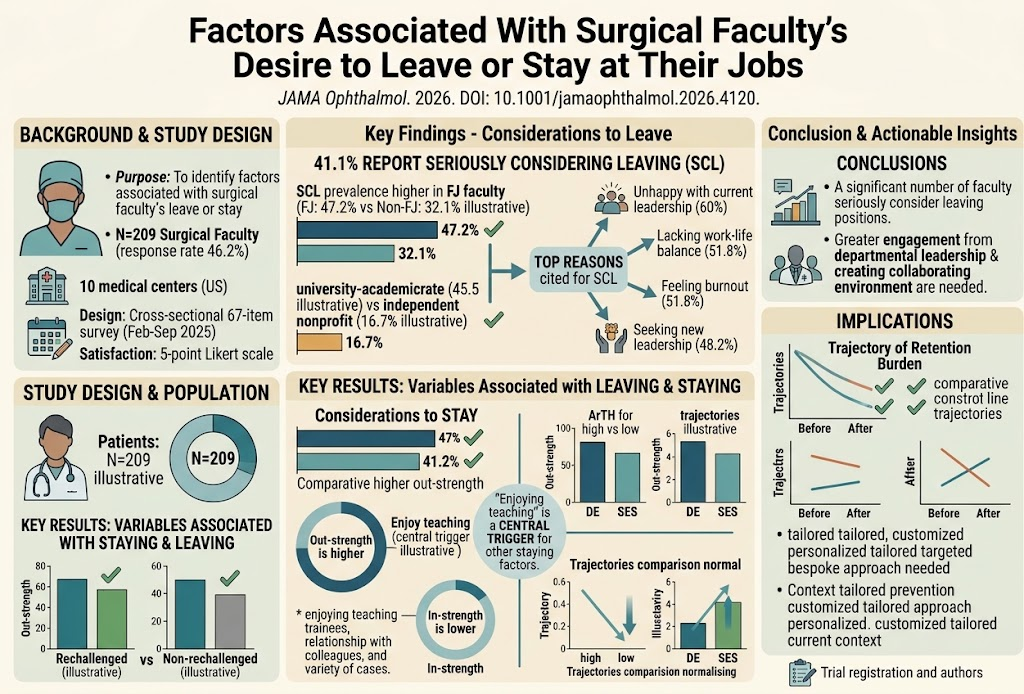
This study identifies major factors influencing surgical faculty’s intent to leave their positions at academic medical centers. Nearly 41% of respondents seriously considered leaving, with main drivers being dissatisfaction with leadership, burnout, and poor work-life balance. Conversely, faculty retention was supported by teaching enjoyment, collegial relationships, and case variety.
Background
Faculty retention within academic surgery is a critical issue, as turnover disrupts patient care continuity, compromises trainee education, and leads to financial losses from diminished research funding and clinical revenue. Recruitment of new surgical faculty demands substantial departmental resources, making retention essential for maintaining a stable and productive workforce. Understanding the determinants of job satisfaction and intent to remain or leave is vital to institute actionable strategies in academic medical environments.
Study Design
A cross-sectional survey utilizing a 67-item questionnaire grounded in the job demands-resources framework was conducted from February to September 2025. The survey was distributed to 452 full-time surgical faculty at 10 diverse US medical centers. The questionnaire explored demographics, previous faculty attrition, job satisfaction metrics (rated on a 5-point Likert scale), and factors associated with both the desire to leave and motivations to stay. Statistical analyses included χ2 tests and Mann-Whitney U tests to assess associations, with data analyzed between September 2025 and February 2026. The survey demonstrated good internal consistency (Cronbach α > 0.70).
Key Findings
Out of 452 invitees, 209 surgical faculty responded (response rate 46.2%). Among them, 59.4% were in their first job post-training, and academic ranks were nearly evenly distributed between assistant, associate, and full professors.
Key outcomes included:
- Intent to Leave: 41.1% (95% CI, 34.3%-48.1%) reported serious consideration of leaving their current position (SCL).
- Risk Factors for SCL: Higher among first-job faculty (47.2% vs 32.1%; P = .03), those with longer clinical hours (median 50 hours vs 40 hours; P = .05), and variable by institution type: university academic centers (45.5%), university-affiliated centers (48%), and nonprofit independent centers (16.7%; P = .004).
The predominant reasons cited for SCL were dissatisfaction with leadership and governance (60%), lack of work-life balance (51.8%), burnout (51.8%), and seeking new leadership roles (48.2%).
Interestingly, demographic variables such as age, gender, race/ethnicity, geographic region, and academic rank did not predict SCL.
Conversely, faculty chose to stay because they enjoyed teaching trainees, valued relationships with colleagues, and appreciated the diversity and complexity of surgical cases.
Expert Commentary
This robust survey highlights leadership dissatisfaction and burnout as crucial modifiable factors influencing surgical faculty turnover at academic centers. These findings echo previous literature underscoring burnout prevalence in surgery and its adverse impact on job retention. Additionally, the protective effect of positive interpersonal relationships and meaningful teaching opportunities aligns with job resources buffering occupational stress.
The lack of association between demographic factors and intent to leave suggests the universality of these professional stressors across faculty subgroups. Notably, faculty at nonprofit independent centers had significantly lower rates of SCL, indicating that institutional culture and governance style may play a critical role.
Limitations include the moderate response rate and cross-sectional design, which precludes causal inference. Self-report bias may also affect results. Future longitudinal studies could provide greater insight into faculty trajectories and effective retention strategies.
Conclusion
The study reveals that nearly half of surgical faculty in academic medical centers seriously consider leaving their positions, primarily due to leadership issues, burnout, and work-life challenges. Interventions aimed at enhancing leadership engagement, fostering supportive departmental cultures, promoting work-life balance, and providing leadership development opportunities could improve retention. Promoting the rewarding aspects of academic surgery, such as teaching and collaboration, may further sustain faculty commitment.
Addressing these factors is essential to ensure stable surgical departments, uninterrupted patient care, and robust academic missions within medical centers.
Funding and ClinicalTrials.gov
No specific funding source or clinical trial registration was reported for this survey study.
References
1. Shanafelt TD, et al. Burnout and Satisfaction With Work-Life Balance Among US Physicians Relative to the General US Population. Arch Intern Med. 2012;172(18):1377-1385. doi:10.1001/archinternmed.2012.3199
2. Balch CM, et al. Distress and career satisfaction among 14 surgical specialties, comparing academic and private practice settings: National Survey of ASPS Members. J Am Coll Surg. 2011;213(2):274-282. doi:10.1016/j.jamcollsurg.2011.04.039
3. Dyrbye LN, Shanafelt TD. Physician Burnout: A Potential Threat to Successful Health Care Reform. JAMA. 2011;305(19):2009-2010. doi:10.1001/jama.2011.652
4.Sarkissyan M, de Virgilio C, Amersi F, Blair SL, Cunningham LA, Govekar HR, Senthil M, Shebrain S, Siletz A, Valerian BT, Wexner SD, Schwed AC. Factors Associated With Surgical Faculty’s Desire to Leave or Stay at Their Jobs. JAMA Surg. 2026 Sep 23:e264382. doi: 10.1001/jamasurg.2026.4382. Epub ahead of print. PMID: 42776512; PMCID: PMC13602075.