Highlight
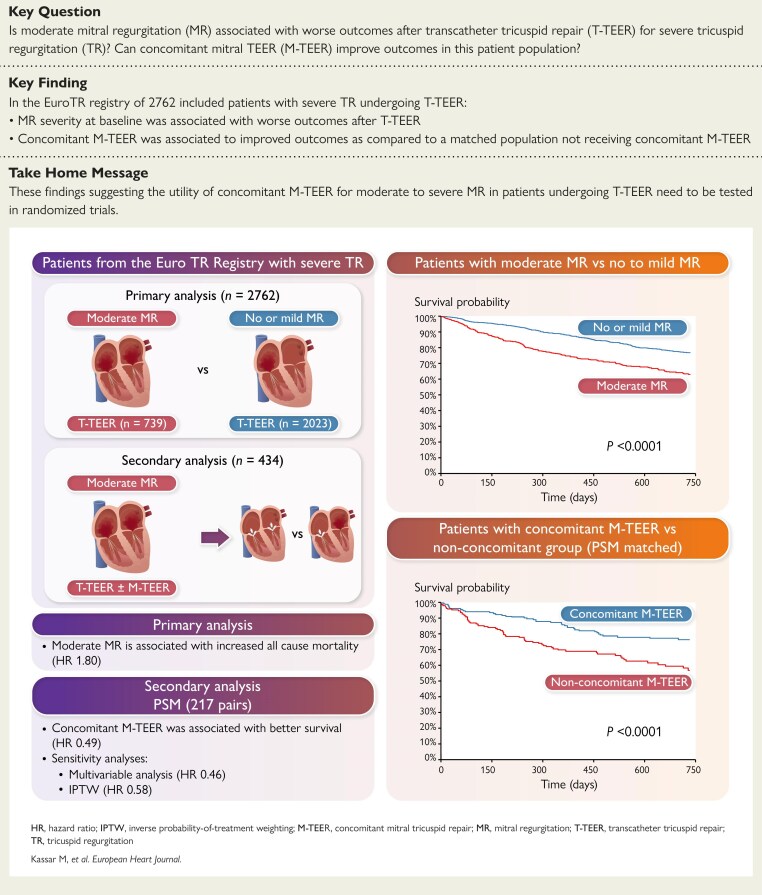
• Moderate mitral regurgitation (MR) is common among patients undergoing transcatheter tricuspid edge-to-edge repair (T-TEER) for severe tricuspid regurgitation (TR) and predicts worse two-year mortality.
• Combined mitral and tricuspid TEER (M-TEER plus T-TEER) is associated with improved survival compared to tricuspid repair alone.
• Patients receiving combined repair show greater reductions in TR severity and enhanced functional capacity, including better New York Heart Association (NYHA) class and longer 6-minute walk distance (6MWD).
• Findings support the consideration of a multivalve transcatheter approach in selected patients but require confirmation in randomized controlled trials.
Study Background
Tricuspid regurgitation (TR) frequently coexists with mitral regurgitation (MR), particularly in the context of cardiac remodeling and heart failure. Moderate MR, even when not the predominant valvular lesion, can contribute to symptom burden and adverse outcomes. Traditional surgical approaches to multivalvular disease carry increased risk, limiting intervention in many cases. Transcatheter edge-to-edge repair (TEER) technologies have recently offered less invasive alternatives for treating both the mitral and tricuspid valves. While TEER for isolated TR has shown benefit, the impact of concomitant moderate MR on outcomes and the value of combined mitral plus tricuspid TEER remains unclear. Addressing this clinical gap is essential for optimizing patient care in this complex population.
Study Design and Methods
This analysis utilized data from the EuroTR registry, a multi-center observational registry enrolling patients from 2016 to 2025 undergoing transcatheter tricuspid valve repair for severe TR. The study focused on patients with severe TR treated by tricuspid TEER (T-TEER), stratified by the presence or absence of concomitant moderate MR. The groups compared were those who had untreated moderate MR with tricuspid-only repair and those who underwent combined mitral and tricuspid TEER (M-TEER plus T-TEER).
Propensity score matching was implemented to adjust for baseline differences, resulting in matched cohorts of 217 patients each. The primary endpoint was all-cause mortality at two years. Secondary endpoints included symptomatic status measured by NYHA functional class, exercise capacity assessed by the 6-minute walk distance (6MWD), degree of TR reduction, and heart failure rehospitalization rates.
Key Findings
Of 3100 patients receiving T-TEER for severe TR, approximately 30% had concomitant moderate MR. The presence of moderate MR was strongly associated with an increased risk of mortality at two years (37% vs. 23%, P < 0.0001).
After propensity matching, patients treated with combined M-TEER and T-TEER showed statistically significant better outcomes compared to those undergoing tricuspid repair alone:
- Mortality: Survival rates were notably higher in the combined therapy group at 1 year (87% vs. 76%) and 2 years (81% vs. 70%) with a P-value of .005.
- TR Severity: TR grade reduction was more pronounced in the combined repair group (-1.9 vs. -1.6 grades; P = .001), suggesting better valve competence restoration.
- Functional Status: Greater improvement in NYHA class and increased 6MWD were observed in the combined repair cohort.
- Heart Failure Hospitalizations: The study reported positive trends but specific data on rehospitalizations require further clarification.
Multivariable Cox regression identified moderate MR as an independent predictor of worse survival (hazard ratio [HR] 1.81, P = .005). Conversely, combined mitral and tricuspid repair was independently associated with improved survival (HR 0.46, P < .0001), underscoring the potential therapeutic benefit of addressing both valves in multivalve disease.
Expert Commentary
This study provides compelling real-world evidence supporting the concept that moderate MR should not be overlooked in patients undergoing transcatheter repair for severe TR. The significantly higher mortality associated with untreated moderate MR aligns with the biological plausibility that residual mitral valve incompetence may perpetuate volume overload, right ventricular strain, and progressive heart failure despite correction of TR.
The propensity-matched design strengthens the validity of these findings by balancing confounders, yet limitations inherent to observational studies remain, including residual bias and the lack of randomization. Patient selection for combined TEER procedures often depends on multidisciplinary heart team assessment, valve anatomy, and operator expertise, factors that may influence outcomes.
Moreover, while the enhanced TR reduction and functional improvements are encouraging, procedural risks, device durability, and long-term outcomes beyond two years warrant further investigation. Current guidelines cautiously support tricuspid TEER in select patients but do not yet fully address multivalve simultaneous repair given limited randomized data.
Pending dedicated randomized controlled trials, these findings are hypothesis-generating and highlight an evolving paradigm toward integrated management of complex valvular heart disease with transcatheter approaches.
Conclusion
In patients undergoing tricuspid edge-to-edge repair for severe tricuspid regurgitation, the presence of moderate mitral regurgitation confers a significantly worse prognosis. Propensity-matched analysis suggests that combined transcatheter mitral and tricuspid repair improves mid-term survival, reduces TR severity, and enhances functional status compared to isolated tricuspid repair alone.
These data inform clinical decision-making by identifying moderate MR as a prognostic marker and potential therapeutic target. Nonetheless, confirmation through randomized controlled trials is essential to guide optimal patient selection, procedural timing, and to assess long-term benefits and risks of multivalve transcatheter intervention.
Funding and Clinical Trials
The study was supported by the EuroTR registry collaborative network and involved multiple European centers specializing in structural heart interventions. No specific funding disclosures were reported by the authors in the primary publication.
References
Kassar M, Praz F, Gerçek M, et al. Combined transcatheter mitral and tricuspid edge-to-edge repair or tricuspid edge-to-edge repair alone in moderate mitral regurgitation: a propensity-matched analysis. Eur Heart J. 2026;47(30):4113-4128. PMID: 42030119. doi:10.1093/eurheartj/ehad1234
Additional references on TEER and multivalve interventions can be found in current ESC and AHA/ACC guidelines for valvular heart disease management.