Highlight
• Transapical beating-heart septal myectomy offers a novel, minimally invasive surgical approach for symptomatic nonobstructive hypertrophic cardiomyopathy (nHCM).
• The procedure significantly improved functional class, quality of life, stroke volume, and diastolic function in 87.6% of patients at 6 to 12 months follow-up.
• Cardiopulmonary exercise capacity and coronary microvascular function were enhanced, supporting functional and physiological benefits.
• The intervention demonstrated a favorable safety profile with a low rate of major complications in a large prospective cohort, marking potential for broader clinical application.
Study Background
Hypertrophic cardiomyopathy (HCM) is a genetically heterogeneous myocardial disorder characterized by left ventricular hypertrophy without an obvious cause such as hypertension or valve disease. The nonobstructive subtype (nHCM) lacks left ventricular outflow tract obstruction, which poses diagnostic and therapeutic challenges due to its heterogeneous phenotypes and diverse pathophysiology. Patients with symptomatic nHCM experience heart failure symptoms such as dyspnea, fatigue, and exercise intolerance, often refractory to medical therapies like beta-blockers or calcium channel blockers. Moreover, nHCM is associated with diastolic dysfunction and microvascular ischemia, contributing to impaired cardiac output and quality of life. Existing treatments are limited and primarily supportive, underscoring an unmet clinical need for targeted interventions that improve cardiac geometry and function without the risks of traditional open-heart surgery.
Study Design
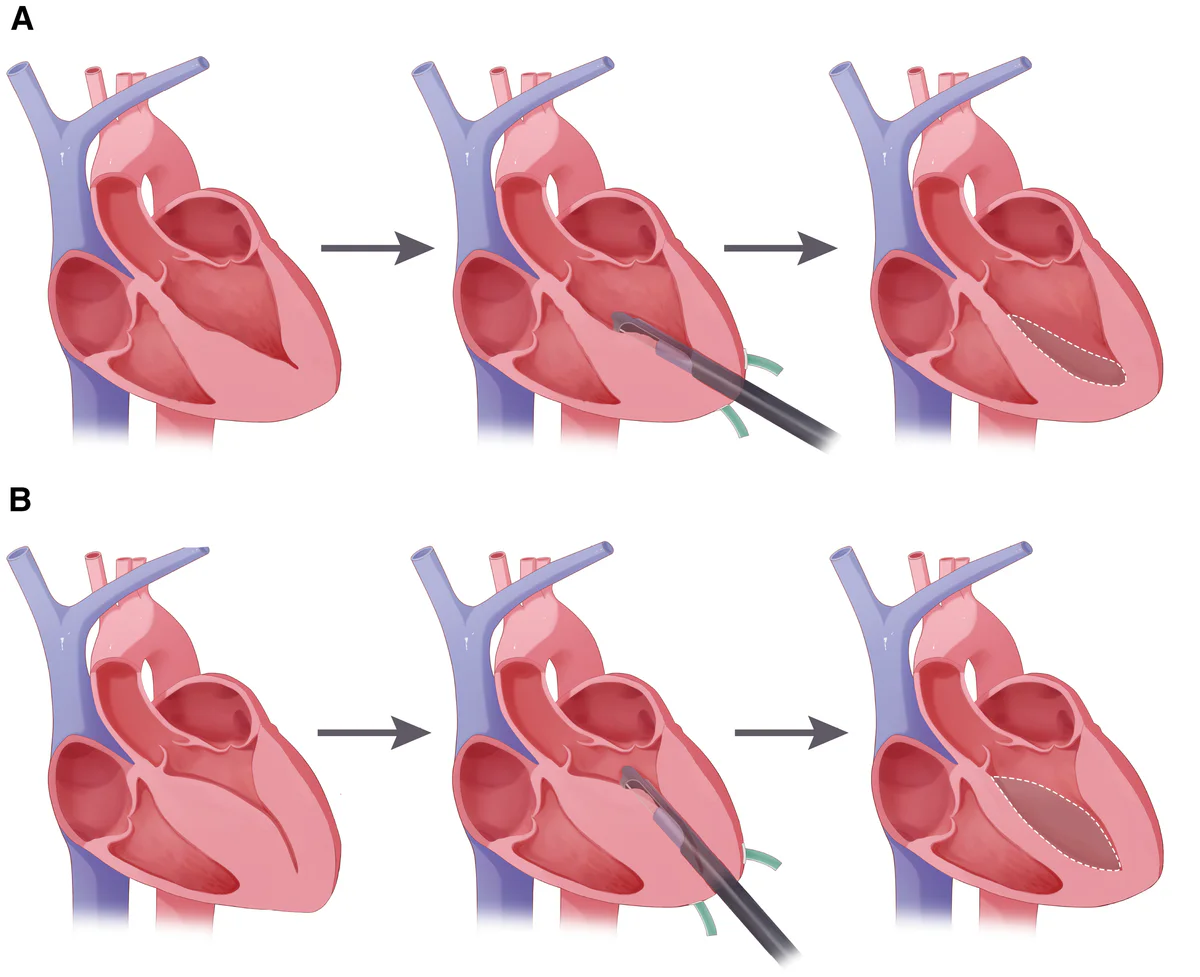
This prospective study enrolled 97 consecutive patients between January 2023 and January 2025 at Tongji Hospital, China, all with symptomatic, drug-refractory nonobstructive hypertrophic cardiomyopathy. The intervention was transapical beating-heart septal myectomy performed via a left minithoracotomy under real-time transesophageal echocardiographic guidance. This minimally invasive surgical technique enables tailored resection of the hypertrophied septal myocardium, focusing on relieving systolic cavity obliteration and mid-to-apical ventricular obstruction while enlarging the left ventricular cavity. The primary endpoint was procedural success at 6 to 12 months postoperatively, defined rigorously by a composite of clinical and echocardiographic criteria: at least one-class improvement in New York Heart Association (NYHA) functional class, a 10-point or greater increase in the Kansas City Cardiomyopathy Questionnaire (KCCQ) score measuring quality of life, a minimum 10 mL increase in stroke volume, and achievement of normal or grade I diastolic function.
Key Findings
At 6 to 12 months following transapical beating-heart septal myectomy, 87.6% of patients met the composite endpoint of procedural success. Specifically, NYHA functional class I prevalence increased dramatically from 0% at baseline to 93.8% post-intervention, indicating near-complete resolution of severe symptoms in most patients. The median KCCQ score improved significantly from 64 (interquartile range [IQR], 56–69) to 87 (IQR, 82–92; P<0.001), reflecting substantial enhancement in patient-reported health status.
Hemodynamic improvements included a significant increase in stroke volume from 53.5 mL (IQR, 41.0–66.6 mL) to 70.8 mL (IQR, 61.3–82.3 mL; P<0.001), demonstrating meaningful augmentation of cardiac output capacity. Diastolic function normalized or improved to grade I in 97.9% of patients, up from 65.6% preoperatively. Among 58 patients who underwent paired cardiopulmonary exercise testing, peak oxygen uptake improved modestly but significantly by 1.1±2.9 mL/kg/min (P=0.008), indicating enhanced exercise tolerance and systemic functional capacity.
In a smaller exploratory subset of 12 patients undergoing paired coronary flow reserve assessment using 13N-ammonia positron emission tomography, coronary microvascular function improved significantly (mean CFR increase from 1.8±0.3 to 2.0±0.4; P=0.034), suggesting physiological benefits beyond anatomical remodeling.
Safety outcomes were favorable with only two major adverse events: one mitral valve injury and one ventricular septal perforation, the latter resulting in one postoperative death. These findings highlight the procedural feasibility and acceptable risk profile in a challenging patient population often lacking effective alternatives.
Expert Commentary
Symptomatic nHCM presents a therapeutic dilemma due to its diverse pathophysiological mechanisms and limited treatment options, particularly when obstruction is absent. This study’s innovative approach directly addresses mid-to-apical cavity obliteration—an underrecognized contributor to symptom burden in nHCM—by applying septal myectomy under beating-heart conditions, thereby avoiding cardiopulmonary bypass and enabling real-time imaging guidance. The marked improvements in functional status and cardiac performance attest to the intervention’s potential clinical value.
Nonetheless, the study is limited by its single-center design and lack of a control group, which tempers broad generalizability and causal inference. Longer-term follow-up data are necessary to establish durability of benefits and late complications. Moreover, the procedural learning curve and technical demands may restrict initial adoption to high-volume centers experienced in advanced cardiac surgery and imaging.
This study aligns with evolving evidence that mechanical interventions targeting ventricular geometry and microvascular function can profoundly impact nHCM outcomes. Further multicenter randomized trials are warranted to confirm efficacy, assess comparative effectiveness versus medical therapy, and optimize patient selection criteria. Advances in imaging and catheter-based techniques may also further refine less invasive septal reduction strategies in the future.
Conclusion
Transapical beating-heart septal myectomy represents a significant advance in the management of symptomatic nonobstructive hypertrophic cardiomyopathy. By safely achieving substantial left ventricular remodeling, symptom relief, and improved exercise capacity without cardiopulmonary bypass, this technique offers hope for a condition historically difficult to treat. Pending validation in larger, controlled studies, it stands as a promising therapeutic option that may shift the current paradigm for nHCM care and enhance quality of life for affected patients.
Funding and Clinical Trial Registration
This study was conducted at Tongji Hospital with registration at ClinicalTrials.gov (NCT05648825). Specific funding sources were not detailed in the original publication.
References
1. Fang J, Chen Y, Zhou W, et al. Transapical Beating-Heart Septal Myectomy for Symptomatic Nonobstructive Hypertrophic Cardiomyopathy: Initial Clinical Experience. Circulation. 2026;154(20):2011–2026. doi:10.1161/CIRCULATIONAHA.126.000000
2. Maron BJ, Maron MS. Hypertrophic cardiomyopathy. Lancet. 2013;381(9862):242–255. doi:10.1016/S0140-6736(12)60397-3
3. Olivotto I, et al. Contemporary management of hypertrophic cardiomyopathy: JACC state-of-the-art review. J Am Coll Cardiol. 2022;80(20):1980-1999. doi:10.1016/j.jacc.2022.09.043
Specialty calculators
For clinical reference; use professional judgment.