Introduction and Context
The 2026 Task Force 6 statement, “Clinical Considerations for the Care of Competitive Athletes with Congenital Heart Disease” (Brothers et al., Medicine & Science in Sports & Exercise, 2026), addresses a persistent and practical clinical dilemma: how to evaluate and counsel children, adolescents, and young adults who have congenital heart disease (CHD) and wish to participate in competitive sport. Athletes with CHD are too often excluded from competition on the basis of tradition, fear, or limited data rather than individualized risk assessment. Task Force 6 responds to gaps in evidence and evolving opinions by offering a practical framework that integrates anatomy, physiology, symptoms, and targeted testing with a strong emphasis on shared decision-making. Why this statement matters now – The population of children and adults living with repaired or palliated CHD continues to grow; most live well into adulthood and aspire to normal activities, including competitive sport. – Historical guidance was often broad and conservative, partly because sudden cardiac events in athletes with CHD are rare and heterogeneous, producing sparse data for rigid rules. – Advances in imaging, electrophysiology, exercise testing, and ACHD (adult congenital heart disease) care enable more nuanced risk stratification. Task Force 6 consolidates current evidence and expert consensus to help providers move from blanket exclusions toward individualized, evidence-informed decisions.New Guideline Highlights
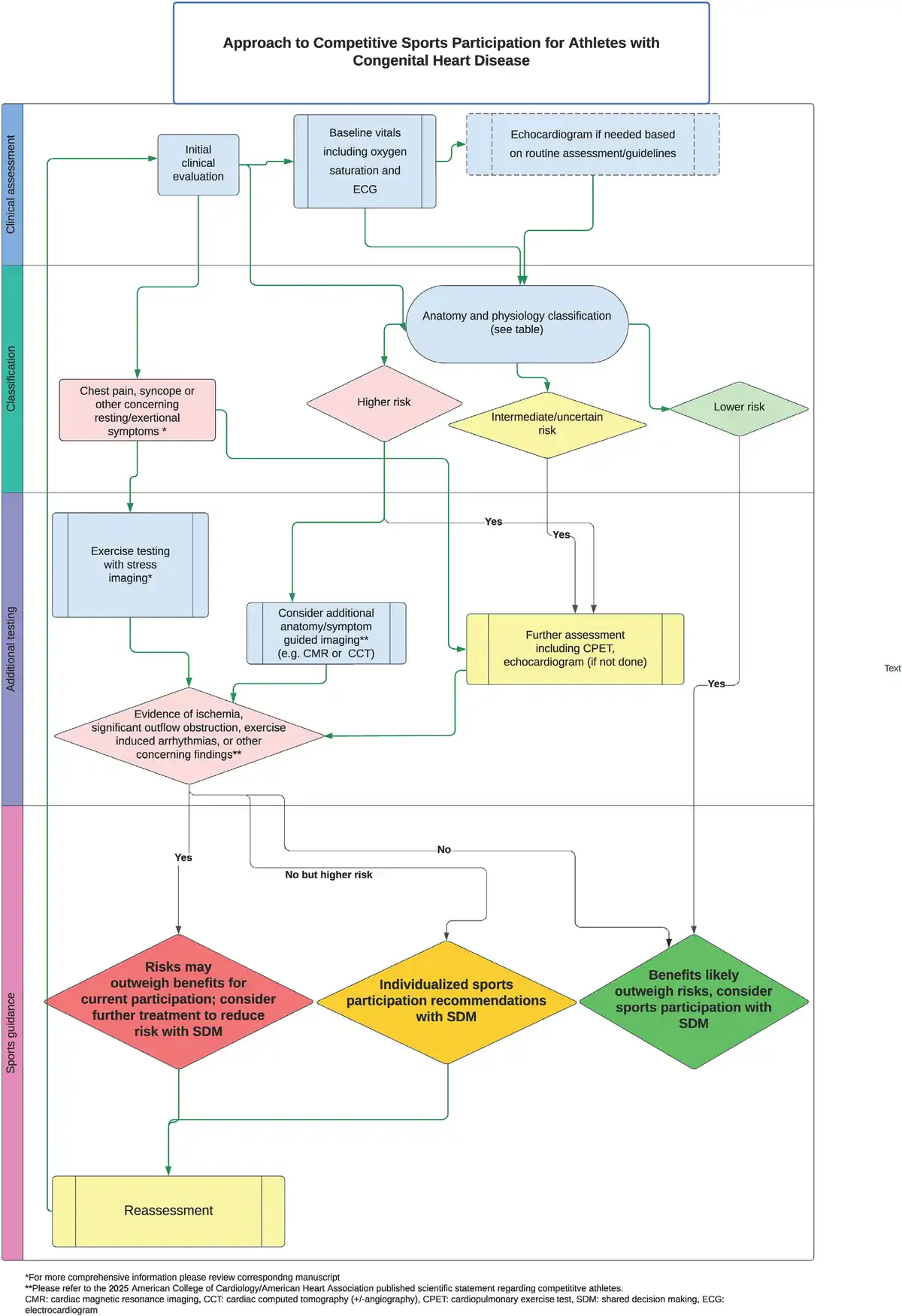
Major themes and takeaways – Presumption in favor of participation: For many athletes with CHD, the benefits of competitive sport—physical fitness, psychosocial well-being, social integration—outweigh the small but real risks of exercise-associated adverse cardiac events. The statement emphasizes individualized assessment rather than automatic restriction. – Integration of four pillars in decision-making: cardiac anatomy (lesion type and repair), physiologic status (ventricular function, hemodynamics), symptoms (syncope, exertional chest pain, palpitations), and testing (ECG, echocardiography, exercise testing, Holter/ILR, cardiac MRI when indicated). – Shared decision-making: The athlete (and family, for minors), the treating clinician (pediatric cardiologist/ACHD specialist), and, when necessary, a sports cardiologist should collaborate in transparent discussions of risks, uncertainties, and preferences. Documentation of the shared decision-making process is recommended. – Specialist involvement: Athletes with moderate or complex CHD, residual lesions, arrhythmia history, ventricular dysfunction, or uncertain hemodynamics should be evaluated by an ACHD or pediatric congenital cardiology expert before final clearance decisions. – Safety planning: Where athletes are cleared, institutions (schools, clubs) should implement emergency action plans, ensure AED availability, and train staff in recognition and response to cardiac emergencies. Key practical points – Simple, well-repaired lesions with normal ventricular function and no symptoms are frequently compatible with full participation. – Residual hemodynamic lesions, cyanosis, significant ventricular dysfunction, uncontrolled arrhythmias, active myocarditis/endocarditis, or significant aortopathy may necessitate restriction or further intervention. – Regular follow-up intervals are tailored by lesion complexity, symptom burden, and competition intensity.Updated Recommendations and Key Changes
What is new or emphasized compared with previous practice – From paternalism to partnership: Explicit endorsement of shared decision-making for most scenarios represents a cultural and practical shift away from clinician-driven blanket prohibitions. – Risk framing by ACHD complexity: The statement leans on established ACHD categorizations (simple, moderate, complex) when recommending who needs subspecialty assessment, refining prior binary ‘‘allow/deny’’ frameworks. – Broader use of functional testing: Cardiopulmonary exercise testing (CPET) and standardized exercise ECG are given higher prominence for assessing exercise capacity, arrhythmia provocation, and hemodynamic responses than in older guidance. – Emphasis on multi-modality imaging: Cardiac MRI is recommended more readily for defining ventricular size/function and scar when echocardiography is limited, especially in tetralogy of Fallot and complex repaired lesions. Summary table: notable shifts (text format) – Prior approach: Conservative exclusion for many repaired lesions without routine testing. – Task Force 6 approach: Individualized evaluation; testing guided by symptoms, lesion type, and athletic level. – Prior approach: Rare use of CPET for routine clearance. – Task Force 6 approach: CPET is encouraged when questions remain about functional capacity or exertional symptoms. Evidence driving changes – Increased survivorship and longitudinal data on repaired CHD show low absolute rates of exercise-related sudden cardiac events except in specific high-risk conditions. – Improved diagnostics (MRI, CPET, ambulatory rhythm monitoring) identify substrate and physiology that better predict risk than diagnosis alone.Topic-by-Topic Recommendations
Preparticipation evaluation: components and triggers for further testing – History and physical exam: Obtain detailed history of surgery/interventions, residual lesions, medications, exercise symptoms (syncope, pre-syncope, palpitations, atypical chest pain), and family history of sudden cardiac death. – Baseline testing recommended for athletes with known CHD: 12-lead ECG (interpreted using athlete-adapted criteria), transthoracic echocardiography targeted to lesion and repair type, and exercise testing (CPET or exercise ECG) when capacity, symptoms, or hemodynamics are uncertain. – Advanced testing: Cardiac MRI for ventricular size/function or scar assessment; ambulatory ECG (Holter or implantable loop recorder) when arrhythmia is suspected; invasive hemodynamics when noninvasive data are insufficient or there is concern about pulmonary vascular disease. Risk stratification by lesion complexity (guided by AHA/ACC ACHD categories) – Simple lesions (e.g., small secundum ASD previously closed without residual shunt, small VSD, isolated bicuspid aortic valve without stenosis or significant aortopathy): Often compatible with full participation after routine testing confirms normal function and no symptoms. – Moderate lesions (e.g., repaired tetralogy of Fallot with residual pulmonary regurgitation, repaired coarctation, moderate valvular lesions): Require individualized assessment, often with CPET, echocardiography, and consideration of MRI. Competitive high-intensity sport may be allowed with counseling if ventricular function is preserved and arrhythmia risk is low. – Complex lesions (e.g., functionally single ventricle/Fontan, transposition after atrial switch, significant cyanotic heart disease, severe pulmonary hypertension, large residual shunts): Typically require ACHD specialist evaluation; many athletes will need tailored activity prescriptions or restrictions depending on function and risk. Arrhythmia considerations – Athletes with a history of sustained ventricular arrhythmia, syncope of suspected cardiac cause, or ICD shocks need specialist evaluation and often restriction until arrhythmia is controlled and risk reassessed. – For those with atrial arrhythmias, stroke risk mitigation and rate control strategies should be individualized; many athletes may continue sport with appropriate anticoagulation and rhythm control as indicated. Aortopathy and risk of aortic events – Significant aortic root dilation (size indexed for body surface area and sex) warrants careful risk stratification. High static-load sports (e.g., weightlifting) may be relatively contraindicated in marked dilation; thresholds should be individualized with ACHD/aortopathy expertise. Pregnancy and transition considerations – For adolescent and young adult female athletes with CHD, counseling should integrate both sports and reproductive planning, as pregnancy-related hemodynamic changes can interact with lesion physiology. – Transition planning from pediatric to adult congenital cardiology care is emphasized to maintain surveillance for late complications that could affect athletic participation. Follow-up and monitoring – Frequency of follow-up is individualized: simple stable lesions may be monitored annually to every few years; moderate/complex lesions often need annual or more frequent review depending on symptoms and testing results. – Repeat CPET, echocardiography, and rhythm surveillance are guided by clinical course, symptoms, and level of competition.Expert Commentary and Insights
Committee perspectives – Balanced risk approach: Task Force authors emphasize the low absolute risk of catastrophic exercise-related events in most CHD populations, advocating for evidence-informed permissive approaches rather than default exclusion. – Need for multidisciplinary care: Multiple authors stress the importance of engaging ACHD-trained cardiologists, electrophysiologists, exercise physiologists, and when appropriate, cardiovascular surgeons in complex decisions. Areas of consensus – Individualized clearance decisions grounded in anatomy, physiology, symptoms, and targeted testing. – Shared decision-making as a central ethical and practical principle. – Importance of AED availability and emergency planning wherever competitive sport is conducted. Areas of controversy and uncertainty – Absolute thresholds for restriction (e.g., specific aortic diameters, ventricular ejection fraction cutoffs) remain imperfect because prospective data linking precise numeric thresholds to outcome in athletes with CHD are limited. – Best modality and frequency for routine longitudinal surveillance in asymptomatic athletes—some experts favor routine CPET while others prioritize symptom-driven testing. – Legal and liability concerns: physicians may face medico-legal pressure either to clear or to restrict athletes. The Task Force recommends careful documentation of the shared decision-making discussion and rationale. Future research priorities highlighted by the panel – Prospective registries of athletes with CHD to better quantify risk by lesion and activity intensity. – Studies to validate exercise- and imaging-based risk markers (e.g., MRI-detected scar, CPET abnormalities) that predict adverse events. – Research into exercise prescription to optimize cardiovascular and psychosocial benefits while minimizing risk.Practical Implications
How clinicians can apply these recommendations now – Start with a thorough history and focused physical exam. Use athlete-specific ECG interpretation criteria (e.g., 2017 International Criteria) to reduce false positives. – For any athlete with moderate or complex CHD, symptomatic athletes, those with documented arrhythmia, or uncertain imaging findings, seek ACHD or pediatric cardiac specialty input before clearance. – Employ CPET or exercise ECG when there are exertional symptoms, unexplained reduced performance, or concern for ischemia/arrhythmia during exertion. – Discuss risks and benefits openly with athletes and families; document the discussion and the rationale for clearance, restriction, or further testing. – Coordinate with schools, clubs, and athletic trainers to ensure emergency action plans and AED availability. A brief illustrative vignette – Maya is a 16-year-old high-school soccer player with repaired tetralogy of Fallot at age 2. She has occasional palpitations but no syncope. Echocardiography shows mild right ventricular dilation; CPET demonstrates normal peak oxygen consumption for age. Ambulatory monitoring captures brief nonsustained ventricular runs without symptoms. After ACHD consultation, MRI confirms only mild RV dilation without dense scar; shared decision-making with Maya and her parents favors continuation of competitive play with enhanced rhythm surveillance (repeat Holter and CPET annually) and an emergency action plan at her school. This vignette typifies the Task Force approach: individualized evaluation, specialist input, and shared decision-making rather than automatic restriction.References
– Brothers JA, Dean PN, Molossi S, Kim JH, Baggish AL, Levine BD, Shafer KM. Task Force 6: Clinical Considerations for the Care of Competitive Athletes with Congenital Heart Disease. Med Sci Sports Exerc. 2026 Nov 13;58(12):2860-2866. PMID: 43024815. https://pubmed.ncbi.nlm.nih.gov/43024815/ – Stout KK, Daniels CJ, Aboulhosn JA, et al. 2018 AHA/ACC Guideline for the Management of Adults With Congenital Heart Disease: Executive Summary. Circulation. 2018;139(14):e637–e697. doi:10.1161/CIR.0000000000000603. – Sharma S, Drezner JA, Baggish A, Papadakis M, Wilson MG, Prutkin JM, et al. International recommendations for electrocardiographic interpretation in athletes. Br J Sports Med. 2017;51(9):704–731. doi:10.1136/bjsports-2017-097035. Note: Task Force 6 complements existing ACHD guidance (e.g., AHA/ACC 2018) by focusing specifically on competitive-sport participation and providing a structured, modernized approach to testing, specialist involvement, and shared decision-making. Clinicians should integrate these principles with local laws, school policies, and individual patient context when making clearance decisions.Closing
Task Force 6 marks a pragmatic shift: from fear-driven exclusions to individualized, evidence-informed partnership. For most athletes with congenital heart disease, careful evaluation and collaborative decision-making allow safe participation in competitive sport along with the many physical and psychosocial benefits it brings.Specialty calculators
For clinical reference; use professional judgment.