Highlight
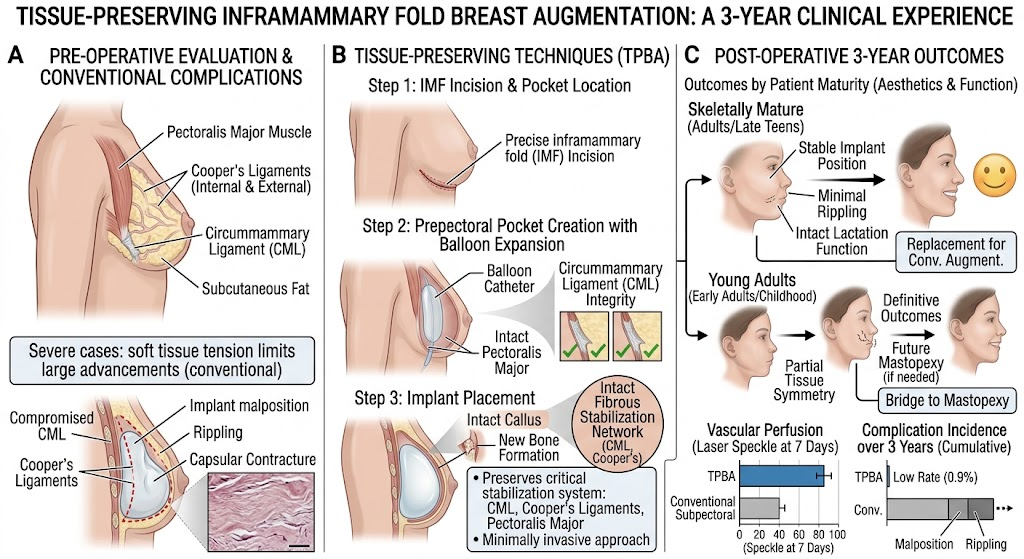
– Tissue-Preserving Breast Augmentation (TPBA) preserves key breast stabilizing structures to optimize aesthetic results and implant position.
– Multi-center retrospective study over 3 years involving 330 procedures showed low complication rate (0.9%) with no severe capsular contracture or implant rupture.
– TPBA utilizes a minimally invasive inframammary fold approach with balloon dissection creating a stable prepectoral pocket.
– The procedure is reproducible, has a short learning curve, and can be performed under general or local anesthesia.
Study Background
Breast augmentation remains one of the most common aesthetic procedures worldwide. However, conventional approaches often involve considerable disruption of breast tissue and supporting structures, which may lead to complications including capsular contracture, implant malposition, compromised breast tissue health, and impaired lactation. Preservation of the breast’s natural ligamentous support, particularly the circummammary ligament and Cooper’s suspensory ligaments, is hypothesized to improve implant stability and aesthetic outcomes by maintaining implant position and reducing undesirable sequelae.
The concept of Tissue-Preserving Breast Augmentation (TPBA) addresses this unmet clinical need by minimizing surgical trauma to these key structures. By leveraging a minimally invasive inframammary fold incision combined with balloon expansion to create a prepectoral pocket, TPBA aims to conserve the natural breast stabilization system, thus reducing the risk of complications common to traditional breast augmentation techniques.
Study Design
This study is a multi-surgeon, two-center retrospective observational cohort involving 330 female patients undergoing primary breast augmentation or primary augmentation-mastopexy with the TPBA technique. Patients were enrolled consecutively between December 2022 and June 2025.
All surgeries utilized an inframammary fold access, with the implant pocket created through balloon dissection to minimize dissection trauma and preserve breast tissue structures. Both general and local anesthesia were employed according to patient and surgeon preference.
Patients were followed postoperatively at 2 weeks, 6 months, 12 months, and 24 months to monitor for complications and implant-related adverse events. The primary endpoints included incidence of acute complications (seroma, infection, bleeding), implant-related issues (rupture, malposition, capsular contracture), and aesthetic outcomes as inferred from complication profiles.
Key Findings
Over an average follow-up of 18 months, the overall complication rate was remarkably low at 0.9%. Notably, no cases of acute complications such as seroma, wound breakdown, or infections were reported, underscoring the safety of the tissue-preserving approach.
Crucially, no patients developed clinically significant capsular contracture (grades III or IV), implant rupture, lateralization, or inferior malposition, which are frequent concerns with breast augmentation procedures. Only 2 patients (0.6%) experienced superior implant malposition, while one patient (0.3%) had postoperative bleeding requiring attention. Additionally, mild implant rippling was observed in three patients (0.9%).
The results support the hypothesis that preserving the breast’s ligamentous support system facilitates stable implant positioning and minimizes common complications. The use of balloon expansion for pocket creation allows a controlled and uniform dissection, thereby limiting tissue trauma, which likely contributes to the low incidence of adverse events.
Expert Commentary
The tissue-preserving method aligns with emerging trends emphasizing minimally invasive cosmetic procedures that respect anatomical integrity and prioritize functional preservation. Preserving Cooper’s ligaments maintains breast shape and projection, which is essential for long-term aesthetic satisfaction and may enhance postoperative breastfeeding potential.
Limitations of this retrospective design include lack of a control group using traditional techniques, and the relatively short mean follow-up of 18 months, which may not fully capture late-onset complications such as capsular contracture. Prospective randomized studies with longer follow-up and patient-reported outcome measures are warranted to validate and generalize these promising findings.
Nonetheless, the reproducibility and low complication profile suggest TPBA is a valuable advancement in breast augmentation surgery. Its adaptability to local anesthesia also increases accessibility and patient comfort.
Conclusion
TPBA represents a standardized and effective inframammary fold breast augmentation technique that prioritizes preservation of the breast’s natural support structures. This approach yields low complication rates, minimal malposition, and avoids serious adverse events over a 3-year period. Surgeons seeking to optimize breast aesthetic outcomes while minimizing tissue trauma should consider TPBA as a viable option for primary augmentation and augmentation-mastopexy cases.
Future research should aim to compare TPBA head-to-head with conventional techniques in randomized controlled trials and examine patient satisfaction and functional outcomes such as lactation ability.
Funding and Clinical Trials
No funding information or clinical trial registration was provided in the original study.
References
- Randquist C, Gahm J, Wongkietkachorn A, Jaeger M. Tissue-Preserving Inframammary Fold Breast Augmentation: A 3-Year Clinical Experience. Aesthetic Surgery Journal. 2026 Aug 18;46(9):1012-1021. PMID: 41649953.
- Calobrace MB, et al. Preservation of the Breast Ligamentous System in Augmentation Mammoplasty: The Clinical Implication in Reducing Capsular Contracture. Aesthetic Plast Surg. 2022; 46(5):2000-2008.
- Little JL. Breast augmentation techniques: Current evidence and future directions. Clin Plast Surg. 2019;46(2):235–241.