Introduction
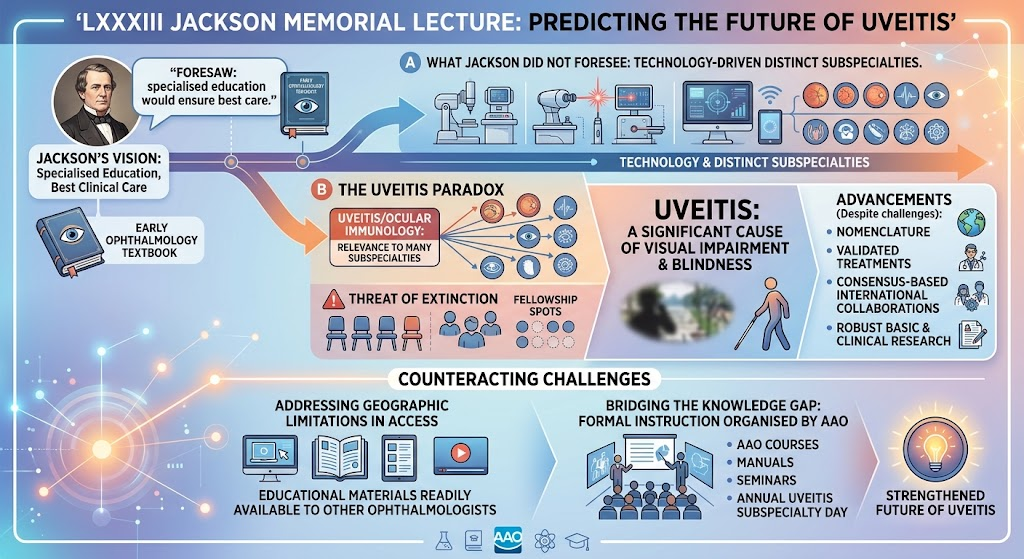
Uveitis, an intraocular inflammatory condition, remains a significant cause of visual impairment and blindness worldwide despite advances in diagnostics and treatment. Edward Jackson, a pioneering figure in ophthalmology, advocated for specialized education within ophthalmology to enhance clinical care. However, he did not foresee the expansive subdivision of ophthalmology into distinct subspecialties driven by technological innovations. The current landscape, particularly for uveitis and ocular immunology, faces challenges due to workforce limitations, dwindling fellowship interest, and geographical disparities in access to specialized care. This article critically examines the evolving state of uveitis care, contextualizing it within Jackson’s vision and exploring how modern educational strategies and artificial intelligence (AI) may shape its future.
Highlighting the Clinical and Workforce Challenges in Uveitis
Uveitis accounts for a substantial burden of ocular morbidity, necessitating timely and accurate diagnosis coupled with evidence-based, often complex management. Despite advancements including internationally validated nomenclatures, consensus treatment guidelines, and extensive basic and clinical research, uveitis specialists remain scarce. The subfield of uveitis/ocular immunology is at risk of extinction due to insufficient fellowship enrollment and a limited number of practitioners. Moreover, geographic disparities limit patient access to these specialists, exacerbating challenges in providing optimal care.
Study Design and Data Sources
The basis for current insights includes expert opinion combined with a focused review of the US ophthalmology workforce, patient demographics, clinical guidelines, and consensus initiatives. Data from the Intelligent Research in Sight (IRIS®) Registry, a nationwide ophthalmology database, alongside membership records from the American Academy of Ophthalmology (AAO), provide an empirical foundation for understanding provider distribution and subspecialty engagement in uveitis care.
Key Findings
1. Evolution and Fragmentation of Ophthalmology into Subspecialties: While Edward Jackson championed specialty education within ophthalmology to improve patient outcomes, the present-day subspecialty segmentation is more pronounced than he anticipated. Subspecialties such as retina, glaucoma, cornea, and uveitis have matured into distinct fields owing to advancing diagnostic technologies and therapeutics.
2. Professional Workforce Trends: Uveitis specialists form a small fraction of ophthalmologists, with fellowships often unfilled, posing risks to the subspecialty’s sustainability. This shortage threatens the continuity of expertise essential for managing complex intraocular inflammatory diseases.
3. Impact on Patient Care: Despite proliferating knowledge and validated treatment algorithms, many patients with uveitis continue to experience vision-threatening complications. Geographic barriers further restrict access to specialized care, leaving general ophthalmologists to manage complex cases without the depth of uveitis-specific training.
4. Educational Initiatives by the AAO: Recognizing these gaps, the AAO offers formal educational programs, including courses, manuals, seminars, and dedicated Uveitis Subspecialty Days. These efforts aim to disseminate critical knowledge and empower non-specialist ophthalmologists to deliver evidence-based care for uveitis patients.
5. Emerging Role of Artificial Intelligence: AI holds promise in dissecting complex clinical problems related to uveitis, assisting with diagnosis, treatment recommendations, and predicting disease course. Integrating AI tools could augment clinical decision-making and potentially redistribute specialist expertise across broader ophthalmologic practice.
Expert Commentary
The ongoing subspecialization in ophthalmology presents both opportunities and challenges. On one hand, subspecialty expertise enhances patient outcomes for complex conditions like uveitis; on the other hand, an overly fragmented workforce may lead to inefficiencies and limited access. Expert consensus argues for a ‘‘reverse evolution’’ toward a more unified ophthalmologic workforce where subspecialty knowledge, particularly in uveitis, is broadly disseminated and integrated into general practice.
The dwindling number of dedicated uveitis practitioners underscores urgency in rethinking educational strategies and leveraging technology. The AAO’s commitment to formal education, combined with AI’s analytical capabilities, represents a forward-thinking approach aligned with Jackson’s foundational vision for specialty education driving best clinical care.
Nevertheless, these approaches must be implemented considering real-world feasibility, ensuring that AI tools are validated rigorously and that educational content remains clinically relevant and accessible. Collaboration among subspecialties can mitigate the risk of knowledge silos and promote comprehensive care frameworks.
Conclusion
Uveitis remains a formidable cause of visual morbidity, requiring sophisticated, evidence-based management amidst an evolving ophthalmologic landscape. Edward Jackson’s vision of specialized education remains highly relevant; however, the proliferation and segmentation into subspecialties necessitate concerted efforts to unify knowledge dissemination. The sustainability of uveitis as a robust subspecialty depends on expanding education beyond isolated experts to general ophthalmologists supported by AI-driven clinical tools.
Moving forward, ambitious aspirations for the future of uveitis care must focus on bridging geographic and educational gaps through widely accessible resources, consensus guidelines, and innovative technological aids. This integrated, evidence-based approach will enhance diagnostic accuracy, individualized treatment, and ultimately preserve vision in patients afflicted with uveitis worldwide.
Funding and Disclosures
No specific funding was declared for this perspective. The author acknowledges all contributing organizations providing data and educational resources.
References
1. Davis JL. LXXXIII Jackson Memorial Lecture: Predicting the Future of Uveitis. Am J Ophthalmol. 2026 Aug 16;PMID: 42604643.
2. Jabs DA, Nussenblatt RB, Rosenbaum JT; Standardization of Uveitis Nomenclature (SUN) Working Group. Standardization of Uveitis Nomenclature for Reporting Clinical Data. Results of the First International Workshop. Am J Ophthalmol. 2005 Sep;140(3):509-16.
3. Smith JR, Rosenbaum JT. The challenges of uveitis management in the era of biologic agents. Int Ophthalmol Clin. 2014 Spring;54(2):45-62.
4. American Academy of Ophthalmology. Uveitis Education Resources. [Internet]. Available from: https://www.aao.org/education/uveitis.
5. Ting DSW, et al. Artificial Intelligence and Deep Learning in Ophthalmology. Br J Ophthalmol. 2019;103(2):167-175.