Highlight
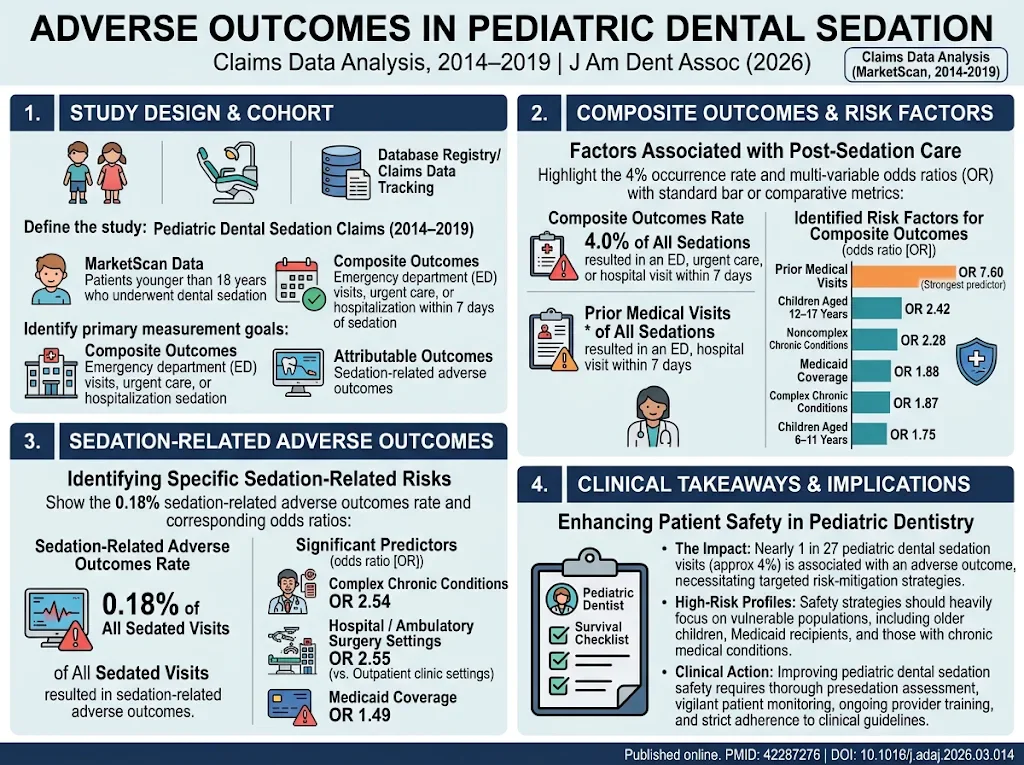
- Approximately 4% of pediatric dental sedation encounters are associated with adverse composite outcomes, such as emergency visits or hospitalization within 7 days.
- Risk factors for adverse outcomes include older pediatric age groups (6-17 years), presence of chronic conditions, Medicaid insurance, and prior medical visits.
- Hospital and ambulatory surgery centers present nearly triple the odds of sedation-related adverse events compared to outpatient dental clinics.
- Only 0.18% of sedations produce sedation-related adverse outcomes, suggesting overall infrequent but significant safety concerns in pediatric dental sedation.
Study Background
Pediatric dental treatment often requires sedation to manage anxiety and ensure procedural compliance. However, sedation involves the use of high-risk medications, which can pose safety challenges, particularly in children with complex health profiles. While medication safety surveillance is well-developed in medical and hospital settings, limited data exist specifically addressing the safety of sedation in pediatric dental clinics. Understanding the frequency and predictors of adverse outcomes following dental sedation is critical to minimizing risks and optimizing care quality in this vulnerable population.Study Design
This investigation utilized the MarketScan claims database to analyze pediatric patients (under 18 years) who underwent dental sedation from 2014 to 2019. The primary endpoints were composite adverse outcomes defined as emergency department (ED) or urgent care (UC) visits and hospitalizations occurring within 7 days post-sedation. Separate analyses addressed sedation-related adverse outcomes attributable directly to sedation practices. Multivariable generalized estimating equations (GEE) models adjusted for patient demographics, clinical complexity, insurance coverage, prior healthcare utilization, and procedural settings to identify independent risk factors.Key Findings
Among all dental sedation events analyzed, 4% were associated with composite adverse outcomes (ED/UC visits or hospitalization), demonstrating a measurable risk burden. A smaller subset, 0.18%, involved sedation-related adverse events, reflecting events directly linked to the sedation process itself. Age stratification revealed that children aged 12-17 years had the highest odds of experiencing composite adverse outcomes (OR 2.42; 95% CI not specified), followed by those aged 6-11 years (OR 1.75). This suggests that older children may be at increased risk, potentially related to more complex procedures, differing sedation protocols, or comorbidities common in adolescence. Chronic health conditions also contributed substantially to risk. Children with noncomplex chronic conditions demonstrated elevated odds (OR 2.28), as did those with complex chronic conditions (OR 1.87) for composite outcomes. For sedation-related adverse outcomes specifically, complex chronic conditions markedly increased risk (OR 2.54). Insurance status was a significant factor, with Medicaid beneficiaries having higher odds of both composite (OR 1.88) and sedation-related adverse outcomes (OR 1.49), possibly reflecting socioeconomic, access, or care quality disparities. Prior medical visits emerged as a strong predictor, with an OR of 7.60 for composite outcomes, indicating that children with recent healthcare encounters, likely reflecting greater baseline morbidity, face a substantially higher risk. Procedural setting influenced sedation safety. Sedations performed in hospital or ambulatory surgery centers had nearly threefold increased odds of sedation-related adverse events compared to outpatient dental clinic settings (OR 2.55). This may relate to case complexity, referral patterns, or variations in monitoring and sedation protocols across settings.Expert Commentary
This comprehensive claims-based study provides crucial epidemiological evidence about the safety profile of pediatric dental sedation across diverse clinical contexts. The large sample size and robust multivariate adjustments enhance the reliability of the associations observed. However, claims data inherently limit granularity on sedation techniques, specific medications used, procedural detail, and physiological measures of safety. The study cannot establish causality or pinpoint exact mechanisms of adverse events. Moreover, it is unclear how factors like provider experience, sedation depth, or use of monitoring technologies may influence risk. The elevated risks associated with Medicaid coverage and chronic disease status underscore the importance of equity-focused approaches and tailored clinical vigilance for medically complex and socioeconomically vulnerable children. Given the increased risk in hospital and ambulatory surgical settings, targeted quality improvement protocols may be warranted in these environments to address case complexity and sedation safety practices. Future prospective studies should aim to validate these findings and explore strategies such as standardized presedation assessment protocols, enhanced provider training, and real-time monitoring innovations that could minimize adverse outcomes.Conclusion
Pediatric dental sedation carries a measurable risk of adverse events, particularly among older children, those with chronic health conditions, and children covered by Medicaid. While sedation-related adverse outcomes are rare, their potential severity necessitates ongoing vigilance. The nearly tripled risk in hospital-based and ambulatory surgery center settings calls for context-specific safety strategies. Implementing comprehensive presedation evaluations, continuous patient monitoring during and after sedation, adherence to best practice guidelines, and focused provider education programs are essential steps to enhance pediatric dental sedation safety. Addressing socioeconomic and clinical disparities will be critical to delivering equitable, high-quality care. This study lays a foundation for risk mitigation and future research in this important but understudied facet of pediatric health care.Funding and ClinicalTrials.gov
The publication did not specify funding sources or clinical trial registration.References
1. Zouaidi K, Hubbard CC, Cooke MR, et al. Adverse outcomes associated with pediatric dental sedation: Claims data analysis, 2014-2019. J Am Dent Assoc. 2026;157(11):1319-1333.e18. PMID: 42287276. 2. Malviya S, Voepel-Lewis T, Tait AR. Adverse events and risk factors associated with sedation of children by nonanesthesiologists. Anesth Analg. 1997;85(6):1207-1213. 3. Coté CJ, Wilson S. Guidelines for monitoring and management of pediatric patients during and after sedation for diagnostic and therapeutic procedures: an update. Pediatrics. 2006;118(6):2587-2602. 4. American Academy of Pediatric Dentistry. Guideline on Use of Anesthesia in Pediatric Dentistry. Pediatr Dent. 2021;43(6):302-310.Specialty calculators
For clinical reference; use professional judgment.