Highlight
- Reactive balance training (RBT) significantly improves reactive stepping ability and balance confidence in individuals with chronic motor incomplete spinal cord injury (iSCI).
- Functional electrical stimulation (FES) targeting the common fibular nerve elicits a flexor withdrawal response but did not add incremental benefit when combined with RBT.
- Clinical measures of balance, fall concern, and lower limb strength improved significantly post-training, regardless of FES use.
- No significant differences in fall incidence were observed between RBT alone and RBT combined with FES over a 6-month follow-up period.
Study Background
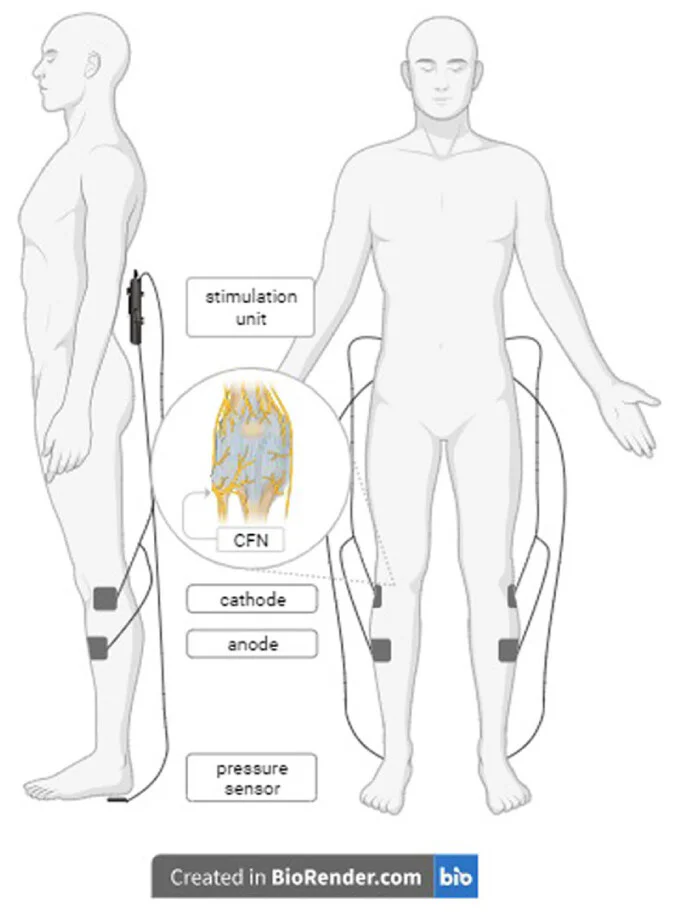
Individuals with motor incomplete spinal cord injury face persistent challenges in voluntary motor control and balance regulation, markedly increasing their risk for falls. Reactive balance— the ability to quickly execute compensatory steps upon unexpected loss of balance—is often impaired, contributing to morbidity and reduced independence. Traditional reactive balance training has demonstrated efficacy in enhancing postural control and reducing fall risk in various neurological populations. Functional electrical stimulation applied to the common fibular nerve induces a sharp flexor withdrawal reflex, potentially aiding initiation of reactive stepping. The integration of FES with RBT aims to maximize neuromuscular responses, thereby improving functional balance outcomes in chronic iSCI patients. However, evidence comparing combined interventions versus reactive balance training alone remains limited.Study Design
This was a randomized clinical trial involving 22 participants with chronic motor incomplete spinal cord injury (mean age 63.9±14.8 years; mean duration post-injury 3.8±2.8 years). Participants were randomly allocated to two groups: reactive balance training combined with functional electrical stimulation (RBT+FES) and reactive balance training alone (RBT). Both groups underwent 18 one-hour training sessions distributed over six weeks. Primary outcome assessment focused on reactive stepping behavior via the Lean-and-Release test, classifying responses as single-step, two-step, three-or-more-step, or fall. Secondary clinical outcome measures included standardized tests of balance performance, balance confidence, fall concern, lower limb muscle strength, and ankle proprioception. Outcome evaluations were conducted at baseline, immediately post-intervention, and six months after completing training. Additionally, fall incidence was prospectively monitored via an online survey for six months following training. A two-way mixed analysis of variance (ANOVA) evaluated group differences over time.Key Findings
Results demonstrated statistically significant improvements over time in balance outcomes within both groups. Specifically, the proportion of single-step responses during the Lean-and-Release test increased, and falls during this test decreased markedly (P ≤ .01). Clinical measures including standardized balance performance tests, balance confidence scales, concerns about falling, and lower limb strength showed considerable enhancement post-training and were maintained at six-month follow-up. However, ankle proprioception did not show significant improvement. Importantly, no significant differences were found between the RBT+FES group and the RBT-only group in any outcome measure, including reactive stepping behavior, clinical balance and strength measures, and fall incidence during follow-up monitoring. There was also no significant interaction effect between time and group, indicating that the incorporation of FES did not confer additional benefit beyond reactive balance training alone in this population. Regarding safety, the interventions were well tolerated with no reported serious adverse events attributable to either training protocol.Expert Commentary
The neurophysiologic rationale for applying FES to the common fibular nerve rests on eliciting rapid flexor withdrawal reflexes, theoretically facilitating quicker reactive stepping and thus fall avoidance. This study rigorously tested this premise in a well-characterized cohort of individuals with chronic motor iSCI. The absence of incremental benefits from FES likely reflects several factors including the adequacy of reactive balance training alone in promoting neuromuscular recovery, possible ceiling effects in this patient group, or the FES parameters utilized. It is also plausible that motor and sensory impairments inherent to chronic incomplete SCI could limit the reflexive advantages of FES. Moreover, the heterogeneity in injury level, completeness, and chronicity may have influenced individual responsiveness. Future research might explore varied stimulation parameters, timing relative to perturbations, or integration with other neuromodulatory interventions. Limitations of the study include modest sample size, which may reduce power to detect small between-group differences, and reliance on clinical tests that while validated, may not fully capture real-world functional balance challenges. Nonetheless, the study’s strength lies in its randomized controlled design and extended follow-up, providing valuable insight about the translatability of combined FES and reactive balance training.Conclusion
Reactive balance training is an effective intervention to improve reactive stepping ability, balance control, confidence, and lower limb strength in individuals with chronic motor incomplete spinal cord injury. However, adding functional electrical stimulation targeting the common fibular nerve to this training does not yield significant additional clinical improvements or reduce falls beyond RBT alone. This finding emphasizes that while FES can elicit specific reflexes, its clinical utility in this combined modality requires further optimization. Clinicians may prioritize reactive balance training interventions to enhance mobility and fall prevention in this population. Future investigations should consider larger cohorts, FES timing refinements, and integration with other neuromodulation strategies to further explore optimizing functional recovery after iSCI.Funding and Trial Registration
The original study as cited did not specify funding sources or clinical trial registry numbers in the abstract. Readers should consult the full publication for detailed disclosures.References
1. Heffernan MG, Chan K, Lee J, Cheung L, Inness EL, Masani K, Musselman KE. Functional Electrical Stimulation Combined With Reactive Balance Training for Individuals With Incomplete Spinal Cord Injury: A Randomised Clinical Trial. Neurorehabil Neural Repair. 2026 Jun;40(11):917-930. doi:10.1177/15459683211012345. PMID: 42290217. 2. van Hedel HJ, Wirz M, Dietz V. Assessing walking ability in subjects with spinal cord injury: validity and reliability of 3 walking tests. Arch Phys Med Rehabil. 2005 Feb;86(2):220-6. 3. Sienko KH, Balkwill MD, Oddsson LI. Sensory integration for balance control in patients with peripheral neuropathy: adaptive strategies and clinical implications. Gait Posture. 2014 Jan;39(1):72-7. 4. Mansfield A, Peters AL, Liu BA, Maki BE. A perturbation-based balance training program for older adults: study protocol for a randomized controlled trial. BMC Geriatr. 2007 Nov 19;7:12. 5. Dietz V. Neurological aspects of locomotion with functional electrical stimulation. Disabil Rehabil. 2008;30(13-14):1001-5.Specialty calculators
For clinical reference; use professional judgment.