Study Background
Benign subglottic and tracheal stenosis (SGTS) represents a challenging clinical condition characterized by narrowing of the airway below the vocal cords, leading to airflow obstruction and significant respiratory morbidity. The pathogenesis often involves inflammation and subsequent fibrosis from diverse etiologies, including prolonged intubation, infections, trauma, or idiopathic causes. Management aims to restore airway patency and alleviate symptoms while minimizing the need for invasive surgical procedures such as tracheal resection. Endoscopic methods remain central to treatment, with dilation, laser interventions, and adjunctive therapies commonly employed.
Cryotherapy, a technique involving the application of extreme cold to induce tissue necrosis and remodeling, has emerged as a less invasive approach for treating SGTS. Despite its theoretical benefits in reducing scar burden with potentially less thermal damage than laser or electrocautery, comparative evidence assessing cryotherapy’s effectiveness against standard endoscopic management strategies is sparse. Moreover, the impact of adjunctive cryotherapy without concomitant thermal interventions on stenosis outcomes has been unclear.
Study Design
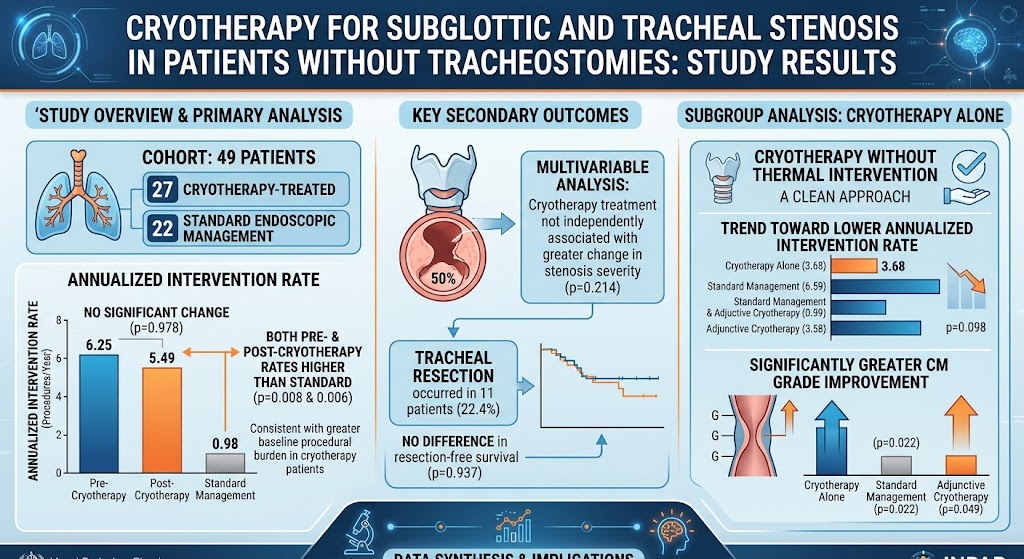
This retrospective chart review conducted by Weinstein et al. encompassed 49 patients treated for benign SGTS without prior tracheostomies between 2017 and 2025. Two patient groups were identified: 27 receiving cryotherapy (with or without adjunctive thermal interventions) and 22 undergoing standard endoscopic management alone. The study assessed a range of clinical outcomes including annualized intervention rate (number of procedures per year), time to tracheal resection, change in stenosis severity quantified by Cotton-Myer (CM) grading, airway-related emergency department (ED) visits, and treatment-related complications.
Key Findings
The analysis revealed no statistically significant difference in annualized intervention rates before versus after initiating cryotherapy (6.25 vs. 5.49 procedures per year, p=0.978) within the cryotherapy cohort. Both rates, however, were notably higher than the intervention rate observed in the standard management group (0.98 procedures/year, p=0.008 and p=0.006 respectively). This discrepancy likely reflects a higher baseline procedural burden among patients selected for cryotherapy.
Tracheal resection—a major surgical intervention—occurred in 11 patients (22.4%) overall, with no significant difference in resection-free survival between groups (p=0.937). Multivariable analysis did not support an independent association between cryotherapy treatment and improved stenosis severity reduction (p=0.214).
Importantly, subgroup analysis focusing on cryotherapy delivered without concurrent thermal interventions showed trends suggestive of clinical benefit: lower annualized intervention rates (3.68 vs. 6.59 procedures/year, p=0.098) and significantly greater improvement in Cotton-Myer grade (p=0.022 compared to standard management and p=0.049 compared to adjunctive cryotherapy). These findings suggest that cryotherapy alone may better preserve tissue architecture and promote remodeling without the potential exacerbation of scarring linked with thermal injury.
Throughout the study, airway-related emergency visits and complications did not differ significantly between groups, indicating cryotherapy’s safety profile is comparable to standard care.
Expert Commentary
This study adds valuable comparative data on the use of cryotherapy in benign SGTS patients who have not undergone tracheostomy, a population where treatment decisions can be particularly nuanced. The lack of overall superiority of cryotherapy over standard management in reducing procedural frequency or delaying surgery reflects the complexity of airway stenosis pathophysiology and the multifactorial nature of treatment response.
The subgroup findings are intriguing, highlighting the potential for non-thermal cryotherapy to yield improved outcomes, possibly by minimizing heat-induced tissue damage and inflammation. This aligns with mechanistic insights suggesting that controlled freezing can modulate fibroblast activity and matrix remodeling favorably. However, these observations must be cautiously interpreted given the retrospective design, modest sample size, and potential selection biases.
Current clinical guidelines do not firmly establish cryotherapy as a first-line adjunct, partly due to limited high-quality evidence. This study underscores the need for well-designed prospective randomized controlled trials to define patient selection criteria, optimal protocols (thermal vs. non-thermal), and long-term efficacy and safety of cryotherapy in SGTS management.
Conclusion
Cryotherapy for benign subglottic and tracheal stenosis in patients without tracheostomies did not demonstrate clear superiority over standard endoscopic management in reducing intervention rates or improving resection-free survival. While overall improvements in airway stenosis were observed across both treatment strategies, cryotherapy alone without adjunctive thermal intervention showed promising results regarding stenosis severity reduction and procedural burden, warranting further prospective research.
Clinicians should consider the existing evidence within the broader clinical context of patient-specific disease severity, prior procedural history, and multidisciplinary treatment planning. Given the favorable safety profile and potential to improve outcomes in selected cases, cryotherapy remains an important tool in the therapeutic armamentarium, but its ideal role requires further elucidation.
Funding and Clinical Trials
The original study did not declare specific funding sources. No registered clinical trials were associated with this retrospective analysis.
References
- Weinstein T, Singh K, Ramkumar S, Bixby B, Chopra M, Yip H. Cryotherapy for Subglottic and Tracheal Stenosis in Patients Without Tracheostomies. The Laryngoscope. 2026 Aug 17. PMID: 42606176.
- Gelbard A, et al. Laryngotracheal stenosis: mechanisms and management. Curr Opin Otolaryngol Head Neck Surg. 2016;24(6):532-538.
- Mehta AC, et al. Endoscopic Management of Subglottic Stenosis. Chest Surg Clin N Am. 2019;29(3):303-320.
- Hu Y, et al. Tissue remodeling by cryotherapy: implications for airway fibrosis. Cryobiology. 2017;75:55-62.