Highlight
Superimposed local vibration (SLV) applied during intermittent isometric knee extensions increases time to task failure (TTF) by approximately 9.5%. This effect is consistent across contraction intensities set at 30% and 50% of maximal voluntary isometric contraction (MVIC) and does not differ between men and women. Despite prolonged performance and increased force output, electromyographic (EMG) activity levels remain unchanged between vibration and control conditions, suggesting novel neuromuscular adaptations warranting further exploration.
Study Background
Muscle fatigue during sustained or repetitive submaximal contractions limits performance in athletic, occupational, and rehabilitation settings. Enhancing muscle endurance is critical to improving functional capacity and reducing injury risk. Among approaches to modulate neuromuscular function, local tendon vibration has been proposed to augment muscle performance by stimulating proprioceptive pathways, possibly enhancing motor unit recruitment or altering central drive.
However, evidence regarding the efficacy of superimposed tendon vibration during intermittent isometric contractions remains sparse, particularly if its benefits vary by contraction intensity or sex. Understanding these effects could direct novel rehabilitation or conditioning protocols tailored to individual physiological profiles.
Study Design
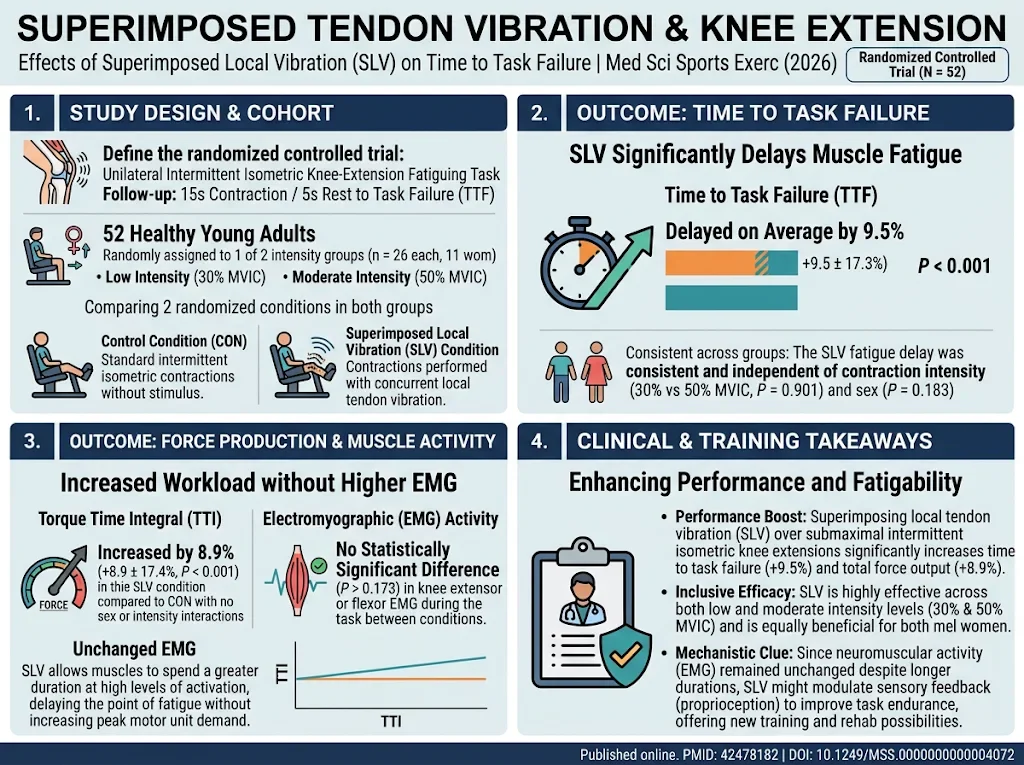
This controlled, randomized, cross-over study evaluated 52 young healthy adults, stratified into two equal groups based on target contraction intensity: 30% or 50% of MVIC. Each group included 11 women. Participants performed unilateral intermittent isometric knee extension tasks (15-second contractions followed by 5-second rests) to task failure, defined as torque dropping more than 10% below target force.
Two conditions were compared in randomized order: superimposed local vibration (SLV) applied to the patellar tendon during contractions versus a control condition (no vibration). Torque output and EMG activity from knee extensor and flexor muscles were continuously recorded. The primary endpoint was time to task failure (TTF). Secondary outcomes included torque time integral (TTI), representing cumulative force output, and muscle activation patterns assessed by EMG.
Key Findings
Time to Task Failure (TTF): SLV significantly increased TTF by an average of 9.5% ± 17.3% (P < 0.001) compared to control. This improvement was independent of contraction intensity (P = 0.901) and sex (P = 0.183), indicating robustness of the vibration effect across these variables.
Torque Time Integral (TTI): Corresponding to prolonged endurance, TTI was elevated by 8.9% ± 17.4% under SLV versus control (P < 0.001). Similar to TTF, no significant interactions with sex or intensity were reported (P > 0.183), signifying that total force production benefits from vibration irrespective of these factors.
Electromyography (EMG) Activity: Surprisingly, despite longer endurance and higher TTI, EMG activity amplitude of both knee extensor and flexor muscles showed no significant differences between SLV and control throughout the fatiguing task (P > 0.173). This suggests that the improved performance was not due to increased muscle activation or altered recruitment patterns detectable by surface EMG.
Expert Commentary
The study offers compelling evidence that superimposed tendon vibration can prolong muscular endurance during intermittent submaximal isometric knee extensions without sex or intensity biases. This indicates a generalized neuromuscular facilitation effect when vibration is applied during muscle contraction. The unchanged EMG profile raises intriguing mechanistic questions. One hypothesis is that vibration may modulate central motor drive or enhance muscle spindle sensitivity, allowing sustained force output without increasing overall muscle activation levels.
These findings align with prior work suggesting tendon vibration improves proprioceptive feedback and motor control. However, the absence of changes in EMG amplitude calls for further investigations using more refined neurophysiological measures such as intramuscular EMG, transcranial magnetic stimulation, or functional MRI to dissect central versus peripheral contributions.
Limitations include the focus on young healthy adults, limiting generalizability to older or clinical populations. Additionally, the fixed intermittent duty cycle precludes assessment of continuous contractions. Future research should evaluate long-term training effects and therapeutic applications in neuromuscular disorders.
Conclusion
Superimposed local tendon vibration is an effective, non-invasive strategy to enhance muscle endurance during submaximal intermittent isometric knee extension exercises, benefiting both sexes equally and across moderate contraction intensities. The sustained force production occurs without increased muscle activation as measured by surface EMG, pointing towards complex neuromuscular modulation that merits deeper mechanistic study. Incorporating tendon vibration could augment rehabilitation protocols or athletic training regimens aimed at improving muscle performance and delaying fatigue.
Funding and Clinical Trials
The original study did not specify funding sources or clinical trial registration details within the abstract. Interested readers should consult the full publication for disclosures.
References
Timbert T, Amiez N, Martin A, Cometti C, Paizis C. Superimposed Tendon Vibration Increases Time to Task Failure During Intermittent Isometric Knee Extensions: Effects of Contraction Intensity and Sex. Med Sci Sports Exerc. 2026 Jul 21;58(11):2535-2548. PMID: 42478182.
Additional literature on tendon vibration and neuromuscular adaptations may be explored to provide context and compare findings.
Specialty calculators
For clinical reference; use professional judgment.