Highlight
Lisocabtagene maraleucel (liso-cel), a CD19-directed CAR T-cell therapy, demonstrated durable efficacy with a 94% complete response rate and a 70% three-year duration of response rate in patients with relapsed/refractory follicular lymphoma after at least two prior therapies. Safety analyses revealed decreasing severe cytopenias and low incidence of serious infections over long-term follow-up. These results support liso-cel as a promising third-line or later therapeutic option even in high-risk patient subsets.
Study Background
Follicular lymphoma (FL) is the most common indolent subtype of non-Hodgkin lymphoma characterized by a relapsing-remitting course. Despite often achieving initial responses to immunochemotherapy, patients eventually develop relapsed or refractory disease with shorter remissions, especially after multiple lines of therapy. High-risk features such as early progression within 24 months (POD24), bulky tumors, or double refractory status predict poor outcomes. Novel treatments that can produce deep, durable remissions and maintain manageable long-term safety profiles remain an urgent clinical need.
Chimeric antigen receptor T-cell (CAR T) therapies targeting CD19 have transformed the treatment landscape for aggressive B-cell lymphomas and are being actively investigated in indolent lymphomas including FL. Lisocabtagene maraleucel (liso-cel) is a defined composition CD19-directed CAR T-cell product designed to optimize efficacy and mitigate toxicity. The pivotal TRANSCEND FL trial previously showed high overall and complete response rates with favorable safety in relapsed/refractory FL, but longer follow-up data were necessary to assess durability and late toxicities.
Study Design
The TRANSCEND FL trial (NCT04245839) is a multicenter, single-arm phase 1/2 study evaluating liso-cel in patients with relapsed/refractory follicular lymphoma after at least two prior systemic lines including an anti-CD20 antibody and an alkylating agent. Inclusion criteria specified patients who had failed ≥2 prior combination systemic therapies. Patients received a single infusion of liso-cel, with efficacy assessed per independent review committee based on standard response criteria.
The primary endpoints included overall response rate (ORR) and complete response rate (CRR). Secondary endpoints comprised duration of response (DOR), progression-free survival (PFS), overall survival (OS), time to next treatment, and safety, with a minimum follow-up of three years. Subgroup analyses included high-risk populations such as those with POD24, bulky disease, or double refractory status.
Key Findings
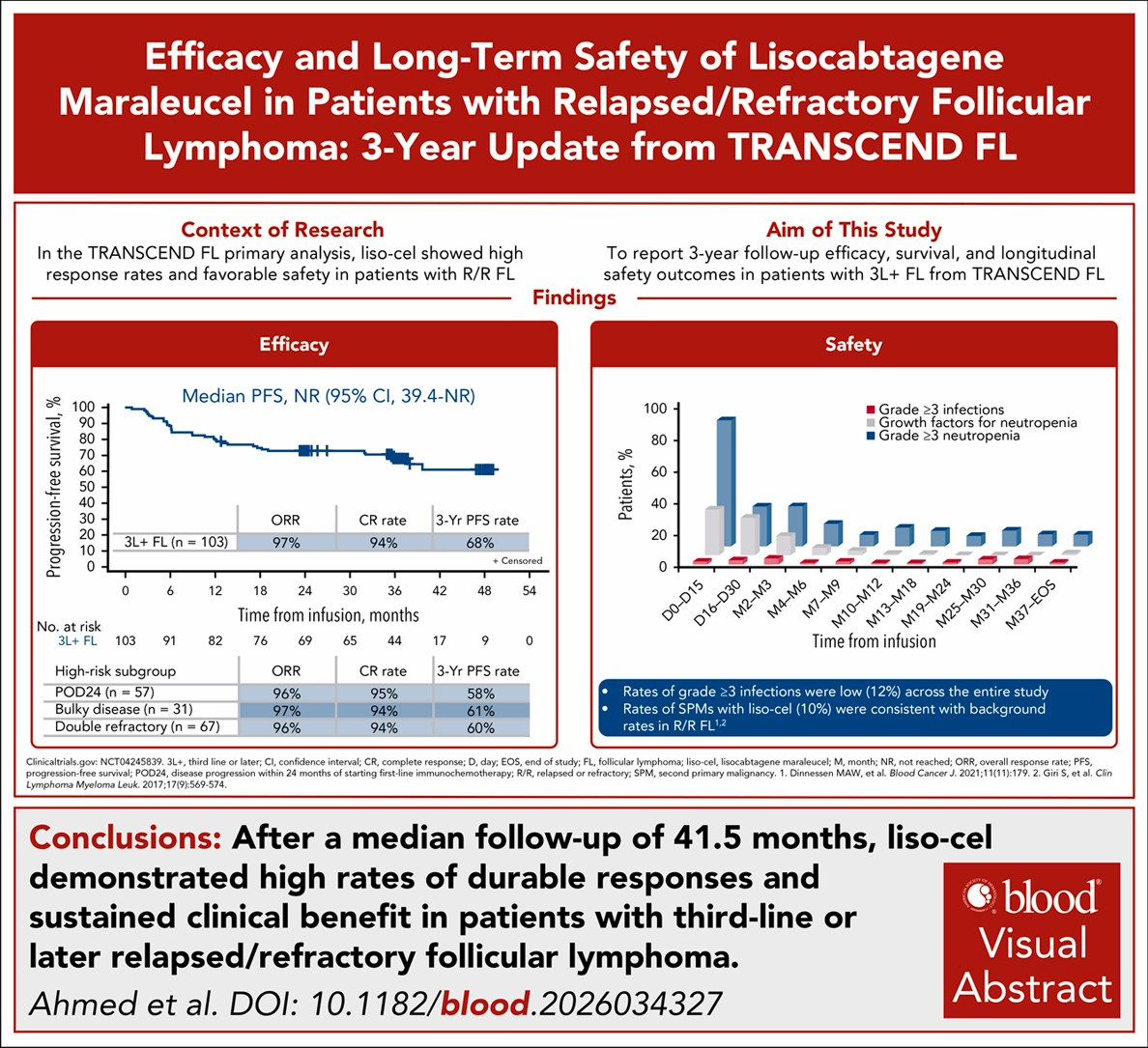
A total of 107 patients received liso-cel, with 103 evaluable for efficacy. The independent review showed a striking 97% ORR (95% CI, 92-99) and 94% CRR (95% CI, 88-98). Median durations for all time-to-event outcomes were not reached at a median follow-up of 41.5 months (range 0.3-54.0 months), reflecting sustained responses.
Estimated three-year rates were 70% for duration of response, 68% for progression-free survival, 75% for being free from next treatment, and an encouraging 86% for overall survival. Importantly, these robust outcomes persisted across high-risk subgroups: patients with disease progression within 24 months of first-line immunochemotherapy, bulky disease burden, or double refractory disease had similar response and survival profiles.
Longitudinal safety analysis demonstrated a declining incidence of grade ≥3 cytopenias and hypogammaglobulinemia over time, primarily concentrated in the first three months post-infusion. Supportive care measures such as transfusions, growth factors, and intravenous immunoglobulin were mainly utilized early after treatment. Notably, serious infections grade ≥3 remained infrequent throughout follow-up, supporting a manageable long-term safety profile.
Expert Commentary
These three-year follow-up results reinforce liso-cel as an effective and durable treatment option for patients with multiply relapsed FL, including those with adverse prognostic factors who typically face poor outcomes. The exceptionally high complete response rates and the plateauing of PFS curves suggest a subset of patients may achieve long-term remission, potentially altering the natural history of this indolent lymphoma.
The favorable safety profile, characterized by limited prolonged cytopenias and low infection rates, is a significant advantage over some earlier-generation CAR T products and other therapies that carry risks of cumulative toxicity. This track record supports liso-cel’s integration into clinical practice for third-line and beyond settings.
Limitations to consider include the single-arm design and lack of a direct comparator, making it essential to contextualize efficacy against historical controls. Longer follow-up will continue to clarify the durability of remission and late toxicities including secondary malignancies. Nonetheless, these data align with emerging evidence supporting CAR T-cells’ transformative role in indolent lymphomas.
Conclusion
Lisocabtagene maraleucel offers durable and deep remissions with a manageable long-term safety profile in heavily pretreated relapsed/refractory follicular lymphoma. This three-year TRANSCEND FL update demonstrates sustained high response rates and favorable survival outcomes even in high-risk patients. Liso-cel represents a promising therapeutic advancement with the potential to redefine treatment paradigms in advanced FL.
Future research should focus on head-to-head comparisons, biomarker-driven patient selection, and combination strategies to further optimize outcomes and broaden applicability.
Funding and ClinicalTrials.gov
The TRANSCEND FL trial was registered at ClinicalTrials.gov under identifier NCT04245839. Funding and disclosures for the study are detailed in the original publication.
References
- Ahmed S, Martín García-Sancho A, Reguera Ortega JL, et al. Durable efficacy and manageable long-term safety of lisocabtagene maraleucel for 3L+ FL: 3-year update from TRANSCEND FL. Blood. 2026 Oct 1;148(14):1789-1799. PMID: 42462111.
- Casulo C, Friedberg JW. Treatment approaches for follicular lymphoma: past, present, and future. J Clin Oncol. 2018 Sep 20;36(27):2715-2723.
- Jacobson CA, Chavez JC, Sehgal AR. CAR T-cell therapy for follicular lymphoma: current evidence and future directions. Leuk Lymphoma. 2021 May;62(5):1146-1157.