Highlight
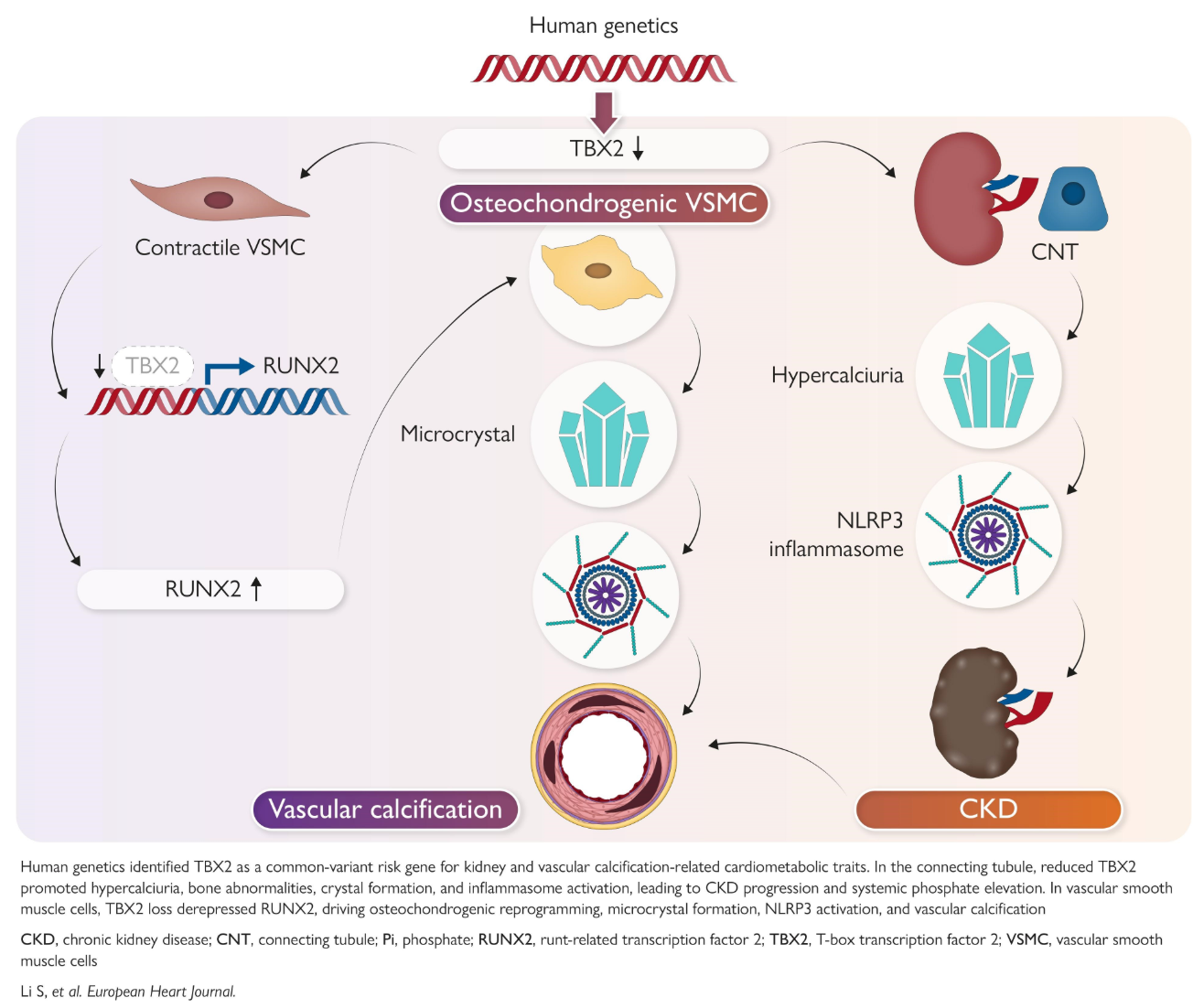
- TBX2 functions as a transcriptional repressor that inhibits RUNX2, a key osteogenic driver in vascular smooth muscle cells (VSMCs).
- Genetic deficiency of TBX2 in animal models leads to exacerbated vascular calcification, kidney injury, and mineral metabolism disturbances, mimicking chronic kidney disease (CKD) phenotypes.
- TBX2 loss sensitizes VSMCs to NLRP3 inflammasome activation triggered by calcification microcrystals, linking osteogenic signaling with sterile inflammation.
- Restoring TBX2 function or targeting the RUNX2-NLRP3 axis represents a promising therapeutic strategy to mitigate cardiovascular risk in CKD patients.
Study Background: Disease Burden and Unmet Needs
Vascular calcification is a pathologic mineral deposition in the arterial wall that strongly predicts cardiovascular morbidity and mortality, particularly in patients with chronic kidney disease (CKD). Despite its clinical importance, the molecular and genetic mechanisms driving vascular calcification remain incompletely understood. CKD patients experience accelerated vascular calcification due to disturbed phosphate and mineral metabolism, which leads to arterial stiffening, impaired hemodynamics, and increased risk of cardiovascular events. Existing therapies have limited efficacy in halting calcification progression, underscoring an urgent need to identify key regulatory pathways involved in disease pathogenesis. This study by Li et al. sought to elucidate transcriptional regulators linking mineral dysregulation, osteogenic reprogramming of vascular cells, and sterile inflammation in vascular calcification associated with CKD.
Study Design and Methods
The authors employed an integrated multi-omics and functional genetics approach. First, they performed genome-wide and phenome-wide association studies combined with expression quantitative trait loci (eQTL) and Bayesian colocalization analyses to identify genes genetically associated with kidney function and calcification-related cardiometabolic traits. Single-cell RNA sequencing (scRNA-seq) and ATAC-seq data from human kidney and coronary artery tissues helped define cell-specific regulatory networks and chromatin accessibility.
Chromatin immunoprecipitation sequencing (ChIP-seq) and transcriptional profiling in vascular smooth muscle cells (VSMCs) assessed direct gene targets and transcriptional control mechanisms.
Genetic mouse models with targeted deletions of TBX2, RUNX2, NLRP3, CASP1, and GSDMD were used to evaluate in vivo functional consequences on vascular calcification, kidney pathology, mineral metabolism, and inflammation. Primary VSMCs isolated from these models allowed mechanistic in vitro studies focusing on osteochondrogenic differentiation and inflammasome activation.
Key Findings
Genetic and Expression Evidence Highlight TBX2 as a Central Regulator
Genome-wide association studies identified TBX2 as a shared genetic locus linked to kidney function and calcification-related traits. Colocalization and eQTL data demonstrated that TBX2 expression in vascular and renal cells was inversely correlated with disease severity.
TBX2 Deficiency Aggravates CKD-Associated Vascular Calcification
Mice lacking TBX2 showed increased vascular calcification under phosphate stress, a condition mimicking CKD-related mineral imbalance. These mice also exhibited hypercalciuria, bone demineralization, and renal injury, recapitulating systemic manifestations of CKD. In vitro, TBX2-deficient VSMCs underwent enhanced calcification and osteochondrogenic differentiation, as evidenced by upregulation of bone-related markers.
Mechanistic Insights: TBX2 as a Transcriptional Repressor of RUNX2
ChIP-seq revealed that TBX2 binds directly to the promoter region of RUNX2, a master osteogenic transcription factor known to promote calcification in vascular cells. TBX2 represses RUNX2 expression, thus restraining osteogenic signaling in VSMCs. Notably, deletion of RUNX2 in TBX2-deficient VSMCs reversed the calcification phenotype, confirming RUNX2’s critical downstream role.
TBX2 Links Osteogenic Signaling to Sterile Inflammation via the NLRP3 Inflammasome
The study discovered that TBX2-deficient VSMCs were hypersensitive to activation of the NLRP3 inflammasome by microcrystals formed during osteogenic differentiation. Genetic knockout of NLRP3, CASP1 (caspase-1), or GSDMD (gasdermin D, an executioner of pyroptosis) in TBX2-deficient mice markedly reduced vascular calcification and renal injury, demonstrating the inflammasome’s pivotal role in disease pathology.
Human Correlates Confirm Clinical Relevance
Analysis of human kidney and vascular samples showed diminished TBX2 expression in calcified lesions and an inverse correlation with kidney fibrosis severity, supporting translational relevance.
Expert Commentary
This comprehensive study integrates human genetics, epigenomics, and functional experiments to uncover TBX2 as a master transcriptional regulator that coordinates mineral metabolism, osteogenic gene programs, and inflammatory mechanisms in CKD-associated vascular calcification. The demonstration that TBX2 represses RUNX2 provides a molecular brake on pathological vascular ossification, while the link to NLRP3 inflammasome highlights how mineral crystal formation can drive sterile inflammation and tissue injury.
These insights offer a novel therapeutic axis: enhancing TBX2 function or pharmacologically targeting the RUNX2-NLRP3 pathway may prevent or reverse vascular calcification, a major contributor to cardiovascular risk in CKD—a high-need patient population with limited current options.
Limitations include the focus on CKD models, which may not fully encompass all etiologies of vascular calcification, and the need for clinical trials to validate therapeutic targeting of TBX2 or inflammasome components. Nevertheless, the rigorous multi-layered evidence presents a compelling mechanistic framework and actionable targets.
Conclusion
The transcription factor TBX2 emerges as a central regulator restraining vascular calcification by suppressing RUNX2-driven osteogenic differentiation and modulating sterile inflammation through the NLRP3 inflammasome. TBX2 deficiency exacerbates CKD-associated vascular and renal pathology. Targeting the TBX2-RUNX2-NLRP3 axis holds promise for innovative therapies aimed at reducing cardiovascular mortality linked to vascular calcification in CKD patients. Future research should focus on drug development strategies to restore TBX2 activity or selectively inhibit downstream effectors to improve clinical outcomes.
Funding and ClinicalTrials.gov
This study was presumably supported by research grants detailed in the original publication by Li et al. (2026). No registered clinical trials are directly linked to these findings at present; further translational research and clinical trials are warranted to evaluate therapeutic interventions emerging from this pathway.
References
1. Li S, Liu H, Lee S, Ha E, Dumoulin B, Palmer MB, Miller CL, Damrauer SM, Malhotra R, Susztak K. Transcription factor TBX2 is a key regulator of vascular calcification. Eur Heart J. 2026 Oct 6; PMID: 42834001.
Additional contextual references:
2. Lanzer P, Boehm M, Sorribas V, et al. Medial vascular calcification revisited: review and perspectives. Eur Heart J. 2014;35(23):1515–1525.
3. Shanahan CM, Crouthamel MH, Kapustin A, Giachelli CM. Arterial calcification in chronic kidney disease: key roles for calcium and phosphate. Circ Res. 2011;109(6):697–711.
4. Libes P, Yang H, Viegas CG, et al. The NLRP3 inflammasome as a therapeutic target in vascular calcification. Front Immunol. 2020;11:590755.