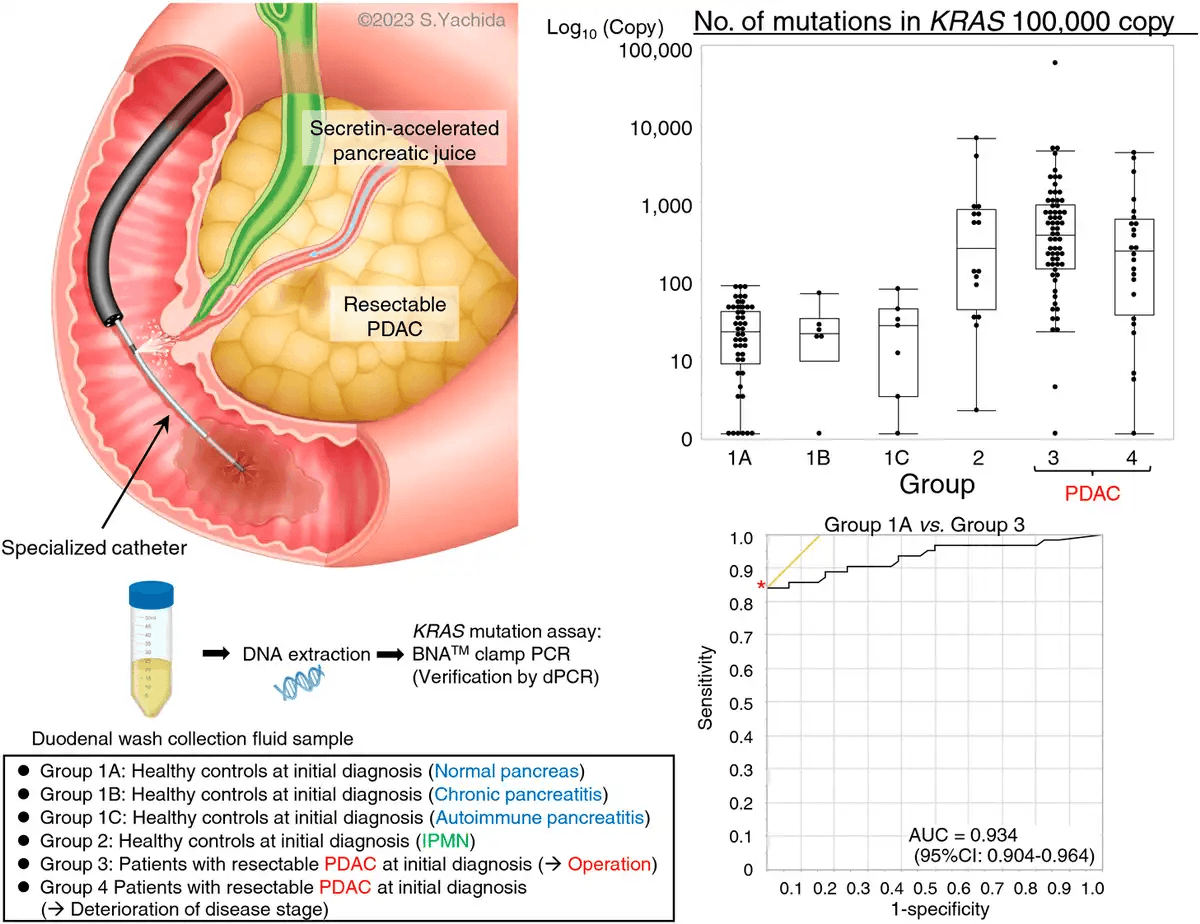
Secretin-stimulated duodenal lavage fluid enables collection of pancreatic juice for genetic analysis in a minimally invasive manner.
KRAS mutations in duodenal lavage fluid show high diagnostic accuracy (AUC 0.934) for detecting resectable pancreatic ductal adenocarcinoma (PDAC).
KRAS mutation analysis surpasses serum tumor markers CEA and CA19-9 in sensitivity while maintaining 100% specificity.
Detection of KRAS mutations in pancreatic juice may also identify microscopic precancerous lesions, expanding possibilities for risk stratification in high-risk populations.
Background
Pancreatic ductal adenocarcinoma (PDAC) holds a dismal prognosis with late diagnosis in most cases, accounting for its status as a leading cause of cancer mortality. The five-year survival rate dramatically improves when PDAC is identified at an early, resectable stage. Traditional imaging and serum tumor markers, such as carcinoembryonic antigen (CEA) and carbohydrate antigen 19-9 (CA19-9), lack sufficient sensitivity and specificity for effective early detection. KRAS gene mutations represent the earliest and most prevalent genetic alterations in PDAC, occurring in over 90% of tumors. Thus, leveraging KRAS mutational status in pancreatic secretions presents an attractive biomarker avenue for screening and early diagnosis.
Emerging minimally invasive approaches to collect pancreatic juice, specifically through secretin stimulation followed by duodenal lavage during esophagogastroduodenoscopy (EGD), provide access to molecular material shed from pancreatic ductal cells. This review synthesizes recent advances focusing on KRAS mutation detection in secretin-stimulated duodenal lavage fluid as a biomarker for early PDAC detection.
Key Content
Chronological Development and Evidence Synthesis
Initial endeavors to detect KRAS mutations in pancreatic juice have established the feasibility of mutation analysis in secretin-stimulated pancreatic fluid collected from the duodenum. A pivotal study by Farrell et al. (2015) involving 272 subjects with varying pancreatic disease risks demonstrated that KRAS mutations were present in 73% of pancreatic cancer patients and 50% of individuals at high cancer risk undergoing screening, compared to 19% of controls. This study underscored the presence of KRAS mutations as a potential early biomarker but also revealed mutation detection in controls, likely reflecting microscopic pancreatic intraepithelial neoplasia (PanIN) lesions invisible to imaging modalities.
Building on prior findings, the recent multicenter prospective study by Yachida et al. (2025) evaluated 169 subjects undergoing EGD with secretin stimulation. The authors deployed a highly sensitive mutation detection technique on duodenal lavage fluid from 89 patients with resectable PDAC and 75 controls. The study reported a receiver operating characteristic area under the curve (AUC) of 0.934 with sensitivity of 83.1% and specificity fixed at 100%. This performance surpasses conventional serum biomarkers, as KRAS mutation sensitivity was significantly higher (P <0.0001) than that of serum CEA and CA19-9, which are limited by false positive rates and lower sensitivity, especially in early-stage disease.
Methodological Advances
Secretin administration induces pancreatic exocrine secretion, flushing pancreatic juice into the duodenum. Specialized catheters facilitate gentle washing collection during EGD with minimal invasiveness. Highly sensitive digital PCR and next-generation sequencing platforms allow detection of low-frequency KRAS mutations amid wild-type DNA, an essential feature given the limited mutation abundance in early disease stages.
Moreover, quantitative assessment of mutation allele frequency in duodenal lavage fluid enables discrimination between cancerous and benign states. The approach capitalizes on the abundant exfoliation of neoplastic cells into pancreatic juice and the biological predilection of PDAC cells to harbor KRAS activating mutations.
Comparative Diagnostic Value
KRAS mutation detection improves early PDAC identification compared with serum tumor markers, which often elevate only in advanced disease. The 2025 study’s use of duodenal lavage fluid demonstrated a sensitivity of 83.1% with perfect specificity, while the serum markers achieved lower sensitivities under similar specificity conditions.
This difference highlights the potential of this technique as a screening tool, particularly in high-risk cohorts where noninvasive methods are preferred and early diagnosis is critical. Also, the method circumvents the need for invasive procedures like endoscopic ultrasound-guided fine needle aspiration (EUS-FNA) in asymptomatic or screening settings.
Implications for High-Risk Screening
The detection of KRAS mutations in individuals without radiologically identifiable lesions raises the possibility of identifying precursor lesions such as PanIN or intraductal papillary mucinous neoplasms (IPMN). Integrating this molecular approach with imaging could refine risk stratification strategies. However, false positives due to age-related or subclinical neoplastic changes must be carefully considered when interpreting mutations in asymptomatic patients.
Expert Commentary
The highlighted research signifies a major leap toward a minimally invasive, molecular diagnostic tool for early PDAC detection. The ability to detect KRAS mutations in secretin-stimulated duodenal lavage fluid combines molecular precision with clinical accessibility afforded by EGD, a commonly performed endoscopic procedure.
Mechanistically, KRAS mutations drive early oncogenesis in pancreatic ductal cells, offering a rational target for early detection. From a translational standpoint, this approach aligns with precision oncology principles, enabling detection before morphological changes become evident.
However, challenges remain. The presence of KRAS mutations in controls necessitates cautious interpretation, indicating the need for adjunctive biomarkers or longitudinal monitoring to distinguish benign from malignant mutation signals. Larger multicenter validation and standardization of collection and detection protocols are essential to implementing this method in routine clinical practice.
Moreover, cost-effectiveness and procedural safety must be evaluated, although secretin administration and EGD are well-established modalities with favorable safety profiles.
Conclusions
Detection of KRAS mutations in duodenal lavage fluid after secretin stimulation represents a clinically promising approach to identify resectable PDAC with high specificity and sensitivity superior to conventional serum biomarkers. This approach has the potential to transform PDAC screening paradigms, especially for high-risk populations.
Future efforts should focus on:
Validation of KRAS mutation-based testing in larger, diverse cohorts including asymptomatic high-risk individuals.
Integration with other molecular markers and imaging techniques to enhance predictive value and accuracy.
Longitudinal studies to assess the natural history and progression risk of mutation-positive but imaging-negative cases.
Development of standardized protocols to ensure reproducibility and scalability in clinical settings.
Overall, secretin-stimulated duodenal lavage KRAS mutation analysis offers a compelling avenue toward early pancreatic cancer detection, with meaningful implications for improving survival outcomes in this deadly malignancy.
References
Yachida S, Yoshinaga S, Shiba S, et al. KRAS Mutations in Duodenal Lavage Fluid After Secretin Stimulation for Detection of Pancreatic Cancer. Ann Surg. 2025;284(4):e62-e72. PMID: 39902566.