Introduction and Context
Type 1 diabetes (T1D) is an autoimmune disease in which the immune system progressively destroys insulin-producing beta cells in the pancreatic islets. Worldwide incidence is rising, and diagnosis frequently occurs after metabolic decompensation: depending on the setting, between about 20% and up to two-thirds of children and adolescents present in diabetic ketoacidosis (DKA) at clinical diagnosis. DKA is preventable when disease is identified earlier.
In recent years, a growing body of evidence and practical program experience (for example, regional screening pilots such as the Fr1da program) has shown that systematic testing for islet autoantibodies (IAbs) in the general population can detect presymptomatic, or “early-stage,” T1D (the preclinical stages) and that early detection reduces DKA, enables outpatient initiation of insulin, supports better short‑ and long‑term glycemic outcomes, and provides opportunities for disease‑modifying interventions and trial enrollment.
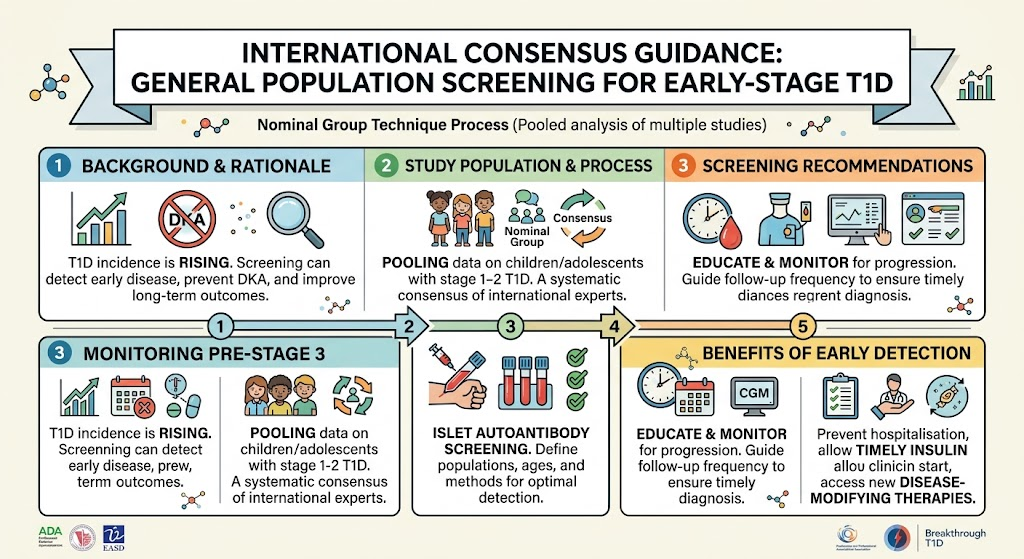
On 10 September 2026, an international multi‑society consensus guidance was published (Ziegler et al., Diabetologia 2026) developed through a nominal group technique. The statement is endorsed by major diabetes societies and patient organizations worldwide and sets out principles and minimum requirements for implementing general population IAb screening programs to diagnose early-stage T1D.
Why this consensus now? Key reasons:
– Clinical gap: most T1D is diagnosed only after symptomatic hyperglycemia or DKA. Early detection remains uncommon outside of relatives of people with T1D.
– New options: therapies (for example, teplizumab) that can delay clinical onset in high‑risk individuals are now available in some jurisdictions, increasing the utility of early identification.
– Program experience: regional screening studies demonstrated feasibility, clinical benefit (lower DKA rates), and acceptability when integrated with follow‑up care and education.
– Need for harmonization: variability in testing methods, follow‑up pathways, and ethical and operational frameworks call for international guidance.
New Guideline Highlights
The consensus does not simply ask “should we screen?” — it defines the principles and minimum program elements for safe, ethical, and effective general population screening for IAbs to detect early-stage T1D. Major takeaways:
– Recommendation in principle: There was strong consensus that general population screening for islet autoantibodies to detect early-stage T1D is appropriate where programmes can meet minimum quality, clinical follow‑up and psychosocial support requirements.
– Target of screening: Children are the priority population given the peak age of seroconversion and high incidence in childhood, but local decisions may include adolescents and adults depending on burden and infrastructure.
– Testing strategy: Screening should use validated autoantibody assays (commonly GADA, IA‑2A, IAA and ZnT8A) with laboratory standardization and external quality assurance. A positive screen requires confirmatory testing and rapid linkage to specialist follow‑up.
– Staging and actions: The consensus endorses the established preclinical stage framework (Stage 1: ≥2 confirmed IAbs, normoglycemia; Stage 2: ≥2 IAbs with dysglycemia; Stage 3: clinical diabetes). Each stage carries defined follow‑up/actions ranging from education and periodic monitoring to consideration of disease‑modifying therapy where available and indicated.
– Minimum program requirements: laboratory quality control, clear clinical pathways, education and psychological support, data systems for results and follow‑up, and population engagement strategies.
Key clinical implications: screening programmes that meet these minimum standards can reduce DKA at diagnosis, facilitate outpatient management, enable access to therapies and trials, and improve family and system preparedness for onset.
Updated Recommendations and Key Changes
How does this consensus differ from prior practice? Historically, routine IAb screening focused on first‑degree relatives and selected research cohorts. This consensus marks an international move toward endorsing general population approaches — not as mandatory for every country, but as an evidence‑informed feasible option where infrastructure exists.
Notable updates and emphases in the 2026 consensus:
– Scope broadened: from “screen relatives or research cohorts” to “general population” screening where minimum requirements are met.
– Program standards: detailed minimum operational criteria (laboratory verification, referral pathways, education, psychosocial support, data governance) that earlier position statements did not comprehensively specify.
– Actionability clarified: the guidance aligns screening with concrete next steps — confirmatory testing, staging, glycemic monitoring cadence, DKA prevention education, and consideration of disease‑modifying therapy where authorized.
– Equity and implementation: explicit attention to health‑system readiness, cost‑effectiveness evaluation, and the need for pilot modelling and stakeholder engagement before large‑scale rollout.
Topic‑by‑Topic Recommendations
Below is a practical summary of core recommendations by topic. The consensus used a nominal group technique to derive agreement; recommendations are expressed here with the consensus strength indicated (Strong consensus, Moderate consensus, or Conditional/Expert opinion).
Screening population and timing
– Recommendation (Strong consensus): Offer general population screening for IAbs in childhood where programmes can provide the necessary follow‑up and support. Prioritize children because most seroconversions occur early; many programmes begin screening in preschool years.
– Practical window (Expert guidance): A one‑time screen in early childhood (commonly proposed between ~2 and 6 years) captures a large proportion of seroconversions; programs may elect repeat screening (for example, at intervals) depending on resources and local epidemiology.
Autoantibodies and testing approach
– Recommendation (Strong consensus): Use a multi‑autoantibody panel as the screening test—commonly GAD autoantibodies (GADA), insulin autoantibodies (IAA), IA‑2 autoantibodies (IA‑2A), and zinc transporter 8 autoantibodies (ZnT8A).
– Laboratory standards (Strong consensus): Screening laboratories must use validated assays with participation in international standardization and external quality assurance programs; clear thresholds and confirmatory testing are required.
– Confirmatory testing (Strong consensus): Any initial positive should be repeated on a new specimen (or with an independent assay) to confirm positivity before labeling someone as having early-stage T1D.
Diagnostic staging and risk communication
– Recommendation (Strong consensus): Use the established staging system for T1D:
– Stage 1: two or more confirmed IAbs, normoglycemia
– Stage 2: two or more IAbs with dysglycemia
– Stage 3: clinical diabetes (symptomatic hyperglycemia requiring insulin)
– Communication (Strong consensus): Convey results in a structured, family‑centered manner that explains what stage means for near‑term risk, monitoring, DKA prevention, and options (including trials and therapies where available).
Follow‑up and monitoring
– Stage 1 (Strong consensus): Offer structured education, DKA prevention counseling, and periodic glycemic monitoring (for example, HbA1c, random/fasting glucose, or oral glucose tolerance testing at agreed intervals). Suggested interval: every 3–6 months, with frequency tailored to age, family preference, and local pathways.
– Stage 2 (Strong consensus): Intensify monitoring and expedite consideration of disease‑modifying therapy where indicated and available; monitoring intervals often monthly to every 3 months depending on dysglycemia severity.
– Transition and urgency (Strong consensus): Provide clear emergency plans for symptoms of hyperglycemia and expedited access to care if glucose levels or symptoms escalate.
Disease‑modifying therapies and trials
– Recommendation (Strong consensus): Screening programs should link identified at‑risk individuals to clinical trials and, where therapies are approved (for example, teplizumab in selected jurisdictions), to clinical treatment pathways consistent with regulators’ labels and local practice.
– Eligibility and counselling (Moderate consensus): Offer informed counselling about potential benefits, risks, and unknowns of immunomodulatory therapies; participation in trials should be encouraged when available.
Program infrastructure and ethics
– Minimum requirements (Strong consensus): Before population screening is offered, systems must be in place for:
– Confirmatory testing and standardized reporting
– Specialist follow‑up clinics and diabetes education
– Psychosocial support services
– Data systems for tracking results and outcomes
– Quality assurance and laboratory accreditation
– Informed consent and privacy (Strong consensus): Programs must include informed consent processes adapted for parents and older children, clear data governance, and attention to psychosocial implications.
Cost, equity and public health
– Recommendation (Conditional consensus): Jurisdictions should conduct local health‑economic modelling and pilot programs; focus on equitable access so that screening does not widen disparities.
Special populations
– Relatives of persons with T1D (Strong consensus): Continue targeted screening of first‑degree relatives with immediate referral options; these individuals remain high‑yield targets.
– Adults (Conditional consensus): Consider inclusion of adolescents and adults in program designs depending on local incidence and capacity; evidence in adults is less robust but still supports benefit in some settings.
Expert Commentary and Insights
The consensus panel included clinicians, researchers, public‑health experts and patient representatives. Several themes and debates emerged:
– Actionability is critical. Many panelists emphasized that screening without the ability to provide timely confirmatory testing, education, or follow up is unethical. The consensus therefore ties approval of general population screening to minimum program capabilities.
– Lab quality matters. False positives (or poorly standardized assays) risk harm through anxiety and unnecessary follow‑up. The panel strongly recommended use of validated assays and routine external quality assurance.
– Psychosocial support must be central. Families receiving news that a child has early‑stage T1D face uncertainty; structured counseling, peer support and clear education reduce distress and improve adherence to monitoring plans.
– Disease‑modifying therapy availability changed the calculus. The approval and clinical availability of agents that delay progression (such as teplizumab in jurisdictions where it is authorized) increase the clinical value of early detection, but also raise questions about equitable access and long‑term outcomes.
– Cost and resource allocation remain debated. Some experts argue that large‑scale screening is cost‑effective when DKA prevention, improved long‑term outcomes and therapy opportunities are factored in; others call for careful, context‑specific economic evaluation before national roll‑out.
– Evidence gaps: optimal screening age and cadence, long‑term psychosocial outcomes, and cost‑effectiveness across diverse health systems were flagged as priority research areas.
Practical Implications for Clinicians and Health Systems
What should clinicians and health systems do now?
– If your system is considering screening: perform pilot projects, ensure laboratory and clinical follow‑up infrastructure, and build protocols for result disclosure, education and psychosocial support.
– If screening is already underway: align with the consensus’ minimum standards—confirmatory testing, standardized staging, timely referral to specialty care, and participation in quality assurance.
– For primary‑care clinicians: be prepared to counsel families about what positive results mean, the natural history of early‑stage T1D, how monitoring works, and when urgent evaluation is necessary.
– For policymakers: invest in laboratory standardization, workforce development (education and counseling capacity), and data systems; consider incremental roll‑outs with built‑in evaluation to measure DKA rates, clinical outcomes and equity.
Practical checklist for a program (minimum elements)
– Validated autoantibody assays and external QA participation
– Protocol for confirmatory testing and staging
– Clear patient/family information materials and consent processes
– Rapid referral pathway to pediatric endocrinology/diabetes clinic
– Structured education and DKA prevention plan
– Access to psychosocial support
– Data collection for outcomes, safety, and cost analyses
Example vignette
Emily, age 5, participates in a school‑based screening pilot. Her sample returns positive for two confirmed autoantibodies (GADA and ZnT8A). She is counselled in a same‑week clinic visit: Stage 1 T1D is explained, a monitoring plan every 3 months is agreed, and the family receives DKA‑prevention education and contact guidance for symptoms. Because Emily later develops impaired glucose tolerance at 9 months, her care team discusses eligibility for an immunomodulatory trial available locally. Because Emily was identified early, she avoids DKA and initiation of insulin occurs electively as an outpatient when (if) needed.
References
– Ziegler AG, Rewers MJ, Achenbach P, et al. International consensus guidance for general population screening for islet autoantibodies to diagnose early‑stage type 1 diabetes: a nominal group technique process. Diabetologia. 2026 Sep 10. PMID: 42720753.
– Herold KC, Bundy BN, Long SA, et al. An anti‑CD3 antibody, teplizumab, in relatives at risk for type 1 diabetes. N Engl J Med. 2019;381:603–613.
– U.S. Food and Drug Administration. Tzield (teplizumab‑mnzm) prescribing information, 2023. (FDA approval for delaying type 1 diabetes in at‑risk individuals.)
– American Diabetes Association. Standards of Care in Diabetes—2024. Diabetes Care. 2024;47(Suppl 1):S1–S200.
(here and elsewhere clinicians should consult the full Diabetologia consensus paper and local regulatory guidance for jurisdiction‑specific details and the most current implementation recommendations.)
Conclusion
This international consensus marks an important shift: general population screening for islet autoantibodies is now framed as an acceptable and actionable public‑health strategy where programs can meet minimum standards for laboratory quality, confirmatory testing, specialist follow‑up, education and psychosocial support. The guidance is pragmatic — emphasizing staged diagnosis, rapid linkage to care, and ethical program design — and it aligns detection with prevention of DKA, outpatient initiation of insulin when necessary, and opportunities for disease‑modifying therapy and research participation. Local implementation should proceed through pilots, economic evaluation, and a commitment to equitable access and quality assurance.
Further reading
Consult the full consensus statement (Ziegler et al., Diabetologia 2026) and national guidance from diabetes societies for operational details and jurisdictional recommendations.