Temple Syndrome: Unveiling a Hidden Multi-System Growth Disorder and Introducing a New Diagnostic Score

Introduction

Temple syndrome (TS14) is a genetic imprinting disorder caused by abnormalities at the chromosome 14q32.2 region. It is characterized by a multi-system growth failure and endocrine dysfunction. Despite its distinctive features overlapping with Silver-Russell syndrome (SRS) and Prader-Willi syndrome (PWS), Temple syndrome remains under-recognised and frequently misdiagnosed or diagnosed late. This delay impedes timely intervention and management of its complex manifestations. The largest cohort study to date, conducted across specialist centers in the United Kingdom and The Netherlands, comprehensively delineates the endocrine and clinical phenotype of TS14, evaluates the efficacy of growth hormone (GH) therapy, and introduces a TS14-specific clinical scoring system to aid in earlier diagnosis and treatment initiation.


Study Background

TS14 arises due to maternal uniparental disomy (UPD), hypomethylation, or deletions affecting the imprinted genes at 14q32.2. Clinically, it presents with prenatal and postnatal growth retardation, feeding difficulties, short stature, early-onset obesity, dysregulated appetite including hyperphagia, and endocrine abnormalities such as growth hormone deficiency (GHD) and precocious puberty. These features overlap substantially with SRS and PWS phenotypes, complicating diagnostic clarity. Moreover, the endocrine spectrum associated with TS14 has been insufficiently characterized, limiting clinicians’ ability to provide comprehensive care. Given the scarcity of large datasets, this multicentre cohort analysis aims to fill these knowledge gaps.

Study Design and Methods

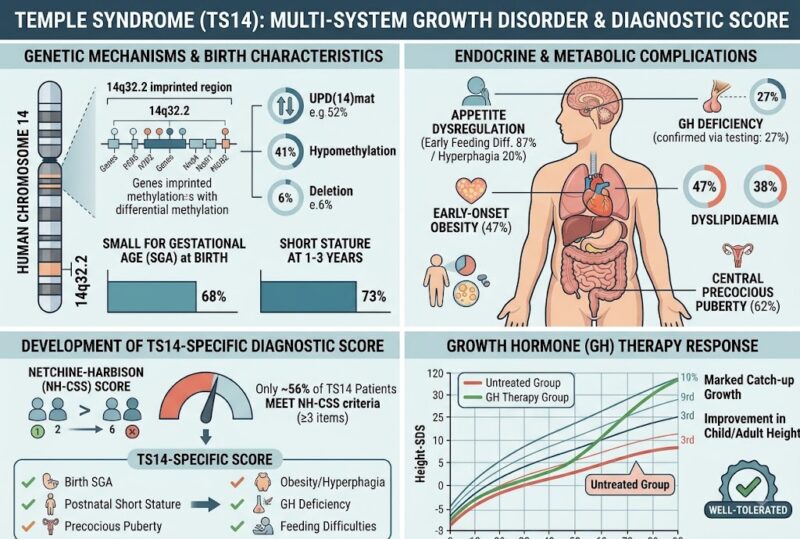
This was a retrospective and prospective cohort study involving 71 individuals diagnosed with TS14, enrolled from specialist endocrinology centers in the UK and the Netherlands. The cohort encompassed a broad age range, stratified for detailed phenotypic analysis. Genetic subtypes were classified as maternal UPD (52%), hypomethylation (41%), and deletion (6%). Key endpoints included assessment of growth parameters (birth and childhood height and weight), endocrine function tests including GH stimulation and insulin-like growth factor 1 (IGF-1) levels, metabolic complications, and response to GH therapy. Additionally, the study evaluated the performance of the established Netchine-Harbison clinical scoring system (NH-CSS) used in SRS and developed a novel TS14-specific clinical scoring system to improve diagnostic ascertainment.

Key Findings

Genetic and Growth Characteristics

Most patients (68%) were born small for gestational age (SGA). At 1-3 years of age, short stature was present in 73% of patients; however, this improved markedly by 11-14 years, with only 15% remaining short stature. This improvement was partly attributed to GH therapy, which facilitated catch-up growth. Baseline IGF-1 concentrations were within normal range (≥-2 standard deviation scores [SDS]) in all patients, yet 27% had confirmed GH deficiency based on stimulation testing.

Endocrine and Metabolic Features

Early feeding difficulties were reported in 87% of individuals, reflecting complex appetite dysregulation. Obesity affected almost half (47%) of the cohort, and hyperphagia (excessive hunger) was noted in 20%, suggesting divergent appetite control mechanisms. Dyslipidaemia, identified in 38%, and central precocious puberty, observed in 62%, highlight significant endocrine and metabolic complications requiring age-specific management strategies. The high prevalence of central precocious puberty differs from classical PWS and underscores the need for tailored surveillance in TS14.

Clinical Scoring and Diagnostic Performance

Only 56.5% of patients met three or more criteria of the Netchine-Harbison scoring system (NH-CSS), an established clinical tool primarily designed for SRS diagnosis. Recognizing the overlapping but distinctive phenotype, the authors developed a TS14-specific clinical scoring system incorporating key features such as growth parameters, endocrine abnormalities, and metabolic signs. This scoring system aims to enhance early recognition and prompt genetic testing for TS14, which may otherwise be overlooked when using SRS-focused criteria.

Response to Growth Hormone Therapy

Patients receiving GH therapy demonstrated significant improvement in growth outcomes compared with untreated individuals. GH treatment was well-tolerated and appeared effective even in patients without classical GHD, suggesting therapeutic benefits extend beyond GH deficiency. This supports GH therapy as a promising intervention to address growth failure and improve overall health status in TS14.

Expert Commentary

Temple syndrome poses diagnostic challenges due to phenotypic overlap with other imprinting disorders. This large cohort study elucidates the broad endocrine spectrum and highlights distinct features such as the high frequency of central precocious puberty and early obesity. The introduction of a TS14-specific clinical scoring system represents a valuable tool to aid clinicians in considering TS14 in differential diagnoses when encountering SGA infants with feeding difficulties and endocrine manifestations.

By demonstrating a favorable response to GH therapy, the study supports current clinical practice of early endocrine evaluation and treatment in this population. Nonetheless, the heterogeneity of genetic subtypes and variable phenotypes warrant individualized monitoring and management. Future prospective studies are needed to refine treatment protocols and long-term outcomes in TS14.

Conclusion

Temple syndrome is an under-recognised, multi-system imprinting disorder characterized by growth failure, GH deficiency, precocious puberty, appetite dysregulation, and metabolic abnormalities. Early diagnosis remains challenging due to overlapping clinical features with other syndromes like SRS and PWS. This study delivers a comprehensive phenotype description from the largest cohort to date and introduces a TS14-specific clinical scoring system to facilitate earlier recognition and genetic testing. Growth hormone therapy shows promise in ameliorating growth deficits, underscoring the importance of timely endocrine evaluation and intervention. Integrating this evidence into clinical practice could improve patient outcomes and reduce diagnostic delay in this elusive disorder.

Funding and Trial Registration

This research was conducted at specialist endocrine centers in the United Kingdom and The Netherlands. Specific funding sources and clinical trial registration details were not provided in the report.

References

1. Juriaans AF, Gazdagh G, Temple IK, Mackay DJG, Kerkhof G, Davies JH. Temple syndrome – an under-recognised multi-system growth disorder: large cohort analysis and proposed scoring system. The Journal of Clinical Endocrinology and Metabolism. 2026 Aug 11. PMID: 42576450.

2. Netchine I, et al. Clinical scoring systems and genetic testing for imprinting disorders associated with growth failure. Hormone Research in Paediatrics. 2020.

3. Eggermann T, et al. Imprinting disorders: clinical phenotype, molecular diagnosis and genetic counselling. European Journal of Medical Genetics. 2015;58(1):1-13.

4. Mackay DJG, Temple IK. The 14q32 imprinted region: update on genetic and epigenetic aspects, clinical phenotype, and diagnosis. European Journal of Human Genetics. 2017.

5. Clayton PE, et al. Consensus statement on the management of growth hormone deficiency in childhood and adolescence: summary of NICE guidance. Archives of Disease in Childhood. 2013.

Comments

No comments yet. Why don’t you start the discussion?

Leave a Reply