Highlight
- Tavapadon, a selective D1/D5 dopamine receptor agonist, significantly improved motor and daily living activities in early-stage Parkinson’s disease compared with placebo over 26 weeks.
- Flexible dosing (5-15 mg once daily) was generally well tolerated, with adverse events mostly mild-to-moderate and manageable; nausea, headache, and dizziness were the most common effects.
- The trial showed low incidences of somnolence and impulse control disorders, differentiating tavapadon from traditional D2/D3 agonists.
- Long-term safety and efficacy remain to be established in ongoing extension studies.
Study Background
Parkinson’s disease (PD) is a progressive neurodegenerative disorder characterized predominantly by motor symptoms such as bradykinesia, rigidity, and tremor, due to dopaminergic neuronal loss in the substantia nigra. Dopaminergic therapies remain the mainstay for symptom management. Levodopa is highly effective but is associated with long-term motor complications, including dyskinesias and motor fluctuations. Meanwhile, dopamine agonists targeting primarily D2/D3 receptors are linked with non-motor adverse effects such as impulse control disorders and somnolence, reducing their tolerability and utility. There remains an unmet need for novel treatments with effective symptom control and better safety profiles, particularly in early disease stages.
Tavapadon is an orally administered, once-daily selective agonist at D1 and D5 dopamine receptors, representing a mechanistically distinct approach. By targeting these receptor subtypes, tavapadon aims to improve motor symptoms while potentially avoiding some adverse effects associated with non-selective dopamine agonists. The phase 3 TEMPO-2 trial sought to rigorously assess the safety, tolerability, and efficacy of flexible-dose tavapadon in people with early Parkinson’s disease, either treatment-naive or minimally treated.
Study Design
TEMPO-2 was a multinational, phase 3, randomized, double-blind, placebo-controlled clinical trial conducted at 75 sites spanning both community and academic settings across 13 countries. Adults aged 40 to 80 years with early-stage Parkinson’s disease were enrolled if they had a diagnosis of less than 3 years’ duration and were either treatment-naive or had received dopaminergic therapy for fewer than three months.
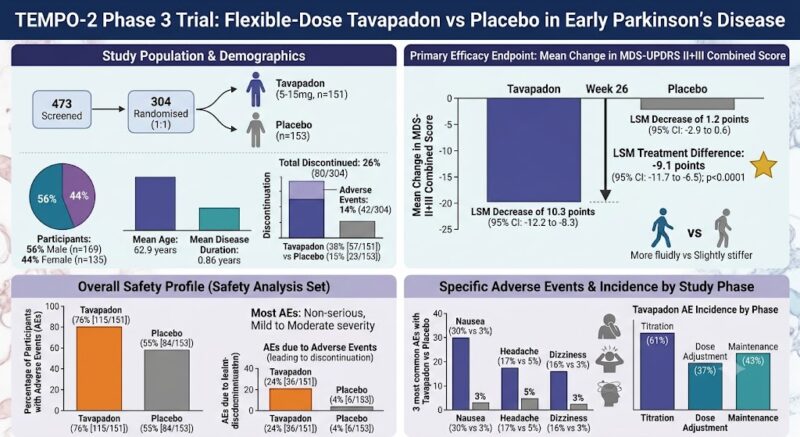
Participants (n=304) were randomized in a 1:1 ratio to receive flexible-dose tavapadon (5 to 15 mg once daily) or placebo for 27 weeks. Dose adjustments were permitted to optimize tolerability and efficacy.
The primary efficacy endpoint was the change from baseline to week 26 in the combined score of the Movement Disorder Society Unified Parkinson’s Disease Rating Scale (MDS-UPDRS) Parts II and III, which reflect activities of daily living and motor examination, respectively. Safety assessments included recording adverse events (AEs), laboratory parameters, vital signs, and electrocardiogram (ECG) monitoring. The modified intent-to-treat (mITT) population included participants who received at least one dose of study medication and had baseline plus post-baseline efficacy measurements, while the safety set included all treated participants.
Key Findings
Between January 2020 and February 2024, 473 individuals were screened, and 304 randomized (151 to tavapadon, 153 to placebo). The cohort’s mean age was 62.9 years (SD 9.2), with 56% male participants, and mean disease duration was less than one year.
Efficacy:
Tavapadon demonstrated significant and clinically meaningful improvement in motor symptoms compared to placebo. Specifically, the least squares mean (LSM) decrease from baseline in MDS-UPDRS Parts II and III combined score at week 26 was 10.3 points (95% CI, -12.2 to -8.3) with tavapadon versus 1.2 points (-2.9 to 0.6) with placebo. The between-group difference of -9.1 points (95% CI, -11.7 to -6.5) was highly statistically significant (p10% incidence) were nausea (30% vs 3% placebo), headache (17% vs 5%), and dizziness (16% vs 3%). Somnolence and impulse control disorders were low and not prominently increased compared to placebo, a distinct safety advantage over existing D2/D3 agonists.
Interpretation of Effect Size:
An approx. 9-point difference on the combined MDS-UPDRS II and III scale is considered clinically meaningful, indicating tangible improvements in motor function and activities of daily living in early PD. This positions tavapadon as a promising adjunct or initial therapy to potentially delay levodopa introduction.
Expert Commentary
The TEMPO-2 results represent an important advance in PD therapeutics. Targeting D1/D5 receptors selectively with tavapadon may circumvent limitations of current dopaminergic agents—reducing motor complications and neuropsychiatric side effects commonly encountered with levodopa and D2/D3 agonists, respectively.
Nonetheless, the relatively high discontinuation rate on tavapadon due to AEs—largely driven by nausea—suggests the need for careful titration and management of side effects in clinical practice. The trial’s focus on early-stage, minimally treated patients enhances generalizability to real-world initiation scenarios but limits understanding in more advanced disease.
Crucially, the short 26-week duration precludes conclusions on long-term safety and efficacy, especially regarding motor fluctuations, dyskinesias, and non-motor outcomes. The ongoing extension study will be critical to establish whether tavapadon’s benefits sustain and whether tolerability improves over time.
From a mechanistic perspective, D1 receptor agonism may enhance basal ganglia output pathways differently from traditional therapies, offering a novel route to symptom control. This trial’s robust design and global sample strengthen its impact and provide a foundation for updating clinical guidelines as further data emerge.
Conclusion
In summary, the phase 3 TEMPO-2 trial demonstrates that flexible-dose tavapadon offers significant motor and daily living activity improvements in early Parkinson’s disease with an acceptable safety profile. While adverse events such as nausea were more frequent, the drug exhibited a low incidence of somnolence and impulse control disorders. These results suggest that selective D1/D5 receptor agonism is a promising therapeutic strategy that could complement or potentially delay traditional dopaminergic therapies like levodopa.
Further long-term studies are needed to fully characterize tavapadon’s safety and efficacy profile, determine its impact on disease progression and motor complications, and integrate it into treatment paradigms. For clinicians managing early PD, tavapadon represents an emerging option potentially balancing efficacy with improved tolerability.
Funding and Trial Registration
This study was funded by AbbVie. The clinical trial is registered with ClinicalTrials.gov under the identifier NCT04223193.
References
1. Fernandez HH, Bhatia P, Cloud L, et al. Safety, tolerability, and efficacy of flexible-dose tavapadon for Parkinson’s disease (TEMPO-2): a phase 3, randomised, placebo-controlled, double-blind trial. Lancet Neurol. 2026 Aug;25(8):721-730. doi:10.1016/S1474-4422(26)00123-7. PMID: 42456682.
2. Olanow CW, Stocchi F. Levodopa: a look backward and forward. Mov Disord. 2018;33(7):1014-1022.
3. Kalia LV, Lang AE. Parkinson’s disease. Lancet. 2015;386(9996):896-912.
4. Boess FG, Martin WRW. Therapeutic potential of selective dopamine D1 receptor agonists. J Neural Transm. 1994;Suppl 40:27-49.