Highlight
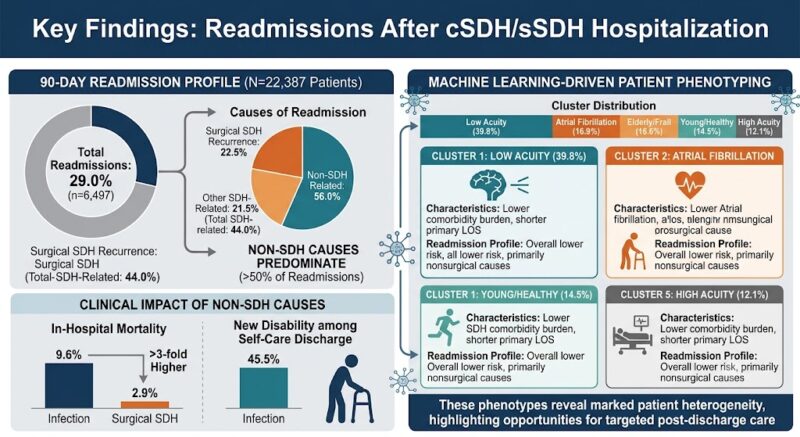
Readmissions within 90 days post-hospitalization for chronic or subacute subdural hematoma (cSDH/sSDH) occur in nearly one-third of patients, predominantly due to nonsurgical causes. Infection-related readmissions have significantly higher mortality and new disability rates than surgical recurrences. Machine learning-driven patient phenotyping identifies five distinct clusters with divergent readmission risks, highlighting substantial clinical heterogeneity. These findings advocate for broadened clinical trial outcomes beyond surgical recurrence and personalized postdischarge care models.
Study Background
Chronic and subacute subdural hematomas (cSDH/sSDH) represent common neurosurgical conditions primarily affecting older adults. Although surgical recurrence is a recognized complication, clinical focus and trial designs have historically concentrated on this single event. However, readmissions following initial hospitalization are frequent and encompass a broad range of clinical causes beyond surgical recurrence. These nonsurgical readmissions may contribute substantially to morbidity, mortality, and healthcare costs but remain understudied. With a growing elderly population and increasing incidence of cSDH, identifying the full burden and patterns of readmission is critical to optimize care and allocate resources effectively. Novel approaches such as machine learning can uncover patient phenotypes that inform risk stratification and personalized interventions.
Study Design
This retrospective cohort study utilized the Nationwide Readmissions Database from 2016 to 2022 to analyze adult patients hospitalized nonelectively for cSDH/sSDH. The primary endpoint was all-cause hospital readmission within 90 days post-index hospitalization, categorized by cause—surgical recurrence of SDH versus non-SDH-related reasons such as infections and other medical complications. Outcomes assessed during readmission included length of stay, hospital costs, in-hospital mortality, new disability, functional decline, and the ability to return home. Machine learning phenotyping employed a multinomial gradient-boosted model with Shapley Additive Explanations values to identify influential features, followed by K-means clustering to delineate patient subgroups with distinct clinical and readmission profiles.
Key Findings
The cohort consisted of 22,387 patients with mean age 70.8 years, 29.6% female. Overall, 6,497 patients (29.0%) were readmitted within 90 days. Surgical SDH recurrence accounted for 22.5% of these readmissions, while the majority (56%) were for non-SDH causes, demonstrating a diverse readmission spectrum. Notably, infections represented a critical non-SDH cause, with infection-related readmissions associated with the highest mortality at 9.6%—more than triple that seen in surgical recurrence (2.9%). Infection readmissions also had the highest new disability rate (45.5%) among patients initially discharged with routine self-care capability.
Machine learning clustering identified five phenotypic clusters with distinct patient characteristics and readmission risks:
- Low Acuity (39.8%): Younger, fewer comorbidities, lower readmission risk.
- Atrial Fibrillation (16.9%): Characterized by high prevalence of atrial fibrillation, likely contributing to cardiovascular and thromboembolic complications.
- Elderly/Frail (16.6%): Advanced age and frailty-related comorbidities with elevated readmission and morbidity.
- Young/Healthy (14.5%): Younger patients with fewer health issues but distinct readmission patterns.
- High Acuity (12.1%): Patients with severe underlying conditions and highest readmission rates and adverse outcomes.
Each cluster displayed unique risks for different causes of readmission and varied clinical outcomes during readmission. This heterogeneity underscores that risk stratification and management strategies must be tailored to patient-specific profiles rather than a uniform approach focusing solely on surgical recurrence.
Expert Commentary
This study robustly challenges the traditional neurosurgical paradigm emphasizing only surgical recurrence in post-cSDH care. By leveraging machine learning to dissect a large, heterogeneous dataset, the investigators provide compelling evidence that nonsurgical readmissions, particularly infections, contribute significantly to mortality and morbidity. These findings align with broader health services research recognizing the vulnerability of older adults with neurological conditions to systemic complications. The defined phenotypic clusters may facilitate precision medicine approaches—targeting prevention strategies such as infection control protocols for the high-acuity and elderly/frail clusters or comprehensive cardiovascular management in the atrial fibrillation cluster.
Limitations include the retrospective design and reliance on administrative coding, which may introduce misclassification bias. The database does not contain granular clinical details such as hematoma size or functional status markers, which could further refine phenotyping. Prospective studies should validate these clusters and evaluate interventions tailored to each subgroup.
Conclusion
Readmission after cSDH/sSDH hospitalization is frequent and clinically diverse, with nonsurgical causes predominating and often resulting in worse outcomes than surgical recurrence. Machine learning-driven phenotyping reveals marked heterogeneity within this patient population with distinct readmission risk profiles. These insights advocate for expanding clinical trial endpoints beyond surgical recurrence to broader morbidity measures and implementing multifaceted postdischarge care pathways. Ultimately, personalized management targeting the spectrum of readmission risks may improve functional outcomes and reduce healthcare burden in this growing patient population.
Funding and ClinicalTrials.gov
The study was authored by Chen H et al. with no funding disclosures explicitly mentioned in the publication. The retrospective design utilizing anonymized national administrative databases did not involve clinical trial registration.
References
- Chen H, Colasurdo M, McIntyre MK, Lakhani DA, Malhotra A, Gandhi D. Machine Learning Characterization of Readmissions After Chronic Subdural Hematoma Hospitalizations. Neurology. 2026 Aug 7;107(5):e218438. doi: 10.1212/WNL.0000000000002184. PMID: 42566725.
- Edlmann E, Giorgi-Coll S, Whitfield PC, et al. Pathophysiology of chronic subdural haematoma: inflammation, angiogenesis and implications for pharmacotherapy. J Neuroinflammation. 2017;14(1):108. doi:10.1186/s12974-017-0860-6.
- Almenawer SA, Farrokhyar F, Hong C, et al. Chronic subdural hematoma management: a systematic review and meta-analysis of 34,829 patients. Ann Surg. 2014;259(3):449-57. doi:10.1097/SLA.0000000000000292.
- Goldstein LB, Bushnell CD, Adams RJ, et al. Guidelines for the primary prevention of stroke: a guideline for healthcare professionals from the American Heart Association/American Stroke Association. Stroke. 2011;42(2):517-584. doi:10.1161/STR.0b013e3181fcb238.