Highlight
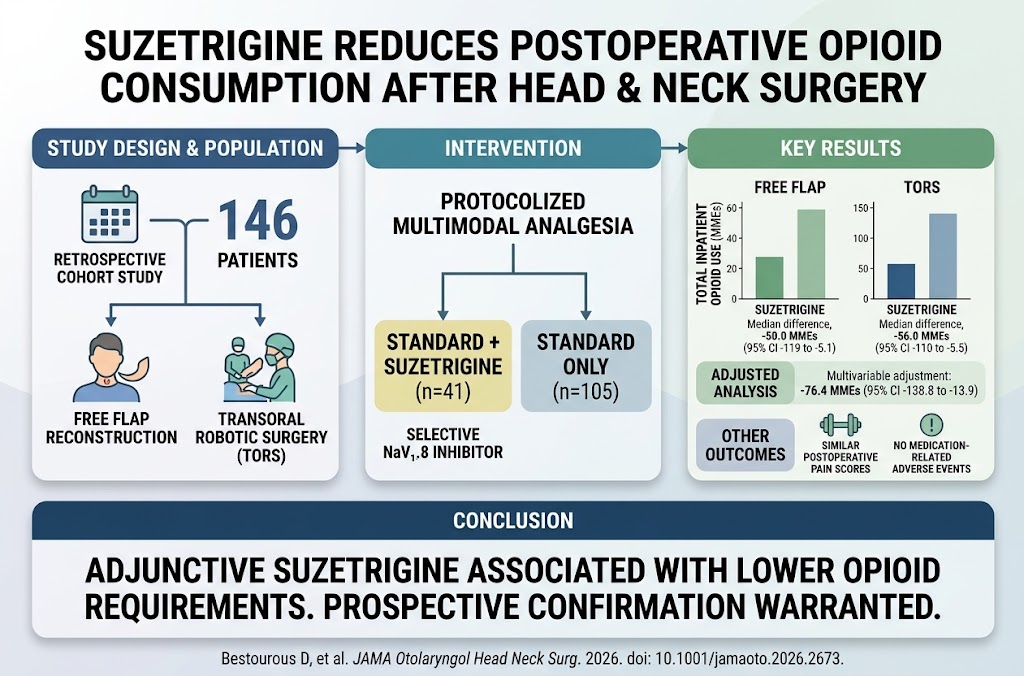
- Adjunctive suzetrigine use correlates with significantly lower opioid consumption in patients after head and neck free flap and transoral robotic surgery.
- The reduction in opioid requirements occurs without an increase in postoperative pain scores or observed medication-related adverse events.
- The retrospective cohort study provides a foundation for prospective trials to confirm suzetrigine’s role in multimodal analgesia protocols for complex head and neck surgeries.
Study Background
Postoperative pain management remains a significant challenge following major head and neck surgeries, including free flap reconstructions and transoral robotic surgery. Despite multimodal analgesic strategies, opioids are commonly employed, exposing patients to risk of adverse effects and potential for opioid dependence. Suzetrigine, a selective NaV1.8 sodium channel inhibitor recently approved in the United States for acute postoperative pain, offers a novel mechanism for analgesia by targeting nociceptive pathways without typical opioid side effects. However, its effectiveness and safety profile in head and neck surgical populations have not been extensively studied, making this evaluation clinically relevant for optimizing analgesia and minimizing opioid exposure in this high-risk cohort.
Study Design
This retrospective cohort study was conducted at a single tertiary academic referral center over a 12-month period in 2025. It included adult patients undergoing either head and neck free flap reconstruction or transoral robotic surgery. Exclusion criteria were chronic high-dose opioid use, chronic pain syndromes, liver dysfunction, or incomplete opioid usage data, ensuring a more homogeneous and evaluable cohort.
Participants received a standardized multimodal analgesic regimen with or without adjunctive suzetrigine. Primary endpoints included total inpatient opioid consumption quantified in morphine milligram equivalents (MMEs) and daily MME use per hospital day. Secondary outcomes evaluated were hospital length of stay, 30-day readmission and emergency department visit rates, oral intake, postoperative pain scores, and incidence of medication-related adverse events.
Key Findings
The final analysis encompassed 146 patients: 114 underwent free flap reconstruction and 32 had transoral robotic surgery. Of these, 41 patients (28.1%) received suzetrigine adjunctively.
In the free flap group, patients receiving suzetrigine demonstrated a statistically significant reduction in median inpatient opioid use (109.0 MMEs) compared with controls receiving multimodal analgesia alone (142.1 MMEs), with a median difference of -50.0 MMEs (95% CI, -119.0 to -5.1). Similarly, in the transoral robotic surgery subgroup, suzetrigine recipients had markedly lower opioid consumption (29.0 vs 108.9 MMEs), corresponding to a median difference of -56.0 MMEs (95% CI, -110.0 to -5.5).
Multivariable analyses confirmed suzetrigine use as independently associated with reduced opioid consumption, with an adjusted median difference of -76.4 MMEs (95% CI, -138.8 to -13.9). Importantly, postoperative pain scores did not differ significantly between groups, indicating effective analgesia despite opioid reduction. No medication-related adverse events attributable to suzetrigine were reported, supporting its tolerability.
Secondary outcomes such as hospital length of stay, readmission rates, and oral intake did not show significant differences, suggesting that suzetrigine’s opioid-sparing effect did not adversely affect clinical recovery parameters.
Expert Commentary
Suzetrigine’s selective blockade of NaV1.8 channels, expressed primarily on nociceptive sensory neurons, provides a mechanistically distinct approach to controlling postoperative pain without CNS opioid receptor engagement. This pharmacological targeting may underlie the observed reduction in opioid requirements without compromising analgesic efficacy or increasing adverse effects.
While the retrospective design limits causal inference, the study’s well-defined cohort and controlled multimodal analgesic protocols strengthen the observed association. The findings align with a growing body of evidence favoring opioid-sparing agents in head and neck surgery to mitigate opioid-related complications and improve recovery profiles.
Limitations include potential selection bias and unmeasured confounders inherent in nonrandomized studies. Further prospective randomized controlled trials are warranted to validate suzetrigine’s efficacy, optimize dosing regimens, and evaluate long-term outcomes including opioid dependence prevention.
Conclusion
This retrospective cohort study identifies adjunctive suzetrigine as a promising component of multimodal analgesia that significantly reduces postoperative opioid consumption after head and neck free flap reconstruction and transoral robotic surgery without increasing pain or adverse events. These results advocate for prospective research to establish suzetrigine’s role in enhancing pain management and opioid stewardship in complex head and neck surgical populations.
Funding and ClinicalTrials.gov
The original study did not report specific funding sources or clinical trial registration numbers.
References
1. Bestourous DE, Soule S, Beiriger J, et al. Suzetrigine for Postoperative Pain in Head and Neck Free Flap or Transoral Robotic Surgery. JAMA Otolaryngol Head Neck Surg. 2026; PMID: 42752794.
2. Derry S, Wiffen PJ, Moore RA. Sodium channel blockers for acute postoperative pain in adults. Cochrane Database Syst Rev. 2020.
3. U.S. Food and Drug Administration. Suzetrigine approval announcement and prescribing information. 2025.
4. Joshi GP, Schug SA, Kehlet H. Evidence-based postoperative pain management after head and neck surgery. Anesth Analg. 2019;129(5):1489-1498.