Introduction and Clinical Background
Allogeneic hematopoietic stem cell transplantation (alloHSCT) remains a potentially curative treatment for a variety of hematological malignancies and disorders. However, graft-versus-host disease (GVHD) continues to pose a significant limitation to transplant success, affecting morbidity, mortality, and overall survival. GVHD arises when donor immune cells attack recipient tissues, manifesting as acute or chronic forms with varying severity. Contemporary advances in GVHD prophylaxis have evolved beyond conventional immunosuppressive regimens, notably incorporating post-transplant cyclophosphamide (PTCy) and antithymocyte globulin (ATG). Originally prominent in haploidentical donor transplants, these agents are increasingly employed across matched related (MRD) and unrelated donor (MUD) settings. Nonetheless, real-world data characterizing the incidence and outcomes of GVHD with these evolving prophylactic strategies remain limited, underscoring a crucial knowledge gap.
Study Design
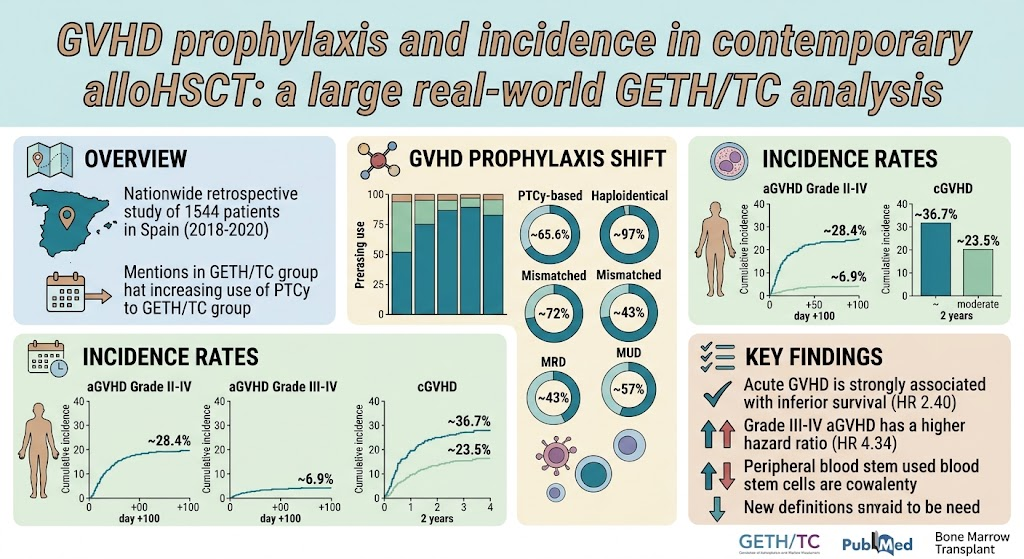
Martínez et al. conducted a nationwide retrospective analysis of 1,544 alloHSCT procedures performed in Spain between 2018 and 2020 under the purview of the GETH/TC consortium. This study aimed to elucidate patterns of GVHD prophylaxis and quantify acute and chronic GVHD incidence in a contemporary, real-world patient population. The cohort included haploidentical, mismatched, MRD, and MUD transplants, with data collection focused on type of GVHD prophylaxis used, donor source, stem cell source, GVHD incidence rates at multiple timepoints, and overall survival metrics.
Key Findings
The study revealed that PTCy-based prophylaxis was employed in 65.6% of all transplants, being the predominant approach in haploidentical procedures (96.9%) and mismatched donors (72.4%), and notably utilized in MRD (43.5%) and MUD (56.8%) settings as well. This reflects a substantial shift from traditional prophylaxis regimens, representing the growing acceptance of PTCy beyond its original donor contexts.
The cumulative incidence of grade II-IV acute GVHD was 28.4% at day +100 and 30.7% at one year post-transplant, while the more severe grade III-IV acute GVHD occurred in 6.9% and 8.0% respectively. Despite the prevalent use of peripheral blood stem cells (PBSC)—an established risk factor for GVHD—the 2-year cumulative incidence of chronic GVHD was 36.7%, with moderate-to-severe cases constituting 23.5%. These rates suggest that GVHD remains a significant clinical challenge even within modern prophylactic strategies.
Importantly, acute GVHD, especially grade III-IV disease, was strongly associated with inferior post-transplant survival outcomes. The hazard ratio (HR) for mortality with any acute GVHD was 2.40 (P < 0.001), increasing to 4.34 (P < 0.001) for grade III-IV acute GVHD, confirming the profound negative impact of severe GVHD on patient prognosis.
Expert Commentary and Context
This large, real-world dataset corroborates the expanding use of PTCy-based GVHD prophylaxis across donor types beyond its traditional haploidentical transplant indication. Notably, the moderate incidence of acute GVHD despite wide PTCy utilization may reflect both the efficacy and limits of current prophylactic approaches. The relatively high chronic GVHD incidence, despite predominant PBSC use, highlights ongoing challenges in balancing graft-versus-leukemia effects and GVHD prevention.
These findings support emerging consensus that PTCy has favorable impacts on acute GVHD, but additional strategies may be needed to mitigate chronic GVHD risk and improve long-term quality of life. The association of high-grade acute GVHD with poor survival further emphasizes the critical need for refined prophylaxis and early GVHD intervention protocols.
Limitations of this retrospective analysis include potential heterogeneity in transplant practices across centers and lack of detailed molecular or immune profiling to identify patient subsets at differential GVHD risk. Nonetheless, this robust national cohort provides valuable external validity relevant to other transplantation programs adopting PTCy-based prophylaxis.
Conclusion
Martínez et al.’s study offers important real-world evidence documenting a transformative shift in GVHD prophylaxis in contemporary alloHSCT, particularly the broad adoption of post-transplant cyclophosphamide. Despite advances, GVHD—both acute and chronic—remains a substantial barrier to optimal transplant outcomes. Future prospective studies should integrate evolving prophylactic regimens with biomarkers and novel agents to better individualize GVHD prevention and tailor interventions.
This analysis directly informs clinical practice by delineating the current epidemiology of GVHD under modern immunosuppressive strategies and underscores an urgent need for ongoing clinical trials designed within this changed prophylactic landscape. Optimizing GVHD management remains imperative to enhancing alloHSCT efficacy and patient survival.
Reference
Martínez C, Bento L, Salas MQ, Montoro J, Sanz J, López Corral L, Pérez López E, Pascual MJ, García-Cadenas I, Suarez-Lledó M, Bermúdez A, Peña F, Carretero C, Jiménez Lorenzo MJ, González-Sierra PA, Sampol A, Heras I, Zudaire T, Filaferro S, Cedillo Á, Balsalobre P, Solano C, Jurado M. GVHD prophylaxis and incidence in contemporary alloHSCT: a large real-world GETH/TC analysis. Bone Marrow Transplant. 2026 Sep 17. doi: 10.1038/s41409-026-03035-4. Epub ahead of print. PMID: 42754641.